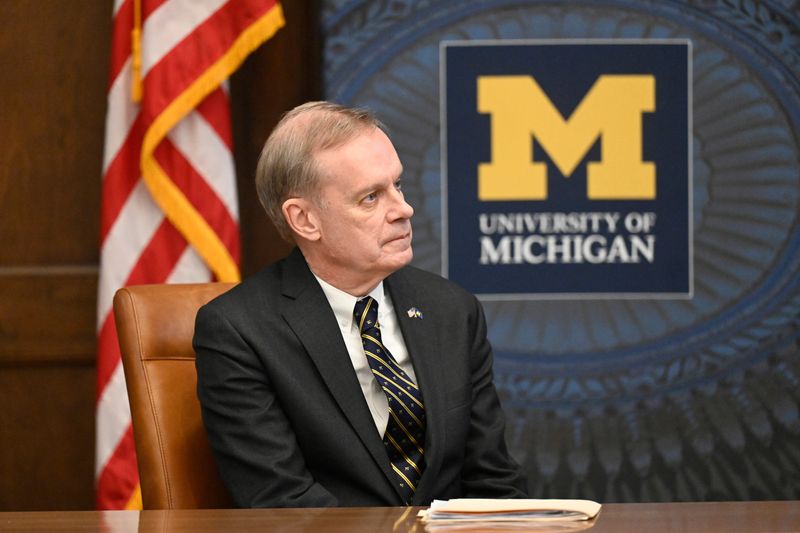
The University of Michigan Regents’ arrangement for Kent Syverud may be humane, but it is difficult to defend as sound public governance.
Any serious discussion of this matter must begin with the obvious. Kent Syverud’s diagnosis is a personal tragedy. He was selected after a national search to lead one of the nation’s premier public universities, only to learn, before taking office, that he faced a grave illness. That reality warrants sympathy, decency and respect.

But sympathy for Syverud is not the same as approval of the Board of Regents’ next decision. And the Regents’ April 15 letter deserves close scrutiny.
Under that letter, Syverud is granted a tenured faculty appointment in the Law School and the position of special advisor to the board, with compensation totaling $2.18 million annually: a $2 million base salary, a $10,000 monthly housing stipend and a $5,000 monthly living expense allowance.
The arrangement has no defined term, no stated performance expectations and no provision to revisit compensation if he becomes unable to work due to the progression of his illness. The letter states simply that these terms apply “during his employment with the University.” This is an extraordinary commitment of public funds without the ordinary features of accountability.
What makes the arrangement even more striking is that the Regents were not fulfilling an existing legal obligation. The April 15 letter explicitly states that Syverud’s Jan. 12 employment contract and the March 13 amendment “are no longer in effect and are replaced” by the new terms. The board built this package from whole cloth — voluntarily, from scratch, without any legal compulsion.
The letter’s closing underscores that point. It ends not with the language of legal duty or institutional necessity, but with “deep gratitude and abiding respect.”
That sentiment is understandable. It is also, standing alone, an inadequate basis for this kind of public decision.
Public university boards are not free to govern by sentiment, no matter how sincere the circumstances may be. Their obligation is fiduciary. They are entrusted with public resources and expected to act in the institution’s interest. The relevant question is not whether a decision is compassionate but whether it is justified, proportionate and grounded in a defensible rationale.
Under that standard, this arrangement raises serious questions. What institutional interest is served by committing $2.18 million annually, without a defined term or meaningful performance conditions, to a faculty appointment created under these circumstances? What analysis did the board conduct before approving the arrangement? Did the Regents receive independent legal and financial advice? Was there any benchmarking against senior faculty compensation at comparable public institutions? Was there any discussion with state officials responsible for oversight of public expenditures?
And one question that has received too little attention: did the faculty vote to grant Syverud tenure? Tenure is not the board’s to bestow unilaterally. Under standard principles of faculty governance, it requires a faculty process — review, deliberation and a vote by peers. If that process was bypassed, the governance problem here extends well beyond compensation.
These questions do not diminish the human reality of Syverud’s illness. They arise precisely because the board had other defensible options. It could have appointed him to a senior faculty role at a salary commensurate with that of distinguished law professors. It could have ensured full access to health and disability benefits. It could have publicly expressed admiration and support in language reflecting genuine compassion. Those responses would have been generous, appropriate and fully consistent with the governing board’s obligations.
What the Regents chose instead is quite different. At $2.18 million annually, this package is not merely generous by public university faculty standards. It exceeds those standards by a remarkable margin. At Michigan’s Law School, Evan Caminker, the former dean and Branch Rickey Collegiate Professor of Law, is among the institution’s most distinguished faculty members. His compensation is about $440,000. Syverud’s package is nearly five times that amount.
That matters not only for the dollar figure but also for the precedent and principle involved. Public universities depend on coherent compensation systems, internal equity and public trust. Faculty and staff who work within established salary structures are entitled to ask what principle governs pay decisions if an arrangement of this magnitude can be created outside the normal contractual framework and justified largely by gratitude.
In board governance, the duty of loyalty requires that decisions be made in the institution’s interest, not on the basis of personal regard, however sincere. The duty of care requires that decisions be grounded in adequate information and a reasonable basis for concluding that the institution will benefit. A public commitment of this scale, without clear conditions or a defined institutional rationale, is difficult to reconcile with either obligation.
The tragedy here belongs to Kent Syverud. The accountability question belongs to the Regents.
James H. Finkelstein is Professor Emeritus of Public Policy at the Schar School of Policy and Government, George Mason University. Judith A. Wilde is Research Professor at the Schar School.
This article originally appeared on The Detroit News: UM regents’ Syverud arrangement is difficult to defend | Opinion
Reporting by James H. Finkelstein and Judith Wilde / The Detroit News
USA TODAY Network via Reuters Connect