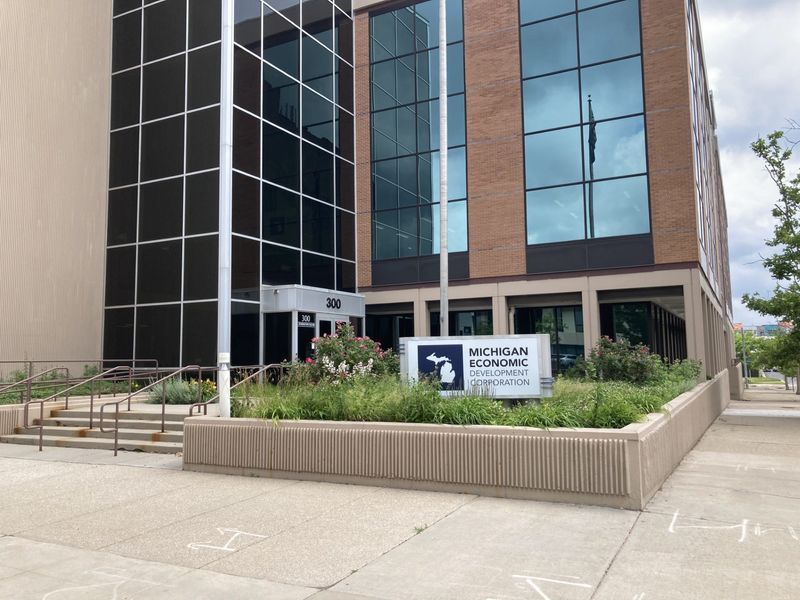
LANSING — Michigan Attorney General Dana Nessel has filed criminal charges against the head of a nonprofit organization who received a $20 million state grant that led to public outrage and a raid on the Lansing headquarters of the Michigan Economic Development Corporation.
Fay Beydoun, 62, who was the politically connected president of the nonprofit corporation Global Link International, was charged Monday, May 4 with 16 criminal counts in Farmington Hills District Court, online records show.

Charges include conducting a criminal enterprise, which is a 20-year felony, forgery, uttering and publishing, larceny by conversion, and larceny, records show.
Nessel said at a May 6 news conference that the investigation continues and more charges are possible, both against Beydoun and other potential defendants. The grant to Beydoun’s nonprofit drew controversy which prompted the AG investigation in 2024 after The Detroit News reported that the nonprofit’s early expenditures from the Legislature’s “Michigan enhancement grant” proceeds included a $4,500 coffee maker, an $11,000 first-class plane ticket, and $408,000 in salaries to two people over three months. Beydoun has defended the expenditures in statements to The News but has not returned calls from the Detroit Free Press.
Vincent Haisha of Flood Law in Detroit, an attorney representing Beydoun, did not immediately return messages left May 6.
Quentin Messer, the CEO of the MEDC, remains a “potential target,” as earlier identified, Nessel said at the May 6 news conference. She would not say why Messer is considered a potential target, but would say only that the investigation continues.
An investigator’s affidavit supporting the charges against Beydoun, released by Nessel’s office, says Beydoun was in contact with Messer about the grant as early as June 2021, more than a month before he was officially named CEO of the MEDC, and that Beydoun made herself a mentor to Messer, who came to Michigan from Louisiana, introducing him to many Michigan leaders through private meetings and parties.
Last June, investigators from Nessel’s office raided Beydoun’s Farmington Hills home, which was the address of Global Link International, and the Lansing headquarters of the Michigan Economic Development Corp.
Messer’s attorney, Mark Chutkow, said in September that Messer “is cooperating in the Attorney General’s investigation of this matter.” Chutkow could not immediately be reached May 6.
Gov. Gretchen Whitmer in 2019 appointed Beydoun, who was a director of the Arab American Chamber of Commerce, to the executive committee of the MEDC. Beydoun, a former vice chair of the Michigan Democratic Party, was on the MEDC executive committee when the grant was awarded by the Legislature as part of the state budget in 2022. At the May 6 news conference, Nessel said Beydoun was involved in political fundraising and used more than $3,400 of the grant money she allegedly misappropriated in 2023 to host two dinners at her home related to then-Detroit Mayor Mike Duggan, now an independent candidate for governor.
Andrea Bitely, a spokeswoman for Duggan’s campaign, said May 6 that Duggan attended two small “meet and greet” dinners as a guest of Beydoun but no money was raised at either event. “The mayor had no knowledge MEDC funds were used for the dinners,” Bitely said in a text message.
Nessel said it’s clear Beydoun’s political connections helped her receive a significant grant, and a $550,000 annual salary at Global Link International, despite a proposal that lacked detail and that was described by a former MEDC official as one of the worst they had ever seen and not “fundable.” Investigation continues into Beydoun’s dealings with Whitmer’s office and others, she said.
“The process by which this ‘grant’ was proposed, developed, awarded, and administered bears practically zero semblance to the traditional grant process, and was only made possible through a system that pairs political cronyism with minimal oversight,” Nessel said in a news release.
Allegations in the charges include that Beydoun forged an invoice from a law firm, misrepresented the expense to the MEDC and used the funds for personal legal expenses. The charges also allege that Beydoun presented a false description of a $40,800 lease to the MEDC, presented a French-language receipt for the purchase of two handmade Tunisian rugs, which cost more than $6,000, supporting the cost of an event to host potential investors, and fraudulently represented personal catering expenses as ones related to the grant’s designated purpose.
Although the grant was administered by the MEDC, it was initiated as a legislative earmark in the state budget passed by the Republican-controlled Legislature and signed into law by Whitmer in 2022.
“Generally speaking, the governor’s office has been cooperative,” Nessel said.
“A lot of the grants go to people who are politically connected,” Nessel said, but just because politicians help someone get a grant does not necessarily mean the politicians who were involved knew that the grant recipient was going to spend the money illegally and lie about it, as alleged, she said.
So far, Nessel said her investigators have not found evidence that anyone who helped Beydoun get the grant was aware that she intended to spend the grant money for anything other than the intended purpose, which was to establish a business accelerator that would help attract business investment and jobs from around the world. Nessel said. That includes state lawmakers involved in directing the grant through the budget process, she said.
Cited as evidence in the investigator’s affidavit is an outline Beydoun prepared for a planned meeting with Whitmer on Dec. 9, 2021. Nessel said investigators have not been able to determine whether that planned meeting ever took place. But Beydoun’s outline references having the approval of MEDC staff and board members and of Chris Harkins, who was state budget director at the time. The outline also references Beydoun having “delivered” $330,000, including $100,000 estimated for January 2022. At the May 6 news conference, Nessel said she believes those dollar amounts relate to political fundraising, but she does not know for which campaigns.
Stacey LaRouche, a spokeswoman for Whitmer, said May 6 that “misuse of taxpayer dollars has no place in Lansing,” and those who do not follow the law and defraud the state “must be held accountable under the law.”
Beydoun sought help obtaining the grant from Sharif Hussein, an Okemos entrepreneur with Republican contacts, according to the affidavit.
In January 2022, Hussein texted then-House Speaker Jason Wentworth, R-Farwell, who was the listed sponsor for the grant, saying that the grant had been “cleared by the Governor,” and that there would be “no negotiations on the line item and that it will be understood that agreement is in place to move forward,” the affidavit said.
Nessel said that many who were involved in the grant believed that Beydoun would manage the grant through her job at the Arab American Chamber of Commerce, but that Beydoun split with the chamber and took the grant for her own nonprofit.
Only the first $10 million of the grant was actually paid, and officials have frozen about $6.5 million held by Beydoun or the nonprofit that could be subject to criminal forfeiture, in the event of a conviction, Nessel said.
Nessel said the state grant process has been reformed in the wake of the scandal to increase transparency but more can be done.
(This is a developing story and will update.)
Contact Paul Egan: 517-372-8660 or pegan@freepress.com.
This article originally appeared on Detroit Free Press: AG files criminal charges against nonprofit leader who got $20M grant
Reporting by Paul Egan, Detroit Free Press / Detroit Free Press
USA TODAY Network via Reuters Connect