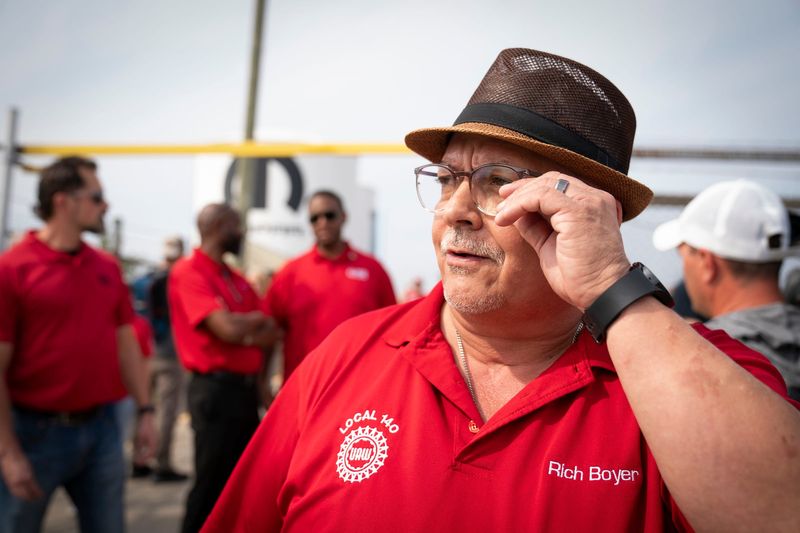
United Auto Workers Vice President Rich Boyer currently oversees the union’s Stellantis department – a job that comes with the responsibility of managing nearly 40,000 members who work or have worked for the parent company of Chrysler, Dodge, Jeep and Ram.
But now, Boyer has loftier ambitions: He wants to be the next president of the union, and he is seeking to unseat Shawn Fain, the union’s ambitious though controversial president, who himself is running for reelection in a six-way race.

The presidential race is Fain’s to lose. He has built a notable name among the rank and file and remains largely popular for helming the union during its widely publicized 2023 so-called Stand-Up Strikes against Ford Motor Co., General Motors and Stellantis.
But Boyer wants to remind members that he was a union leader during those strikes, too.
Boyer’s campaign for the presidency is notable for a few reasons: To start, he is the only candidate running for the top seat who currently holds an elected position on the union’s 14-member International Executive Board (IEB) — the de facto leadership council of the UAW.
For an IEB member to challenge a sitting president is not entirely abnormal, but the circumstances behind Boyer’s run — which he discussed in an exclusive interview with the Detroit Free Press at the union’s 39th Constitutional Convention in downtown Detroit – are novel. Boyer is challenging Fain for the presidency after years of disagreements between the two, which culminated in Fain stripping Boyer of his job atop the Stellantis department.
Boyer previously told the Free Press that he felt Fain was unfairly retaliating against him and creating a toxic workplace at the top level of the UAW, saying that Fain would not hold meetings with Boyer or the other top leaders of the union, creating a culture of fear and retaliation – claims that have been underscored by a series of unflattering investigative reports issued by a federal watchdog who oversees the union.
“Fain doesn’t talk to me,” Boyer said in August. “I don’t talk to him. If I call him, he may call back two weeks later. He doesn’t answer my phone calls. He doesn’t – nothing.”
Asked again on Wednesday, June 17, whether Fain has held a meeting with the five highest officers of the union – the president, secretary-treasurer and three vice presidents – Boyer said: “We have not had one meeting. Not one.”
The federal watchdog, Neil Barofsky, is a court-appointed monitor who has been tasked with overseeing the union as it emerges from a corruption and embezzlement scandal settled in 2021. The agreement that put the monitor in place tasked Barofsky with filing reports about the union every six months until 2027, when the period of oversight concludes.
The fight between Fain and Boyer has been under investigation for nearly two years. And while Barofsky has yet to issue the final word on what precisely happened between the president and vice president, he has already gotten Fain to agree to reinstate Boyer’s duties in a particularly scathing report issued in December. Boyer said he expects the monitor to file the rest of his findings about the fallout between him and Fain in federal court soon. Until then, he is focused on mounting a campaign to take down a popular union leader who he says is letting the membership down.
On Wednesday, June 17, Boyer doffed his trademark fedora in the lobby of Huntington Plaza in downtown Detroit and explained why he was throwing his hat in the ring to be the next president of the UAW.
Fallout with Fain
Fain and Boyer ran together during 2022’s union elections on a hodge-podge slate of stated union reformers, who sought to shake the union out of complacency and into a leaner, more aggressive labor organization capable of earning members big wins at the bargaining table while expanding membership. Together, Fain and Boyer organized a strike campaign that was largely hailed as successful.
But beyond the picket line, Boyer said his faith in Fain has eroded.
Boyer traces the break with the current president to a moment when he says he refused to honor Fain’s order to fire people within the Stellantis department.
According to Boyer, the UAW under Fain has been excessive in its hiring – and negligent in its firing – of staffers at the union’s headquarters. Many union leaders execute their jobs with the help of UAW staffers, often titled “administrative assistants.”
Boyer recalls being instructed by Fain, early in the current administration, to fire five of his assistants – an order he refused.
“(Fain) wanted me to fire members of my staff, and I wouldn’t do it, and I knew he was gonna come after me,” Boyer said, adding that he caught a lot of flak for going against Fain’s direction. “I stood my ground, because them people did nothing wrong.”
The accusation that Fain runs the union with a my-way-or-the-highway approach is not Boyer’s alone. The same monitor investigating claims of retaliation against Boyer has published several reports to the same effect, largely surrounding a similar falling-out between Fain and the union’s secretary-treasurer, Margaret Mock.
Boyer said that, as president, he would be willing to accommodate the viewpoints of those with whom he disagrees. If Boyer wins, he will share the IEB with at least four members of Fain’s slate who are running for regional directorships unopposed.
Beyond retaliation, infighting or drama among union leadership, Boyer said that decision-making at the top of the union has become murky even to him, one of the five highest-ranking officials in the UAW. Boyer said that Fain often makes decisions behind closed doors in consultation with his own administrative assistants, retroactively informing leaders after he has reached a conclusion.
As an example, Boyer said he did not know the UAW had endorsed then-Detroit mayoral candidate Solomon Kinloch until his wife interrupted him while he was mowing his lawn.
“I found out about [the Kinloch endorsement] while I was cutting my grass in my front yard,” Boyer said. “We never went through the process of sitting every candidate down, vetting the person, you know?
“I was out in front of my house, cutting my grass and my wife comes out on the phone, she says, ‘You guys endorsed Kinloch?’ And I said, ‘We did? I don’t know,'” Boyer recalled. “We didn’t know about that. … I heard about it from the [expletive] newspaper.”
Fain’s campaign did not respond to a Free Press request for comment.
Dues debate
Boyer’s criticism of Fain – and the reason he is running for the presidency – goes beyond internal rifts or personal disagreements, he said. Boyer has broader questions about the union’s strategy and financial stewardship, alleging that the organization is spending heavily on bringing in staff to the union headquarters, relying more on dues revenue to sustain operations.
During last week’s convention, delegates voted to keep the UAW rank and file paying dues to the international union at a rate of 2½ hours of pay per month, despite many members’ hopes that dues would be reduced at the convention to just 2 hours per month.
The UAW collects dues in accordance with how much money resides in the union’s strike fund – or, in other words, its war chest, which it can liquidate to pay workers who take to the picket line. The union has set an $850 million goal for that war chest, and said it planned to collect dues at a rate of 2½ hours a month until it reached that goal. The union reached the $850 million goal in the last year, and members expected dues to be adjusted at the latest convention.
However, delegates instead moved the goal from $850 million to $1.3 billion, meaning dues will remain at 2½ hours a month until the new goal is met.
Boyer, who said numerous times that he would like to see dues reduced to 2 hours per month, said the shifting of the goalposts is unfair, and said it may have been done to keep paying for the many staff members working at the UAW’s headquarters.
“My opinion is they’re taking that money out of the strike fund to run the day-to-day operations,” Boyer said. “Our budget isn’t right.”
To be clear, some of the strike fund is routed to the union’s general fund, which is the sum of money used to pay staff salaries at the union.
Boyer, if elected, said he would reduce dues. But, more important, he said, he would seek to change the culture of the union and restore what he sees as missing dialogue at the top.
“I think if I win, I’ll change the mindset and the direction of the IEB,” he said. “Right now, everybody’s in survival mode.”
For now, Boyer is running as both insider and challenger; he fashions himself as a longtime elected union leader who helped shape an insurgent caucus of union reformers that he says has now lost its way.
Liam Rappleye covers Stellantis and the UAW for the Detroit Free Press. Contact him: LRappleye@freepress.com.
This article originally appeared on Detroit Free Press: UAW’s vice president is challenging Fain for presidency. Here is why
Reporting by Liam Rappleye, Detroit Free Press / Detroit Free Press
USA TODAY Network via Reuters Connect
By Liam Rappleye, Detroit Free Press | USA TODAY Network