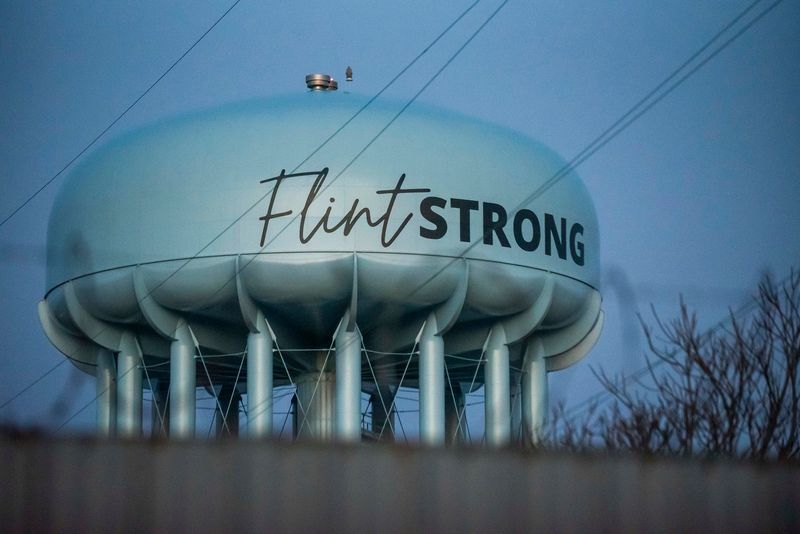
A federal judge has ordered partial payments be disbursed to more than 12,000 adult claimants injured in the Flint water crisis, marking, perhaps, the beginning of the end of a years-long settlement and processing wait.
A secondary payment from the $626 million settlement fund will go out after several appeals related to the agreement have been resolved, a court filing last week said.

The split payment, special master Deborah Greenspan told U.S. District Judge Judith Levy, will allow at least some payments to go out more “promptly.”
“The Special Master is authorized to direct the claims administrator and the distribution vendor to begin the process of distributing payments to eligible claimants with approved adult injury claims through the first of two installments,” Levy wrote.
Levy’s March 23 authorization of payments was first reported by the Detroit Free Press.
Officials are making payments to adult injury claimants, ahead of minors, because the adult claimants are supposed to be in cash, allowing payments to be split. Minors, on the other hand, must receive their payments under the agreement through a structured settlement or trust, both of which must be funded in full.
However, Levy did approve Greenspan’s request to begin cash installment payments to minors who are now adults and opt for cash payments.
“I recommend that once payments to eligible adult claimants commence, we begin the process of issuing similar installment payments to claimants who were minors at the time of the water crisis but are now adults andwho wish to receive their payment in ‘cash’ and do not wish to take advantage of the trust or structure options,” Greenspan wrote on March 23.
In December, the court began distributing some settlement payments for property damage claims, and as of March 20, roughly 8,251 award letters were issued, with another 2,300 letters expected to go out through this week, Greenspan wrote. As of March 20, roughly 6,126 claimants had accessed the payment process to receive those property damage funds.
In August, Greenspan said in court filings that 25,759 individuals had been approved for payment, including 13,169 minors at the time of the water crisis and 12,590 adults or businesses. Those claimants are organized in different tiers, depending on their age at the time of the water crisis and the extent of their injuries.
Additionally, roughly a third of the total settlement is expected to go to claimants’ attorneys and administrative costs.
Greenspan previously said she anticipates the highest possible award, which would be for children who were the youngest at the time of exposure to Flint water between April 25, 2014, and July 31, 2016, and had the highest lead levels based on testing, could be about $100,000.
The $626 million settlement includes payments from a variety of entities. The state’s portion of the settlement, nearly $600 million, was first announced in August 2020. The settlement total also includes $20 million from Flint, $5 million from McLaren Regional Medical Center and $1.25 million from private engineering company Rowe Professional Services Co.
Additionally, in 2024, engineering company Veolia North America settled a $25 million class action lawsuit related to Flint, and, in 2025, the state agreed to dismiss its civil lawsuit against Veolia after the company agreed to pay $53 million to the roughly 26,000 individual Flint plaintiffs suing the company in the class action suit. Boston-based Veolia has admitted no wrongdoing.
The Flint water crisis began in April 2014, when the city of Flint, under state-controlled emergency management, switched its drinking water source from Detroit’s Lake Huron pipeline to the Flint River while construction of a new pipeline from Lake Huron to Genesee County, known as the Karegnondi Water Authority pipeline, was underway.
Flint’s water treatment plant failed to add proper corrosion-control chemicals while treating water from the Flint River, causing the city’s drinking water to leach toxic lead from water service lines between the roadway and homes and from the taps of thousands of homes.
The lead leaching continued for months before then-Republican Gov. Rick Snyder’s administration switched Flint back to Detroit’s water system in October 2015, following the discovery of elevated lead levels in the bloodstreams of Flint children.
eleblanc@detroitnews.com
This article originally appeared on The Detroit News: Thousands of Flint water crisis victims receiving settlement checks
Reporting by Beth LeBlanc, The Detroit News / The Detroit News
USA TODAY Network via Reuters Connect