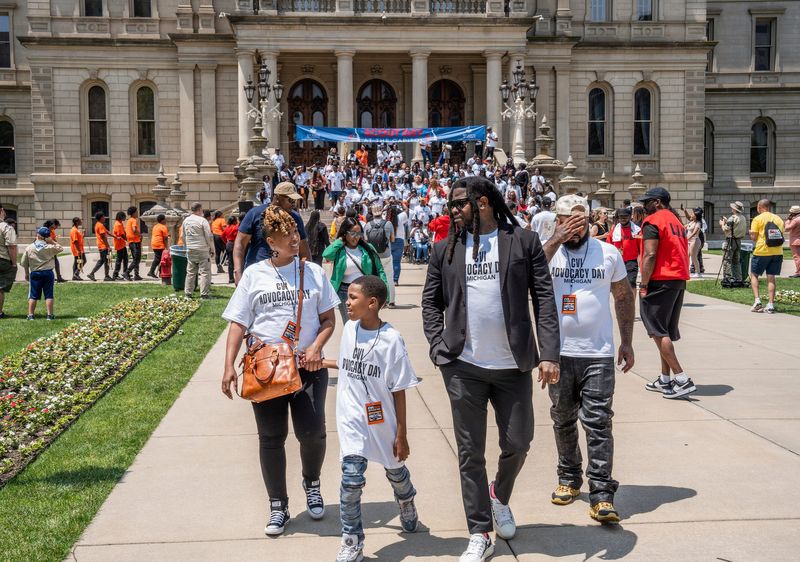
Teferi Brent is out of patience.
The Detroit minister had been involved in Community Violence Intervention work long before federal stimulus dollars to fund such programs ever became available. CVI groups here worked with limited resources, scraping together the dollars to fund the business of saving lives.

CVI is a proven strategy for preventing and reducing gun violence in American cities, the holy grail of street violence prevention, cultivated over decades by a loosely connected, nationwide network of volunteers, activists, academics, church figures and forward-thinking law enforcement leaders. Long-term research, irrepressible determination and, yes, federal dollars have led to unprecedented results in Detroit, Philadelphia, Chicago, Baltimore, Oakland and other cities that have long grappled with street violence.
Brent saw the impact when federal grants poured millions of dollars into CVI. A two-year, $10 million allocation began going to six neighborhood groups in 2023, and homicides and non-fatal shootings in those areas fell by 45%. Last year, the Detroit recorded its lowest homicide count in decades.
Now, Brent and other CVI activists fear what could come as those dollars run out.
The federal stimulus dollars are spent. The Trump Administration has halted and even clawed back grant funding for the community groups driving the progress.
It’s up to the Michigan Legislature to keep these programs operating at full force, but those who control the purse strings in Lansing still can’t seem to recognize the urgency of proactive intervention.
And while lawmakers bicker, children as young as 4 continue to fall victim to preventable gunfire.
‘Quit playing’
“If you all can’t get this right — Republicans, Democrats — if you all can’t get this right, you ain’t worth a damn. You might as well quit,” Brent roared at a July press conference, addressing a crowd at Skinner Playfield, where 4-year-old Samir Josiah Grubb was shot and killed this summer while climbing a ladder to a slide.
An 18-year-old was also killed, and a 17-year-old injured in the shooting, which prosecutors said resulted from a petty dispute that took place on a bus.
“Quit playing politics with Black peoples’ lives,” Brent told the crowd at Skinner Park. “This ain’t no damn game, this ain’t no partisan issue. It’s the most nonpartisan issue on the face of the planet.”
Lives are clearly, immediately at stake. And Lansing?
The House and Senate each passed a different version of a permanent CVI funding mechanism late last year. But a chaotic and disappointing lame duck session, time ran out for lawmakers to resolve the differences between the two bills, and CVI funding never crossed the legislative finish line.
This year, lawmakers decided to cram CVI funding into endless budget negotiations, bogged down over road funding and the size of the budget, shirking deadlines and putting state government at risk of a shutdown.
So, unless something changes, you can add CVI to Freedom of Information Act expansion and fixing the damn roads. Popular measures that both Republican and Democratic leadership have said they want to pass ― and then simply don’t.
Too late for skepticism
Still not sure these intensive intervention programs are worth backing?
You’re too late to the discussion. Too far behind.
This is not some feel-good, kumbaya initiative, throwing money at an impossible task.
CVI work is built on decades of research around the very small number of volatile, vulnerable youths who live on the edge of catastrophe, and drive many of the tit-for-tat violent acts that ravage disadvantaged neighborhoods ― and are often desperately in need of intervention.
“People found it extremely hard to believe that this was real,” said Professor David Kennedy of the John Jay College of Criminal Justice about the early days of researching and developing Ceasefire, a seminal form of measurable community violence intervention.
Kennedy ― a Michigan native currently helping Pontiac and Jackson implement their own CVI programs ― first helped establish Ceasefire in Boston in the 1990s, where the positive impact was clear. Driven by success in Boston, CVI spread to other cities.
“People would come up with almost any possible reason to say ‘That can’t possibly work here,’” he said. “And then, over and over and over, it did. More and more places did it. The formal evaluation got better and better… And CVI is almost normal now.”
The central thesis of preventing violence, Kennedy explained, is understanding that violence is largely caused by small groups of people within a community. Violence, he said, is largely driven not by making money, but by group dynamics.
“It’s the beef and retaliation and vendetta and disrespect and personal issues,” he said. “People whom most had written off as sociopaths or worse ― actually very much do respond to the right kind of engagement.”
CVI strategies have only gotten more refined with time and broader implementation.
“The basic vectors of engagement that the strategy uses is, on the law enforcement side, overwhelmingly deterrence rather than enforcement,” Kennedy said. “Telling people what will happen if violence continues, rather than hiding behind the bushes and trying to lock them up.”
Outside of law enforcement, a basic assumption of community intervention used to be “this assumption that everybody needed a GED and a job,” Kennedy said.
CVI workers have learned that needs are much more urgent.
“For somebody who likely has people trying to kill him ― has been saturated in trauma because of all the violence that he’s has experienced, has all kinds of chaos in his life ― really concrete, immediate steps to protect him and stabilize him, and maybe his family and his circle, really works,” Kennedy said.
The people who power CVI work are deeply connected to the communities they work in. They study their communities, track group and gang conflicts, map out needs and use “credible messengers” ― often neighborhood figures with criminal pasts and cautionary tales of their own ― to intervene in conflicts before they turn violent, offering offer services ranging from therapy and job training to emergency relocation and life coaching.
“I think in a very real way, maybe the most powerful element in all of this becoming mainstream is that people making decisions today have grown up with it,” Kennedy said. “It’s not marginal and insurgent and radical anymore. People just believe in this stuff now.”
Get it done
These programs save lives. And they aren’t going away.
It’s now a just matter of whether those brave and dedicated interveners will have to pass around collection baskets to scratch, claw, thrift and scrounge their way to saving lives, or if they’ll be able to confidently and proudly tackle the job with robust backup from their cities and state.
Will they be able to hire therapists? Social workers? Will they be able to relocate a Detroiter in danger of retaliatory violence to a safe new home, or will they have to hide him in his aunt’s basement?
Will they be able to penetrate neighborhoods at a level that might have prevented the gunfire that killed 4-year-old Samir Grubb?
That, sadly, is in the hands of a Legislature that can’t even meet its budget deadline.
Get our sharpest, most relevant takes delivered straight to your inbox each week ― subscribe to the free Freep Opinion newsletter.
Submit a letter to the editor at freep.com/letters, and we may publish it online and in print. Like what you’re reading? Please consider supporting local journalism and getting unlimited digital access with a Detroit Free Press subscription. We depend on readers like you.
This article originally appeared on Detroit Free Press: This program saves kids’ lives. Why won’t Michigan lawmakers fund it? | Editorial
Reporting by Detroit Free Press Editorial Board / Detroit Free Press
USA TODAY Network via Reuters Connect