At least three Metro Detroit communities, a west Michigan city and Mackinac Island are banning or regulating the use of e-bikes in certain areas, while Michigan police are set to change traffic crash reports in a bid to more accurately track the speedy two-wheel vehicles that have been involved in a spate of injuries and deaths across the state.
Dearborn Heights passed an ordinance last month to ban e-bikes from city parks, playgrounds, city hall, the library and other public city properties due to safety risks for pedestrians. In April, a South Lyon ordinance banned e-bikes downtown and in the historic district, prohibited reckless riding on sidewalks, limited speeds to 15 mph on trails and made e-motos illegal.

E-bike use is banned on Mackinac Island unless an individual has a documented mobility issue. E-bike use for mobility-challenged individuals is limited to Class 1 pedal-assist e-bikes, which can reach up to 20 mph.
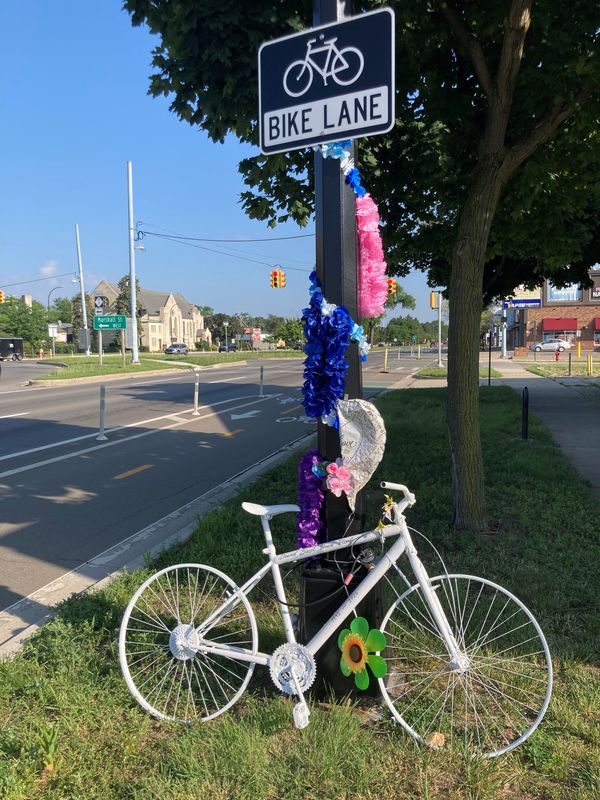
The moves come as Michigan continues to lose residents on e-bikes. On Independence Day, a 15-year-old on an e-bike was killed in southern Michigan. Five days later, a 13-year-old riding an e-bike was killed by a teen driver in Huron Township. In June, two people riding e-bikes were killed within two days in Metro Detroit.
Local hospitals are reporting a spike in e-bike accidents this summer, including Corewell Health. The system’s emergency room at William Beaumont University Hospital in Royal Oak has seen 22 e-bike injury cases from January to mid-June this year, 16 of those being kids.
The Corewell Health emergency room has treated more of these injuries every year since 2023, according to the health provider. That year, six individuals, all adults, were treated by the hospital. The department’s pediatric chief of emergency, Whitney Minnock, said this year’s upward trend has continued into July. She said she sees at least one child with an e-bike injury every shift.
“We’ve seen higher level traumas from these bikes,” Minnock said. “Unfortunately, some of the injuries have been quite severe.”
Krystal Noreus of Ferndale, 37, said she would never consider getting an e-bike for her kid.
“Cars don’t watch for bikes. Bikes don’t watch for cars. And I get scared just having my kid on a regular bike right now, because he’s got no fear whatsoever,” Noreus said.
Right before the school year ended, Noreus said she was in Hazel Park Junior High’s afterschool pickup line when she saw a middle schooler run over another middle schooler with an e-bike. Noreus, who will graduate from the Ross Medical Assistant program next month, jumped out of her car with her medical kit in hand.
“The kid ended up having to go to the hospital and get checked out because he had a knot on the back of his head from being hit at an angle,” Noreus said. “The kid was severely injured. … I don’t approve of them at all.”
Michigan police are changing how crash reports are done after they noticed two years ago that crashes were getting worse thanks to the rise of conversion kits that can make a traditional e-bike run up to 40 mph. It’s illegal to modify an e-bike to reach speeds over 28 mph with motor assistance.
“You increase that speed almost twice as much, and now when they crash, that’s a bad crash,” said Michigan State Police Sgt. Scott Carlson. “We’re having injuries, we’re having fatalities. … Your Bird scooters and your Lime scooters and things of that nature, we are no longer going to consider those motor vehicles as well.”
As the law stands, devices that can go over 28 mph when motor-assisted are not legally considered e-bikes. They may be considered a moped or motorcycle, which may require registration and equipment, such as a horn and a rearview mirror, to use on the road legally.
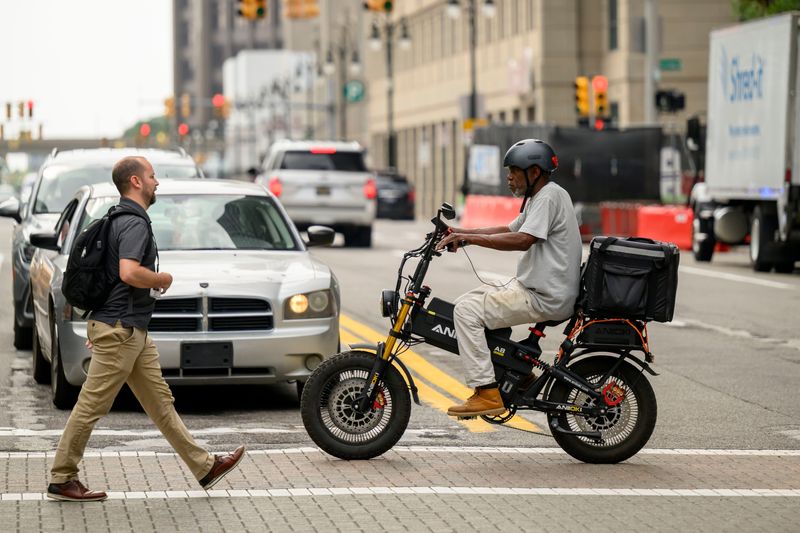
For under $400, a Michigan resident could go online, purchase a two-wheel vehicle advertising itself as an e-bike that can exceed 28 mph with a motor and receive it within days. Some listings boast “e-bikes” with speeds up to 35, 40 and 50 mph. Such two-wheel vehicles are called “e-motos,” high-powered electric models that can be disguised as e-bikes and can reach high speeds of 65 mph and 90 mph. Given their speed and design, e-motos are not legal e-bikes and are barred from using bike lanes, sidewalks and other pedestrian spaces.
What makes e-bikes so dangerous
E-bikes can accelerate much more quickly than traditional bikes and the extra speed can give riders more agility. That can lead to more crashes because other road users, especially pedestrians on sidewalks, have less time to react.
Because they are physically smaller and have less knowledge of the rules of the road, children are at higher risk when using e-bikes, said Shan Bao, a research associate professor at the University of Michigan’s Transportation Research Institute.
Men are the largest demographic to use e-bikes and other so-called micromobility devices. But nationwide, young kids are overrepresented in injuries. Children under 14 years old make up 18% of the population but account for 36% of the micromobility device injuries, according to Bao.
Roadway infrastructure doesn’t help. If bikers aren’t safe on roads and there are no bike lanes available, riders start choosing sidewalks, which puts pedestrians at risk.
“There are so many things we need to do right for infrastructure,” Bao said. “So if you have a dedicated lane, that will solve a lot of problems, but I understand that could be very expensive, right? But if you have those e-bikes shared on the road with the motor vehicles, that’s not safe for the bike riders. But if you’ve put them on the sidewalks, that’s creating another whole level of issues.”
Because traffic crash reports only categorize accidents involving a motor vehicle with property damage of at least $1,000 or injury, Bao said researchers have to turn toward hospital data to track the effect on pedestrians for accidents without a motor vehicle involved.
“For car-to-car crashes, the U.S. Department of Transportation has done a fantastic job recording all those crashes,” Bao said.
But even when Michigan makes the change to specify e-bikes in crash reports, it’s still hard to tease out micromobility crash data on a nationwide level. “That is something we definitely need to improve on,” Bao said.
Local communities push to regulate
The change to crash reports is coming as communities grapple with e-bike injuries and deaths.
On the Fourth of July, a 15-year-old was hit by a semitruck and killed in Lenawee County’s Medina Township while riding an e-bike. Last month, two 14-year-old children were struck in a hit-and-run while riding their e-bikes on June 15 in St. Clair Shores. The same day, in Commerce Township, a 13-year-old on an e-bike was taken to the hospital after being hit by a car.
Three days later, a 33-year-old man was killed by an Oakland County truck while riding his e-bike in Ferndale. The day after, an 87-year-old man on an e-bike was killed by a car in Grand Blanc Township.
Recent research shows that Michigan isn’t alone. Nationwide, the rate of e-bike and e-scooter injury-related emergency department visits increased more than sevenfold among kids between 2023 and May 2026, making those under 18 years old the age group with the highest injury rate.
More than a third of all patients visiting emergency rooms for e-bike and e-scooter injuries were diagnosed with a head or neck injury, according to the report by Truveta, a Bellevue, Washington-based health care data company comprised of health systems across the nation, including Detroit-based Henry Ford Health.
Michigan communities have responded. Grosse Pointe created a “Walk Your Wheels” zone on July 13 that requires riders to walk bicycles, e-bikes, scooters and other similar devices in the village. An update to East Grand Rapids’ bicycle and helmet ordinances in May extended the city’s downtown sidewalk riding ban to e-bikes, e-scooters and other personal transportation devices.
Bruce Byrd of Ferndale said he doesn’t think e-bikes belong on the sidewalk. The 68-year-old emphasized that both drivers and riders need to watch out on the road.
“I’m worried for the people that ride them, and I’m just worried that something else is going to happen. … I’m just hoping everybody can stay safe,” Byrd said.
Byrd’s son, Santiago Byrd, rides an electric scooter that reaches a maximum speed of 9 mph. He said his parents and his friends’ parents don’t think they’re old enough to ride yet.
“That’s dangerous. E-bikes for kids should go, like, nine miles per hour,” 9-year-old Santiago Byrd said.
But the e-bike backlash bubbling across the Metro Detroit area is also targeted toward riders themselves. Residents have congregated on social media to raise concerns about e-bike riders, especially children, zipping along sidewalks, public areas and roads with little regard to safety.
Legislators and city officials are taking note.
Last month, Michigan state Sen. Kevin Hertel, D-St. Clair Shores, hosted a roundtable on e-bike safety that brought together public safety officers and other local leaders from the Grosse Pointes and Harper Woods.
“We’ve been very fortunate here in Grosse Pointe Woods to not have had any fatal accidents involving e-bikes yet, but we can’t afford to wait until that changes,” John Kosnake, Grosse Pointe Woods’ public safety director, said in a press release about the event.
Hertel said education will be key for keeping up with e-bike challenges, in addition to reevaluating the state’s current classification scheme, age limits, helmet requirements and how e-bikes interact with pedestrians on sidewalks and drivers in streets.
“I’ve personally witnessed where one of these is coming very fast on a sidewalk to an intersection, and it looks like that individual is going to keep going straight into the roadway. The drivers react because I think it’s coming, and at the last second, they turn, right?” Hertel said.
Legislation is underway in Lansing
State lawmakers are working on a bill to help steepen punishments for drivers who injure or kill pedestrians, bikers and other vulnerable roadway users.
The Democratic-led Michigan Senate approved the Justice for Vulnerable Roadway Users Act in a 31-5 vote over a year ago and is awaiting action in the Republican-controlled House. The proposed law would steepen punishments for drivers who injure or kill a person who isn’t protected by a motor vehicle on the roadway, including e-bike users.
Current penalties aren’t stringent enough on crashes involving vulnerable roadway users, a category that includes farmers operating farm equipment on the road, Amish people in buggies, pedestrians at crosswalks and cyclists using the roadways legally, said Andy Rohrer, executive director of the League of Michigan Bicyclists.
New felony charges would be created in the case of death or serious injury to a vulnerable roadway user. After an investigation, a driver who hits a cyclist and causes death could be punished with up to 10 years in prison, a $7,500 fine, or both, or up to five years in prison, a $5,000 fine, or both in the case of a serious injury.
Rep. Julie Rogers, D-Kalamazoo, and Sen. Sean McCann, D-Kalamazoo, are among the legislation’s sponsors. Rogers, who has experienced some near misses herself as a cyclist and runner, said she’s optimistic the bill will pass by year’s end.
“The fact that we’ve had some movement is good,” Rogers said. “We’re getting down to the wire with six months left in the year, but we’ve had a lot of positive conversations, and unfortunately, we continue to see these tragedies happen, which I think underscores the need for the legislation.”
The legislation would need to be reintroduced in 2027 if it isn’t passed by year’s end.
Rogers and McCann both represent Kalamazoo, where five bikers were killed and four others were injured when a driver in a pickup truck crashed into their cycling group, the Chain Gang Bicycle Club, in 2016. The bicycle club and other organizations, including Bike Friendly Kalamazoo, have advocated the proposal to become law.
The current misdemeanor penalty for causing death by motor vehicle is up to one year in jail and up to a $300 fine. Otherwise, prosecutors would need enough evidence for a charge of involuntary manslaughter — an unintentional killing caused by reckless or criminally negligent conduct — or second-degree murder, which involves proving someone intended to cause serious harm or death without premeditation.
“Currently, the penalties are kind of an all-or-nothing thing for the prosecutors,” Rohrer said. “There is a misdemeanor statute available to prosecutors, but it’s a big lift even for that.”
Rohrer said the proposed law would lower the bar for proving the motorist was behaving in a careless or reckless manner.
As for state regulations, Hertel said he has been working with state Rep. Veronica Paiz, D-Harper Woods, to look at possible changes that would help regulation keep up with technology.
Michigan follows the law that was passed in 2017 to legalize e-bikes and put the state’s three-class categorization system in place.
Among the ideas under consideration are requiring registration for high-speed e-bikes, educational requirements for riders and making it easier for police officers to enforce e-bike laws, the state senator said.
“We’re going to try to get some drafts done to get something introduced as soon as possible,” Hertel said. “I think the communities themselves can move a lot faster in setting ordinances, and we can move a lot faster on the education side of it.”
How Michigan defines e-bikes
Under the state’s current law, e-bikes are divided into three classes by speed and how the bike is assisted. Any e-bike must have a seat, fully operable pedals and an electric motor of 750 watts or less.
The alteration to the crash reports, which is set to take effect in February, would consider all e-bikes as bikes and would require officers to classify the type of bicycle involved in a crash.
Under the current crash reporting standards, a legal e-bike could be considered a motor vehicle if the motor was engaged or a bicycle if the rider was pedaling. Officers aren’t required to note the type of bicycle.
The current standard can be confusing for officers out in the field.
“I get calls daily. … ‘How do I classify these?’ ‘Is this even a traffic crash?’ ‘Is it a bicycle?’ ‘Is it a motor vehicle?’ ‘What do I do with the scooters?'” said Carlson, the state police sergeant who will train the force on the new requirements this winter.
On the new report, officers will use the categories to indicate whether a bike is a pedal bike, a motorized bike, a bike with a motor that was not in use or an unknown bike type.
In the current crash data, analysts must look at an officer’s note in the “narrative” portion of a crash report and hope the officer even listed the type of bike. Next year, by forcing officers to choose among four types of bikes involved in accidents, state officials hope to enable researchers to more accurately analyze trends in e-bike crashes.
“You can pull from the narrative; it’s just really complicated,” said Patrick Bowman, a transportation statistician with the University of Michigan who works closely with the state’s crash data as a consultant.
If the e-bike involved in an accident were categorized as a motor vehicle, an individual without a driver’s license could end up with a crash on their driving record, including minors not old enough to have a driver’s license. Because e-bikes will no longer be considered motor vehicles when the motor is engaged, the change to the crash reports also means that riders will not end up with an e-bike crash appearing on their driving record.
Michigan’s changes to its crash reporting practices come after national recommendations were updated in 2024 to encourage states to include a motorization category for bikes and other devices that are not motor vehicles. Carlson said the state has been discussing the change for more than two years, before the national recommendations were changed.
What makes e-bikes so popular?
John Waterman estimated he’s been riding e-bikes for at least six years. The 62-year-old cyclist from Saline has spent much of his career teaching individuals with disabilities how to safely operate bikes and other alternative modes of transportation to help increase their autonomy.
An e-bike can help any rider who would benefit from a boost in power, including longtime bikers who can’t get up to the same speeds anymore on a pedal bike, he said.
But Waterman said riders need to be educated to use an e-bike’s extra power safely. He makes sure his students at Ypsilanti-based PEAC, Programs to Educate all Cyclists, have mastered a normal bike before starting on an e-bike.
Waterman said parents who give their kids e-bikes don’t know what they’re getting into.
“You don’t even need to tell a kid to go as fast as they can. That’s what they’re going to do,” Waterman said.
In California, Amazon said it would stop selling e-bikes that exceeded the state’s speed limit after the state’s attorney general issued a consumer alert in April. Michigan may want to follow suit, said Todd Scott, executive director of the Detroit Greenways Coalition, an advocacy group for city planning that focuses on bikers and trails.
The coalition considers legal e-bikes just another part of the biking community that needs different regulations.
“There have been, and still are, bikes being sold that probably shouldn’t be sold in Michigan because they’re not legal…,” Scott said. “They’re not bikes, but they’re oftentimes reported as being e-bikes.”
lcibulskis@detroitnews.com
This article originally appeared on The Detroit News: Surge in e-bike injuries prompts Michigan crackdowns, reporting fix
Reporting by Laine Cibulskis, The Detroit News / The Detroit News
USA TODAY Network via Reuters Connect
By Laine Cibulskis, The Detroit News | USA TODAY Network