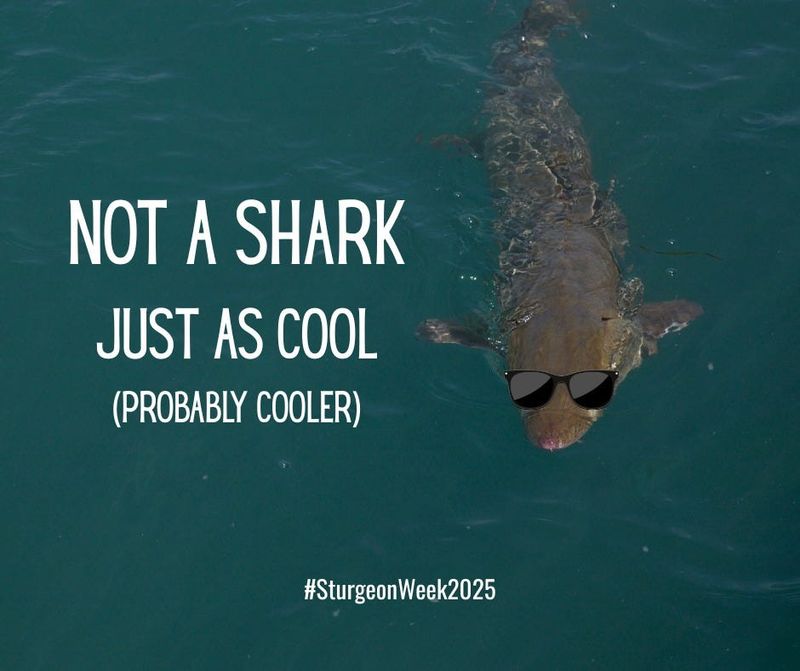
TV networks may have “Shark Week,” but the Michigan DNR is touting Michigan’s less dangerous counterpart with Sturgeon Week.
“It’s Shark Week? Not here! No salt, no sharks, no problem,” the Michigan Department of Natural Resources said on Facebook. “Jokes aside, we don’t have sharks — but we do have a large fish that’s just as cool (OK, maybe we’re a bit biased): the lake sturgeon. This week, it’s all sturgeon, all the time.”

Michigan’s lake sturgeon are a protected species (listed as threatened in Michigan) after decades of habitat destruction, overfishing and general lack of regard for the ancient species.
“Before the mid-1800s, sturgeon were plentiful, but considered a nuisance. Why? They damaged fishing nets. By the late 1800s, a market developed for sturgeon meat, eggs and organs, putting significant pressure on the species,” the DNR said.
“Unsustainable logging and industrial development further reduced their habitat, and dam construction blocked access to spawning sites. There are even reports of dead sturgeon being used as fuel for fires. Needless to say, the species was headed toward possible extinction,” the DNR added.
In the later part of the 20th century, though, conservation efforts began, including protections for the species and its habitat. The fish’s numbers remain low, and there are only a few times and locations where it’s legal to catch them.
What to know about Sturgeon Week, rules and regulations.
What is Sturgeon Week?
In 1988, Discovery Channel launched what became a recurring themed week: Shark Week. The network overwhelmed audiences with multiple shark-themed shows.
The Michigan DNR is highlighting the lake sturgeon this week as a way of bringing attention to its ongoing conservation efforts.
“Conservation efforts have been multifaceted — including habitat restoration, regulated fishing, fish stocking, population monitoring and public education,” the DNR said. “The lake sturgeon is a great example of how collective action can help species rebound, and it highlights the importance of conservation. Follow along with #SturgeonWeek2025 as we continue to explore more about this fascinating fish.”
As part of the campaign, the DNR is posting daily about sturgeon and the efforts to protect them.
What is Sturgeon for Tomorrow?
Sturgeon for Tomorrow is a nonprofit group that promotes and protects the fish species.
“The purposes of Sturgeon For Tomorrow, Inc. (SFT) are to assist fisheries managers in the rehabilitation of the Lake Sturgeon, to advance education, to further other charitable, educational and scientific objectives, to engage in and facilitate scientific research furtherance of such purposes, and SFT, Inc. shall be empowered to engage in such other and further means necessary and proper to accomplish the foregoing objects and purposes,” the group says on its website.
The DNR said people can help the sturgeon by becoming a guardian.
“Each year, volunteers are invited to stand watch along the Black River, where lake sturgeon return annually to spawn. Volunteers help protect the fish at these spawning sites, ensuring they can reproduce without disturbance,” the DNR said. “The Sturgeon Guarding Program is run by Sturgeon for Tomorrow, and it’s a great way to support the species while enjoying the outdoors. A win-win!”
Michigan lakes and streams where sturgeon fishing is illegal
It’s illegal to fish for lake sturgeon in any of the following areas:
Lake sturgeon incidentally caught while targeting other species must immediately be released.
Locations in Michigan with sturgeon seasons
The DNR said there are limited areas that have legal sturgeon seasons:
Catch-and-release fishing is allowed in these waters
Waters with sturgeon fishing seasons (catch-and-release only) include:
In all other waters in the state of Michigan, it is unlawful to fish for lake sturgeon. The 2025 Michigan Fishing Regulations provide detailed information related to lake sturgeon, the DNR said.
What should I do if I accidentally catch a sturgeon?
If you catch a sturgeon by mistake, the DNR says to release it immediately, taking care to do the following:
Anglers can report incidental (unintentional) capture of lake sturgeon, or report illegal harvesting or targeting of lake sturgeon at Michigan.gov/EyesInTheField or by calling the DNR’s Report All Poaching hotline: 800-292-7800.
Why are lake sturgeon protected?
Lake sturgeon (Acipenser fulvescens), the only sturgeon species found in the Great Lakes.
By 1928, the total sturgeon harvest from all the Great Lakes fell to less than 2,000 pounds, according to Sea Grant Michigan.
In 1994, Michigan listed lake sturgeon as a threatened species. Since then, the DNR has partnered with state, federal and tribal agencies to rehabilitate lake sturgeon in the state.
What do sturgeon look like?
Sturgeon grow very slowly, but can reach 8 feet and 300 pounds. It takes about 15 years for male lake sturgeon to reach reproductive maturity and 20-25 years for females, Sea Grant Michigan said.
A female lake sturgeon may only spawn once every three or four years.
They have five rows of bony plates, called scutes, on their backs and sides, as well as whisker-like barbels near their mouths.
Often referred to as “living fossils” or “dinosaur fish,” lake sturgeon first appeared in the fossil record in the Mesozoic Era, 100 million to 150 million years ago. These fish are long-lived, with some documented at more than 100 years old.
Lake sturgeon are freshwater fish native to Michigan and found in North America throughout the Great Lakes, Mississippi and Hudson River basins. In addition to having high ecological significance, the species is an important cultural resource in our region.
How does the state manage sturgeon?
As part of the rehabilitation strategy, the DNR and partners stock lake sturgeon in several rivers and lakes in Michigan.
Lake sturgeon are raised in streamside rearing facilities where naturally produced eggs or larval lake sturgeon are captured in their natal streams and taken into the rearing facilities, where they are protected from predators while still “imprinting” on the stream or river to increase their survival and the chances that the sturgeon will return to the stream or river as mature adults to reproduce.
This article originally appeared on Lansing State Journal: Shark Week? In Michigan it’s Sturgeon Week. What to know about the fish
Reporting by Dan Basso, Lansing State Journal / Lansing State Journal
USA TODAY Network via Reuters Connect