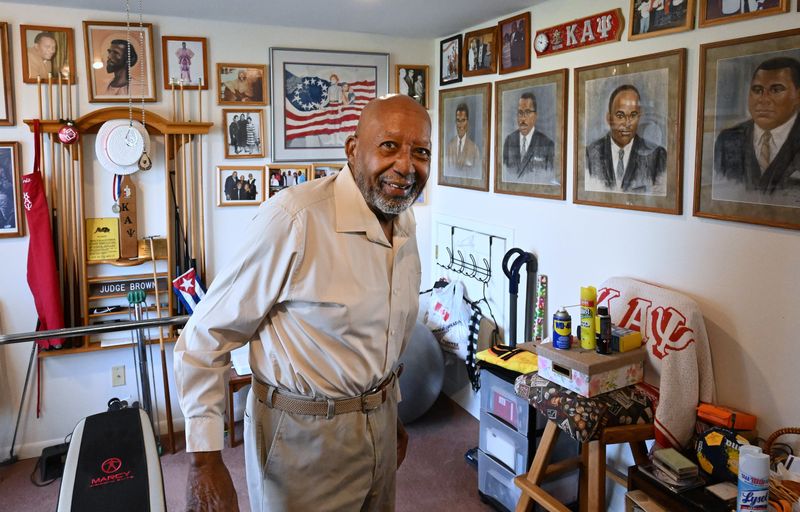
Pontiac — Former Judge Christopher Brown hasn’t just seen Black history in Metro Detroit. He’s lived it.

Brown was the first Black district court judge in Oakland County, where he sat on the bench for 31 years. Before that, he was on the Pontiac school board while his law partners represented the National Association for the Advancement of Colored People in the legal battle integrate the school district. Brown and his law partners also defended themselves against violence and extremism following the court victory.
Now 87, Brown still lives in Pontiac and has a lifetime of fighting for civil rights to look back on. In January, the city honored his work in civil rights with its Dr. Martin Luther King, Jr. Leadership Award.
The Detroit News sat down with Brown to discuss Black history in Pontiac, his career in the legal profession and his thoughts on the current political climate.
The following interview has been edited for length and clarity.
Question: How old were you during the Civil Rights era?
Answer: I graduated high school in 1956 at 17 years old. So I was a young teenager, a young 20-year-old, at the height of Civil Rights.
Q: Can you describe that time?
A: It depends on what phase of Civil Rights you’re talking about. Of course, one of the things about Pontiac, Michigan, is that it was segregated. It was as segregated as it was in Mississippi, Arkansas, Georgia, all the time I went to school. I never had a Black instructor. All of my instructors were White, grade school into high school. When I graduated high school, I think the school district of Pontiac had about four or five Black teachers. They had a couple teaching in grade school, maybe one in junior high school, and then two in high school. But I never had any of them.
Q: When did you graduate law school?
A: I graduated law school in June of 1966.
Q: And where did you graduate from?
A: Detroit College of Law.
Q: So what made you want to get into law?
A: Well, my partner and I, Elbert Hatchett, were both born and raised in Pontiac, and we had been exposed to the segregated community all of our young lives. When we were in high school, he was a couple of years older than me, but we had a speech class together. We used to skip school, and we used to go down to the municipal court and listen to Milton Henry. Milton Henry was an outstanding Black attorney who was very aggressive back in the 50s trying to correct some wrongs of the segregated community. Although he was not very successful, he was very aggressive, and Elbert Hatchett and I used to go down and listen to him in court, and he motivated us to want to be attorneys.
Q: What year did you represent the NAACP in the effort to desegregate Pontiac schools?
A: I didn’t represent them. My partners, Hatchett and Waterman, represented them. But I was on the board of education at the time. I had gotten elected to the board of education in 1968, and they filed the lawsuit against the board of education in 1969. I was on the board, and they accused me of being complicit with them. So the last three years that I was on the board of education, I was not allowed to attend what they referred to as executive session, because the board of education was against integrating the school district through busing. They thought that at these executive sessions, that I would take any information that they would disclose and talk to my law partners about it. So for those last three years, I didn’t attend executive session.
One of the reasons I ran for the board of education is because I was wanting to get equal employment opportunities in the school system. I asked all my questions, they brought all my issues to the floor, during the open sessions that they had.
Q: Were you successful in those efforts?
A: Somewhat, in that we were able to get more Black employment in the school system on a small scale.
Ultimately, my partners prevailed on the busing issue. … But as a consequence of my involvement, the Ku Klux Klan used to shoot through our office up on Orchard Lake. In fact, the bullet holes are still there. And of course, they threatened our families. We did not let that deter us from pursuing our efforts and goals to try and right these wrongs.
Q: How did you and your law partners get through that time, when the Ku Klux Klan was doing those violent acts against you as a business and your families?
A: Well, we got gun permits, and we fired back. I think the FBI back at that time was instrumental in infiltrating the Ku Klux Klan and finding out who was responsible for the bullets and also burning up the buses.
It would be idiotic, in my opinion, for parents not to want their children to be bused to school. I went to grade school seven years, was in junior high school three years, I went to high school three years, and I walked to school every day, whether it was hot, cold, whatever. But there was some busing going on that I walked to school, but you know who was bused? White children. They were bused because Pontiac had a pretty good educational system, and what they did is, they accommodated people who lived in Bloomfield, out in Square Lake. … What happened is, affluent people were building houses out there.
Q: So when your law partners won the case, describe that feeling.
A: We knew we had to be prepared for hot, volatile times that would come in as a consequence, and it came, as I indicated to you, through actions of the Ku Klux Klan and other people who were similarly situated. It was not a pleasant time. It was hot and volatile.
Q: When did you become judge?
A: I became judge in November of 1972, and I took the bench in January 1973.
Q: You were elected?
A: I was elected. Of course, I was elected because, in my opinion, I became a sacrificial lamb, because the court system was racist and discriminatory. So I got elected to try and change some of that.
Q: When you were presented with the award last month, the mayor mentioned you were the first Black judge in Oakland County.
A: When I got elected, I was the first and only Black judge for 16 years. What happened is, our court was the 50th District Court, and we had four judges, and we had the largest district court in the county. When I came aboard, there were three White judges and myself. That was how it was for 16 years, and during those 16 years, there was of course no other Black judges in the county. It stayed four judges until a few years ago, and now Pontiac has three judges, all three of whom are Black. We have a few minority judges. Southfield has a few Black judges.
Then, of course, we had Denise Langford Morris, and she was the first Black (female and circuit) judge in Oakland County. She just recently retired.
Q: Did being the first Black judge in Oakland County bring any challenges?
A: Of course it did. What I did is, I had an open-door policy for my entire 31 years. And also, I was always on time. When court started at 9 o’clock, I was there at 9 o’clock ready to go. I had an open-door policy; lawyers could come and go. I never closed the door because I was aware of being scrutinized, and that I would be accused of acting secretly about litigation that was before me.
Q: Do you think being the first Black judge gave you perspective that other judges might not have had?
A: I tried to be fair and objective to any and all that came before me. I don’t think that was true of judges prior to me being on the bench, and even today, I think some judges have peculiarities that are not objective that have to do with their thought processes and how they got on the bench. All judges nowadays are not fair and cautious.
Q: How so?
A: They have subjective thoughts weigh upon the way they make decisions.
Q: Let’s talk about today. With the perspective you have from the Civil Rights era and from working in law as a judge, what do you think of today’s political climate?
A: We’re in trouble. That’s evidenced by the fact that the federal administration is present here. We’re reverting back to policies that were in existence generations ago. That’s evidenced by ICE. I’m sure that you’re familiar with ICE, and the fact that for instance, they’re trying to open up an office in Southfield, and they say that it’s for administrative purposes only. And they’re trying to open up a detention center in the Detroit airport area, which is Romulus. I don’t think it’s good, and I think we should do any and all we can to prevent both of those things from happening.
Q: Do you have any advice for people wanting to make a difference in today’s political landscape?
A: I think that we have to protest. We have to peacefully protest. I don’t think we should be violent in our protestations. We need to do it peacefully and seek legal opinions about the proper approach to take to protest.
mbryan@detroitnews.com
This article originally appeared on The Detroit News: Q&A: Oakland Co.’s first Black judge talks civil rights past, present
Reporting by Max Bryan, The Detroit News / The Detroit News
USA TODAY Network via Reuters Connect