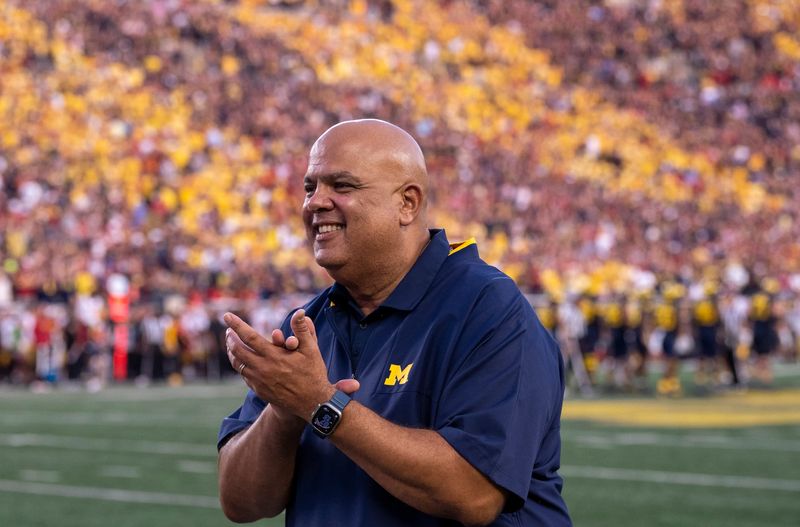
Michigan athletic director Warde Manuel has had to navigate his department through multiple controversies in recent years, including, most recently, the firing of head football coach Sherrone Moore last December.
An investigation revealed Moore had an inappropriate relationship with his executive assistant, Paige Shiver. After Manuel fired him, Moore then barged into Shiver’s apartment and was arrested. Earlier this week, Moore was spared jail time and sentenced to 18 months of probation.

Now, the athletic department awaits the outcome of an investigation conducted by an outside law firm that has looked into the culture of the department. Manuel said he welcomes the results and suggestions on how to grow and improve the Michigan athletic department. During an interview session with The Detroit News, Manuel spoke on a number of topics, including his handling of the Moore situation, his job performance and his critics, as well as the numerous recent successes in Michigan athletics, most notably the men’s basketball team’s national championship.
The following transcript has been edited for length and clarity.
Question: I’m assuming you saw the Sherrone Moore sentencing (Tuesday). What was your reaction?
Answer: I want Sherrone to get through this and to move forward for him and his family, and so I don’t have a reaction to the sentencing itself, more of a reaction to him as a person. I want him and everyone who’s affected to be able to get through it, to move forward, and to learn from it and to be better. That’s the way I think about it. I don’t judge any of the outcomes or the things that he’s going through.
Q: What triggered the initial investigation into Sherrone’s improper relationship? Had you heard a rumor and that’s why the investigation?
A: The university received a hotline report. As the policy goes, because it didn’t contain anything for the Office of ECRT (Michigan’s Equity, Civil Rights & Title IX office) to investigate, that it was on the unit (the athletic department) to have to investigate the hotline report. So I asked my head of HR (Tiffany Raymond, assistant athletic director, human resources) to lead the internal investigation into the matter immediately. And it began that day with interviews of the two people, and then it went from there. It was not for me to direct. She worked with somebody in central HR and our attorney for HR, to figure out what needed to be done in the investigation. She worked through that and then shared with me the response, which at the time was, nothing was going on. We took a thorough look into it as we were required and needed to do, so that’s what prompted it, and that’s how it was handled by us, but not by me. I received a verbal report on what (Raymond) had found, but it wasn’t something that I personally led the investigation.
Q: Once it all came out after an outside investigation, how did you feel? Duped?
A: (lengthy pause) I felt betrayed. It’s the best word that I can use. I felt hurt for all the staff and the student-athletes and the university, because it’s something that I had talked about, as it related to the expectations of our employees in athletics and for the university. I’ve talked about it at all-staff meetings, off of the Martin Philbert (former UM provost fired for sexual misconduct), off of the Mark Schlissel (former UM president fired for having an inappropriate relationship with a staff member) situations, and that this was not going to be tolerated by me or the university, and I thought I was very clear about my expectations and about the outcomes if something like that would happen. I had known Sherrone since he got here (2018 when he was hired as an assistant coach), believed in him as a leader, believed that my staff is doing things the right way, and I felt hurt, and I felt betrayed by it. It was personal, but it was also, I want to emphasize, for so many people that were affected by it. And it’s hard as a leader to have to enforce discipline on people that you care about and that you believe in, but it has to be done. There are a lot of people who claim to be callous, who say, ‘Oh, you should have fired him when the rumor was there.’ But you can’t just fire people on rumors with no evidence. So when the evidence was presented, it was a sense of betrayal and hurt for everybody who was going to be involved with a decision. Players, coaches, their families. Everybody.
Q: As soon as you got the investigation report, how did you handle this?
A: I was on a flight back from the National Football Foundation event out west when I got the message to call Tim Lynch (UM Vice President and General Counsel) immediately. I told him I was an hour out, and then I got the information on the phone call and got home and went into the office and called (Moore) immediately to come in and meet with me. This whole idea that I needed to have somebody else in the room by university policy is not true. There’s no university policy that says you have to have somebody else in the room. I had obviously talked to the (interim university) president (Domenico Grasso) and legal about the situation, and I had made the statement before that if I have any evidence that something like this is going on, I will let him go. We had a brief conversation, and I listened to (Moore), and then I told him that he was no longer going to be the head coach here. He left the room visibly upset, and I tried to get him back to talk to him and calm him down. And when I couldn’t find him, I immediately called DPSS (UM Division of Public Safety and Security) to ask them to look for him, because I was concerned about him. The rest of the situation is well-documented. But this idea that I knew he had any mental health issues, I still don’t know. He’s never disclosed anything to me or HR, and nobody has to. Anybody here who may be dealing with mental health issues or health issues in general does not necessarily have to disclose that. That’s not mandated by the university. Matter of fact, it’s protected by law.
Q: So now there’s this current investigation, that sounds like it’s close to being wrapped up. You said in December that you wanted the investigation for a cultural analysis of the athletic department. Did you want this investigation or the Regents?
A: You’d have to ask the Regents their conversations about it. The next morning (Dec. 11, 2025 after Moore was fired), I talked to Domenico, and I said I would like the Office of Equity, Integrity and Compliance to work with me to find someone to come in and do a cultural assessment, because apparently my words are not getting through. So I’d like some help in what else can be done. And it turned into a conversation where it was recommended that (law firm) Jenner and Block be the ones that do the cultural assessment, because they have expertise in this area as well. I was fine if that was the direction that they wanted to go. What I haven’t appreciated, and I’ve spoken about this, is in the context of an investigation into the culture here. However people want to couch it, what I want is people to understand that 99.9% of the people here are doing things the right way, and are working hard to drive success in the right way. We’ve had our issues and we’re not perfect, and I don’t know any organization that’s without issues and people issues. I wanted a sense of somebody coming in from the outside to say, how can we be better as an organization that we don’t have (these issues). What can we do to ensure that these things don’t continue to happen?
Q: You’re not denying there have been issues at Michigan, but you want solutions on how to move forward?
A: If any leader has had some of the issues that we’ve had, and they don’t say, ‘How can we be better?’ then I think they’re just putting their heads in the sand. I’m not going to put my head in the sand and pretend that these things are not happening. It was my conversation with the president the next morning to ask for some assistance to figure out how to improve, not a quote, unquote investigation into the problems that we have here. You can’t have the success of our teams without having a culture that is solid. Not perfect, but solid in the way that we go about helping our student-athletes, helping our teams, supporting people. It was something that I wanted to see, how can we improve, and it turned into this sense of an investigation into the culture and the issues. Whatever the report will say, we’ll use it to be better. Obviously because of the issues we’ve had within the university itself, outside of athletics, we all need to be better. There’s no perfect there. But I’m also going to defend not myself as much as I’m going to defend the great people we have in this organization, the super majority of people who are working and doing things the right way.
Q: So this has been framed as an investigation into Warde Manuel and the athletic department. That’s how you see this?
A: That’s not how I see it, no. Listen, it’s easy for people to say, well, Warde’s the leader, and therefore this is not just a review, this is an investigation of what the leader has done. That’s not, to me, what I’m going to be taking away from this. I know what I’ve done. I know how I’ve tried to lead. I know the words that I’ve said. I know how I have been as a leader, and I’m not perfect. Again, tell me a leader who is. And I’m not claiming that I can’t be better. I can definitely be better, and I work at trying to be better for this organization and for this department and this university. Again, you can go into any area of this university and probably find issues. We’ve had our issues, and we deal with them, and we try to improve every time. Those who want to see everything with me as a negative, they’ll point to every negative aspect of it and use language that’s extremely negative. Look, as a leader, I know you’re going to take the brunt of the responsibility, and I’m fine with that. That’s the role of any leader. But those who know me well know the effort and the things that I’ve put in place and what I’ve tried to build and work to do, and the results of that speak for themselves.
Q: You mentioned not having your head in the sand. When you say issues in the department, you’re referring to the NCAA investigations, Matt Weiss, DUI arrests, Sherrone, all these things that happened on your watch. What is your responsibility?
A: Yeah, all those issues happened under me, and while I was here. You can take each one of those issues and break it down. During the hiring process, did Warde do background checks? Did Warde do the process in place at the university? Yes. There is no university process that I am aware of that says we need to do some psychological tests. Nobody here says, Hey, you gotta give this (individual) this 50-question psychological questionnaire that would really get at whether or not somebody was doing something on a computer or whether or not somebody is going to violate NCAA rules and go out and do in-person scouting against the rules. I don’t know how many times I need to message to people not to drink and drive. I got to a point at one meeting where I said, don’t break the F-ing law. The Matt Weiss situation was uncovered by IT through them following up on someone’s concern about what’s happening with their phone. How are we going to know? How am I supposed to know that somebody is on a computer in their office doing what he’s accused of doing? He reported to Jim (Harbaugh, former Michigan head football coach), and Jim didn’t know. I didn’t know. These sorts of things people want to say, ‘Well, you didn’t have the right process…’, yes, we had the right process in place. Yes, we did do what we had to do. (Weiss) is accused of doing this at other places, and they didn’t know. As the leader you take you take responsibility for what people do under you, but the question is, what is realistic for leaders to know? The same people who are critical of me, the question is, how would they have done differently What would they have known? I wish I had that power.
Q: To your point, part of your responsibility as AD is once you’re presented the issue, you have to find a way to fix it.
A: You deal with it quickly based on the evidence that you have. That’s what you do as a leader. Going back to the rumors, you can’t take rumors if you have no evidence, but when you have evidence, now you have to deal with it. If you don’t deal with it, then you’re complicit in the issue. That’s the way I look at it, but I’ll leave it to others who feel like they have the superpower to look at somebody and know the nefarious stuff that that they’re doing. I don’t have that superpower, and if there’s somebody out there that does, I’d like to meet him, because I’d like to hire him.
Q: What ultimately do you think the results of this investigation mean for you?
A: I hope it means that we’re going to get better as an organization. I don’t have any concerns, personally. It’s more about the organization and the department, the people here. That’s my hope of all of this, that we get better and be better as a department.
Q: So you don’t have any concerns about your job security?
A: No.
Q: Why are you so confident?
A: I’m confident in what I’ve done and how I’ve done it, and what I’ve asked people to do. Again, I’m not perfect, and I don’t know anybody who is, but I’m confident that I have done everything to make sure that we do things the right way within the department. The rest of it, I don’t sit and worry. I worry about moving us forward and continuing the success that we’ve developed over the years since I’ve been here.”
Q: Do you feel like you have the backing of the coaches, of your staff, of the Regents?
A: I don’t know. Do I believe I do? Of my coaches and staff, I would say yes. And of the Regents, I would say, in general, yeah, I feel good about my relationship with them individually and collectively. I’ve been doing this for 10 years, and I’m sure there’s people, when I make certain decisions because I have to make certain decisions, they’re not happy about it. Does that mean they don’t back me? I don’t know. But I feel good about my relationship with the coaches and the student-athletes and the staff in the general sense.
Q: What’s your reaction to the “Fire Warde” segment out there in the fan base? Is that just part of the job?
A: I don’t know if it’s part of the job, it’s part of life when you’re a leader. Again, not everybody is happy with every decision that you make. There are those who wanted to fire me when I didn’t fire Jim (Harbaugh). There are those who believe I didn’t want Jim around, which is absolutely not true. There are those that believe misinformation that’s out there and make a decision about me. They’re those out there who could be saying, I want to get Warde fired, because they look at all the success we’re having that are, and they’re promoting themselves as Michigan fans, but really not. So what do they call those people, trolls or something? I don’t concern myself with thinking about how people feel about me. I concern myself with supporting our student-athletes, our coaches, our staff, wanting to do great things for our fan base and our season ticket-holders and donors in this great university that I love. That’s what I think about on a daily basis. I don’t think about how I can make everybody happy. I think about how I can help to make us better and to keep us moving forward.
Q: What have been the last four months been like, post-Sherrone firing and hiring Kyle Whittingham, seeing the women’s basketball program have a historic season, hockey going to the Frozen Four, and, obviously, the national championship of basketball?
A: Kyle has been a great addition, the staff that he’s brought in has been a great addition to Michigan. To see the success we’ve had in our programs, men’s and women’s swimming, finishing top 10 in the country, women’s swimming winning the Big Ten, men’s gymnastics winning the regular-season and the Big Ten championship, we had three teams in the Elite Eight at the same time, women’s basketball, men’s hockey going to the Frozen Four, and obviously men’s basketball, and the success they’ve had, it’s something to be very proud. I smile about the success we’ve had even through all the issues with adversity that we’ve had. I think that even makes it sweeter in the way that everybody’s still pulling together to drive success and to get through it. It’s really been exciting and special. I’m a little tired at times over the last five or six weeks with the travel and all of that, but I am invigorated by the opportunities our teams have had and the things that they have done. Very proud.
Q: How much pressure did you feel to lock in (men’s basketball coach) Dusty May?
A: I mean, it’s a big deal. I don’t take any of my coaches for granted as people. He’s earned the level of support that I’m working to provide him with. He’s earned all the accolades and the great success that he’s had. But in my career, I’ve always tried to step up and reward our coaches and our staff for great outcomes. He deserves to be wanted by others. He’s earned that, and I’m just proud that he’s going to stay here and continue to lead our men’s basketball program and be a great ambassador for this department and for this university.
Q: Switching to football, how have you seen the players respond to Whittingham?
A: The players, everyone I’ve talked to have all enjoyed having him as the head coach and have an appreciation for the style that he brings in and how direct he is, but he cares about them as players. The staff is pushing them hard to be better, and they’re getting the chance to understand what he wants as a head coach, and they’ve stepped up. I’m looking forward to watching them in the spring game. I’ve enjoyed the couple of practices that I’ve been able to attend. Kyle feels good about the responsiveness of the players, and he talks about how they’re great people, and that’s one of the things I told him, with all the stuff going on, when you take over this program, you’re going to have a bunch of great young men in this program. I’m really happy he’s here. He’s been a great addition to the family, and I look forward to watching him do great things with the program.
achengelis@detroitnews.com
@chengelis
This article originally appeared on The Detroit News: Q&A: Michigan AD Warde Manuel on Sherrone Moore saga, job security
Reporting by Angelique S. Chengelis, The Detroit News / The Detroit News
USA TODAY Network via Reuters Connect