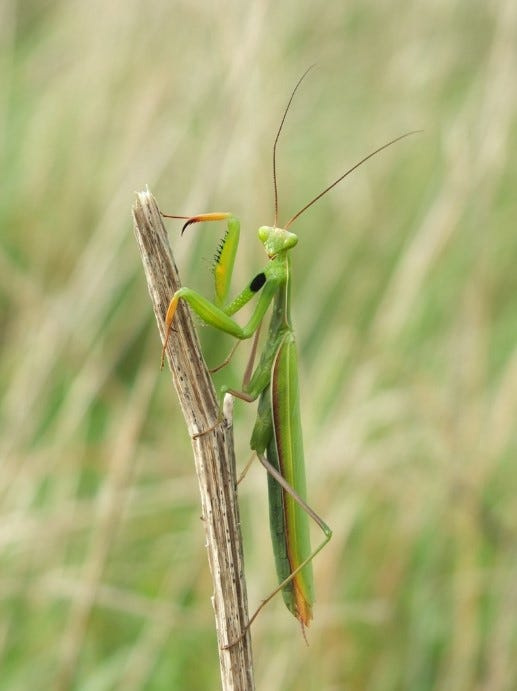
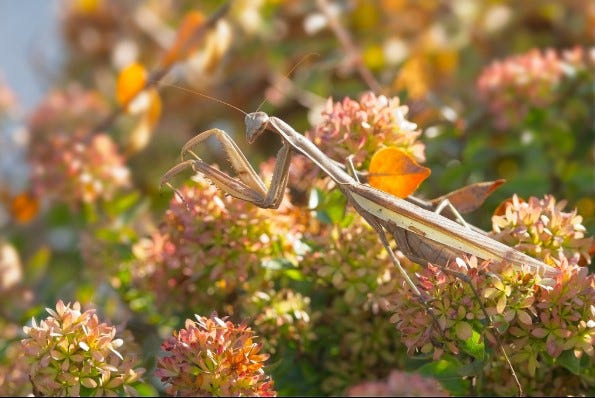
One of Michigan’s best camouflaged insects, the praying mantis, may be more noticeable this time of year while they are out looking for mates.
From August to October, the two mantis species in Michigan: the Chinese and European mantis species breed and lay eggs, according to Michigan State University’s Extension, so residents are more likely to see adults fly around, or clinging to plants and building walls as they make themselves known.

The insects have a reputation for their hunting skills — they are a predatory species — their lanky limbs and, of course, their (at times) deadly mating behavior.
According to The Michigan Nature Guy’s Blog and MSU, a female mantis doesn’t always eat its mate. They are cannibalistic, though a female will only eat the male she mates with if she needs the nourishment to survive and lay her eggs.
“If the female is hungry, then she will try to make a meal out of her mate. It is estimated that 30% of the matings in nature end with the male being consumed,” The Michigan Nature Guy noted.
The fascination behind mantises — or mantids, if you prefer — may also come from their ability to turn their heads 180 degrees, even more so as they are the only insect with that ability on the planet, according to the Forest Preserve District in Will County, Illinois.
As the mantis mating season remains underway, here’s what to know about the species in Michigan:
What species of praying mantis live in Michigan?
There are two species in Michigan: the Chinese mantis (tenodera sinensis) and the European mantis (mantis religiosa) and they are easily distinguishable based on their appearance.
European mantises are a striking green color, while Chinese mantises are larger with a brown color, and only a line of green along their wings (developed once they are mature), according to MSU.
To differentiate between male and female mantises, males have more abdominal segments (about eight) than females do (usually 6) that are more unevenly sized. In addition, they both have wings ,though males are more frequent fliers.
Are praying mantises native to Michigan?
No, the praying mantis, was not a native insect, but over the past few centuries, two species have been introduced, MSU Extension said. Praying mantis have no known significant ecological impacts in Michigan; however, there is continued debate and ongoing research on this topic, MSU said.
Is it preying mantis or praying mantis?
Because of their penchant for hunting live prey, some people think praying mantises are called preying mantises, but the religious spelling of the homophones is the correct name because they really do look like they are praying.
The insects often hold their forelegs in a folded position that gives them the appearance of sitting in prayer, National Geographic said.
Why do I see more many praying mantises in the fall?
In Michigan, the praying mantises breed from August to October.
There is one generation of praying mantises per year. In the spring to summertime, the adults eat and reach full maturity to mate and lay eggs in the fall. The adults die and their eggs endure the winter to repeat the cycle, according to Iowa State University’s Extension.
Their egg case — called an ootheca — is noticeable as they are medium-sized, foamy yet firm brown clumps that adhere to surfaces like twigs or stems of plants, building walls or fences.
The ootheca holds up to 200 nymphs, according to MSU, and once the weather warms in the spring the nymphs emerge as miniature copies of adults mantises, only without wings.
What do praying mantises eat?
Praying mantises ambush their prey like cats, crocodiles or snakes. Their diet includes other insects, including butterflies, bees, flies, mosquitoes or crickets, according to “Birds & Blooms,” a gardening magazine, and though it is rare, they do hunt small birds like hummingbirds, according to MSU.
Spiders, frogs and lizards are also on a mantis menu, according to National Geographic Kids.
Do praying mantises bite?
Yes, praying mantises bite and consume their prey even if it is still alive. They are nonvenomous, so their bites are not deadly. Humans have been bitten on accident and it’s recommended to wash your hands afterward, according to Healthline.
What is the difference between a praying mantis and a walking stick bug?
A similar insect, the walking stick, also lives amongst Michigan’s forests camouflaging itself cleverly as a stick. These species stometimes are mixed up based on their appearance.
According to Sciencing and Whats That Bug, a walking stick has a longer, thinner body and its diet is plant based, while praying mantises are grasshopper-like with a carnivore’s diet. In addition, stick bugs have a slender head, while mantises have a triangular head with larger eyes.
Contact Sarah Moore @ smoore@lsj.com
This article originally appeared on Lansing State Journal: Praying mantises are looking for love. Why the insects are more noticeable in fall
Reporting by Sarah Moore, Lansing State Journal / Lansing State Journal
USA TODAY Network via Reuters Connect