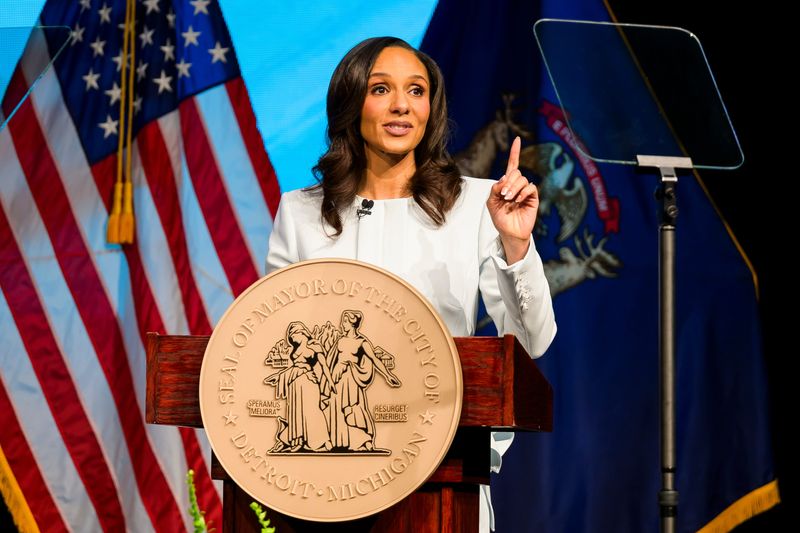
Mayor Mary Sheffield wants to grow Detroit’s economy and population while reducing its tax burden. We can’t think of a better agenda for assuring the city’s long-term viability.
Her first State of the City address since becoming mayor in January was upbeat and ambitious, and should reassure Detroit residents and businesses the momentum of the past several years will continue under her leadership, and perhaps even accelerate.

The highlight was the plan to cut property taxes by 30% to 60% to address the affordability issue. Taxes are too high in the city, and one of the bigger obstacles to attracting and keeping residents.
Her idea would reduce the 64.1844 mill tax rate on homestead property to between 25.6-44.8 mills, and on non-homestead property to 32.8 mills from the current 82.1844 mills.
Allowing residents to keep more of their own money is a powerful anti-poverty tool and will allow Detroiters to finance their own quality-of-life improvements. Money not required to meet the property tax obligation can be spent on food, transportation, education and other necessities.
Sheffield will have to find ways to replace much of the lost revenue. She should resist a tax shift by hiking the sales or income tax.
Instead, the city must work to find savings in existing spending.
Aligning property tax rates more closely to the level of services delivered should also encourage more residents and businesses to pay their taxes.
Historically, Detroit has had a higher-than-national-average tax burden, with a lower-than-average compliance rate.
Bringing the tax rate more closely in line with the services delivered for the money will encourage more taxpayers to pay their obligation. Growth is the other preferred method of covering the cost of a tax cut. More people living in the city and paying both the property and income tax will ultimately produce more revenue, even at a lower rate.
Tax cuts are a growth tool. But Sheffield isn’t relying on tax relief alone. Along with Detroit’s billionaire patron, Dan Gilbert and MoveDetroit, she is launching a new program to retain and attract residents.
Residents and businesses will be eligible for $15,000 grants to support homeownership growth and $1,000 in relocation expenses. This is largely an initiative of corporations, foundations, economic development groups and community and neighborhood organizations.
Sheffield offered several other ambitious programs to improve life in the city, though many will have to wait until money is available to fund them.
But she has charted the right course, and one that stands in stark contrast to other cities such as New York, Chicago and Los Angeles, where mayors are looking for ways to squeeze more money out of their residents. As a result, they are bleeding population.
Meanwhile, Detroit’s population is finally growing. That growth should expand as overtaxed denizens of those other large American cities realize what is happening here.
This article originally appeared on The Detroit News: Our View: Mary Sheffield chooses right growth agenda
Reporting by The Detroit News / The Detroit News
USA TODAY Network via Reuters Connect