

The floodwaters that inundated northern Michigan in April continue to cause headaches on roadways that have been submerged, eroded and, in some cases, completely washed away as state and local officials wait to see if the federal government will give aid.
The floodwaters overwhelmed lakes and waterways throughout northern Michigan in April after 3 feet of snow fell on the region in March. The melting snowpack coincided with a downpour that lasted several days.

The waters ripped apart roads and their infrastructure, which has prompted local governments and the Michigan Department of Transportation to spend millions of dollars on repairs. The rehab work has pushed back other projects and has itself stalled at times because local officials are waiting on the federal government for damage estimates and reimbursement.
“It’s quite a disruption,” said David Kowalski, Presque Isle County’s road commission manager.
Kowalski’s Presque Isle County was one of a host of localities that at some point had an emergency declaration during the flood. Gov. Gretchen Whitmer’s executive order included 41 counties and three municipalities at one point.
While these counties and municipalities are nearly two months removed from the floods themselves, the impact of the natural disaster is still felt today.
“I’ve been on the road commission, on the crew and as a manager, for 36 years. And that’s the most water we’ve had at one time,” Kowalski said. “Everything happened very quickly.”
Earlier this month, Gov. Gretchen Whitmer asked President Donald Trump for a disaster declaration due to April storms and flooding. Whitmer requested aid for homeowners and renters, as well as public aid to reimburse local governments, some nonprofits and tribal agencies for infrastructure repair and debris removal.
The Federal Emergency Management Agency has not issued a decision on the governor’s request, Whitmer spokesman Bobby Leddy said Tuesday.
Michigan Department of Transportation spokesperson James Lake said his agency’s tentative repair estimate for the region is roughly $6.65 million. MDOT plans to submit a funding request to the Federal Highways Administration’s Emergency Relief Program, which would reimburse the agency for repairs after they’re made, Lake said.
“We have not yet submitted a request as we do not yet have a full accounting of the expected costs,” Lake said Tuesday in an email to The Detroit News.
A bridge in Grand Traverse Co. will take months to replace
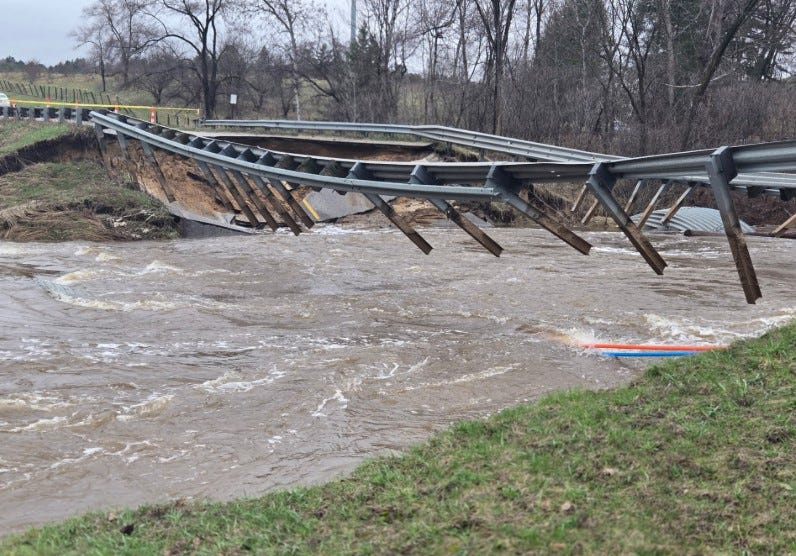
A striking image from the floods can be seen on a road in Grand Traverse County, where a bridge was washed away by a swollen creek — a roadway local officials said will take months to repair.
The bridge on Beitner Road over the Boardman River is now gone. The only thing left for a while was two guardrails suspended in midair from either side of the river. The guardrails marked where the bridge stood before the flood. Those guardrails have since been removed.
Beitner Road is “about a 20,000-car-a-day road,” according to Grand Traverse Roads Commissioner Dan Watkins. Those vehicles have now been rerouted to Airport Road, which is a 40,000-car-a-day road, Watkins said.
“South Airport, originally, we had to close that down for a week when the flooding first started happening because the road completely flooded. At one point, it was a foot underwater. It was dislodging large stumps. It was kind of like a battering ram,” Watkins said.
Now, South Airport serves as an alternative to Beitner, which will have to be replaced. Watkins estimated the cost will be $5 million.
“We’re hopeful, if everything lines up, that we can have that project done before the first of the year,” Watkins said.
The Beitner bridge was already scheduled to be replaced with a full bridge in early 2027 when the washout happened, according to a Grand Traverse County Road Commission Facebook post on May 4. The design process for the bridge replacement had started and was expedited after the bridge failure, the commission said.
The cost of the Beitner Road project is more than half what Watkins estimated all the flood repairs will cost countywide. The road commissioner said all damaged locations will cost around $9 million once it’s all said and done. The county is trying to get as much federal money as possible for these projects to soften the blow, Watkins said.
In addition to the cost, the road commissioner said these repairs have affected the timeline of other projects the road commission planned to do in 2026.
“We had our whole summer planned out for projects, and really, you have a goal that you’re going to try to accomplish for the year, and it definitely is pushing our goals back really far,” Watkins said.
Tunnel of Trees road repairs face a cascade of challenges
While MDOT has a rough estimate of how much road repairs will cost, the final cost remains uncertain due to the repair process.
One example is M-119 in Emmett County, which is overseen by the Michigan Department of Transportation. The highway runs along the north shore of Little Traverse Bay and is most famous for the “Tunnel of Trees,” a stretch from Harbor Springs to Cross Village where trees create a natural tunnel that stretches over the road.
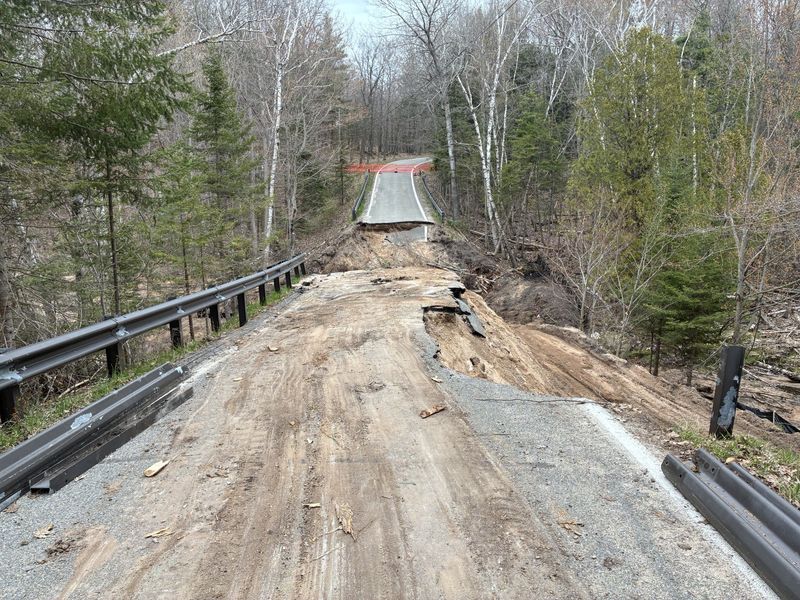
MDOT’s Lake said the slope beneath M-119 deteriorated in two places, causing the road to give out.
“I can’t give you dollar figures to go along with it yet, and the reason is, we don’t have the contracts to fix it, and we don’t have a design yet for those fixes. So until we have a design set, we don’t know how much something is going to cost,” Lake said June 4.
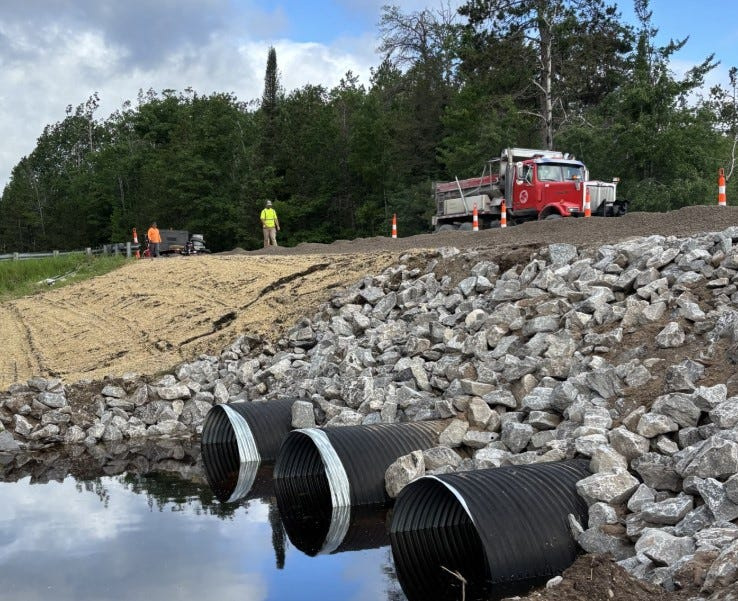
One of the reasons for Lake’s ambiguity is that he was unsure if a culvert between Good Hart and Cross Village that washed out could be easily replaced. Lake expected the culvert would be replaced with a much larger one than the previous one.
“We’re not sure yet if we’re going to be able to replace that culvert with something that is ‘off the shelf,’ that a supplier would have on hand, or if it’s something that would have to be custom-made,” Lake said. “If it is something that is custom-made, it would likely have to be a lead time of several months to procure that.”
Lake said Tuesday that MDOT had just hired a contractor to build a retaining wall along M-119 near Stutsmanville Road. It’s expected to cost $300,000, he said.
Beyond the repairs, Lake called M-119 “a pretty challenging corridor to maintain.” Washouts like the ones seen in the April floods aren’t uncommon, he said.
The road also has a narrow right-of-way and is close to adjacent property owners, Lake said. MDOT has had “a lot of challenges” building a retaining wall along the road because of legal challenges, he said.
“The way it’s built, the location it’s built along this largely sandy bluff along Lake Michigan — we likely would not build this road in this location, in this way, if we were building it today,” Lake said.
‘A lot of shuffling around’
The cost of repairs in Wexford County is not as great as in Grand Traverse County. But that doesn’t mean the rehabilitation process hasn’t been complicated.
Repairs on the county’s local roads cost around $2.5 million, said Karl Hanson, the county road commission’s engineer manager. The commission had already spent $700,000 by the end of May, so motorists could drive where they wished, he said.
But Hanson said federally owned roads around Lake Mitchell present a bigger challenge because the county is seeking federal assistance to repair them.
“That’s going to be a bigger project, and I don’t really have a timeline,” Hanson said.
Like in Grand Traverse, Wexford County is “way behind” on other projects because of the rehabilitation efforts, he said, adding that brining, mowing and shoulder repairs are behind schedule.
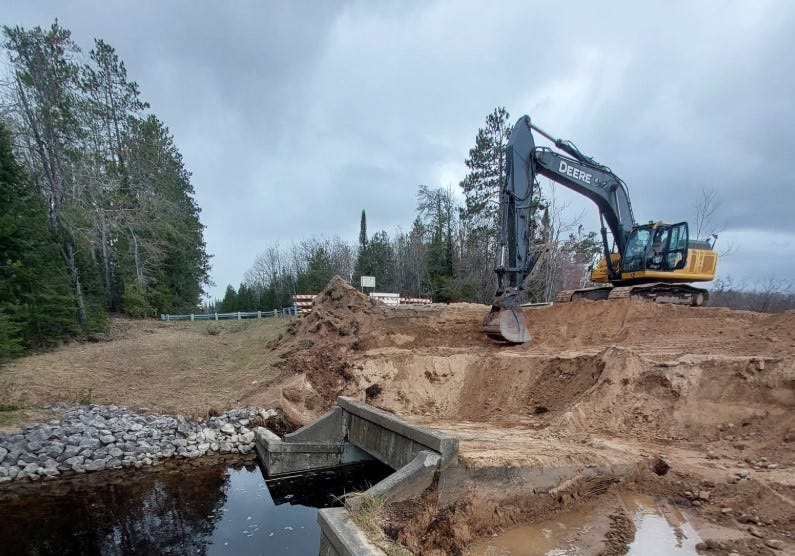
In Presque Isle County, road repairs had cost more than $600,000 as of May 27 — not “perfect fixes,” but enough to open things up for traffic, the county road commission’s Kowalski said. These include 12 locations where the county had to close roads, he said.
One such location is on M-68, which MDOT has temporarily repaired because “they weren’t going to be able to get to it until October,” Kowalski said.
“I wanted it open sooner because the detour is impeding on my system,” he said.
The flood repairs have resulted in “a lot of shuffling around” for the Presque Isle Road Commission, delaying projects.
“Some projects got pushed back a year just because of the amount of money we had to come up with in a hurry to get this stuff fixed,” Kowalski said.
mbryan@detroitnews.com
This article originally appeared on The Detroit News: Northern Michigan was ripped apart by water. That was only the beginning
Reporting by Max Bryan, The Detroit News / The Detroit News
USA TODAY Network via Reuters Connect
By Max Bryan, The Detroit News | USA TODAY Network
