GRAND HAVEN, Mich. — A piece of bipartisan housing legislation expected to reduce housing costs nationwide was overwhelmingly approved by the U.S. Senate on June 22.
The bill, called the 21st Century ROAD to Housing Act, hopes to lower costs, make it easier to build homes and limit Wall Street investors from buying up housing stock, according to reporting from several national outlets, including NBC News. The bill will now go to the House before heading to President Donald Trump’s desk to be signed into law.

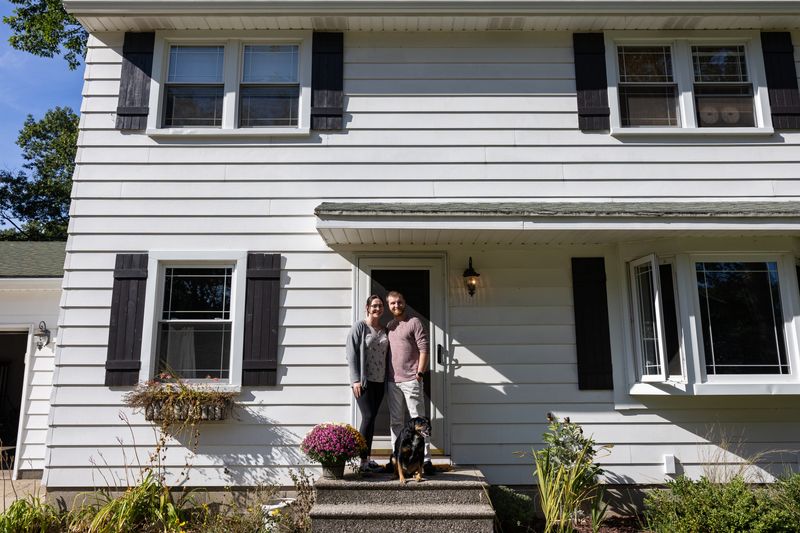
The legislation, which is expected to see swift action in the House, is aimed at making home-buying more accessible and affordable for young families, such as West Michigan couple Nathan Johnson and Kellie Hope.
The young couple had outgrown their one-bedroom apartment in 2025. Their dog yearned for a yard. Throw in noisy neighbors and a three-day maintenance project, and they weren’t just considering home ownership — they needed it.
“We really had no idea going in,” Johnson said. “We didn’t know what the housing market was like at all. … We quickly learned that, to get any house anywhere, you have to be flexible.”
Johnson and Hope represent a majority of first-time homebuyers in today’s housing market, crippled by stagnant wages, skyrocketing sales prices and higher interest rates.
What odds are first-time homebuyers facing?
According to a study from Bankrate, a financial guidance publication, households in America need an annual income of $116,986 to afford a typical home, which cost $418,489 in January 2025. That’s a nearly 50% increase from 2020, when households needed $78,236.
Unfortunately for prospective homebuyers, wages haven’t kept up.
According to the U.S. Census, the median household income was $80,610 in 2023. In the Midwest, that number was slightly higher, at $81,020.
Included in that region are Illinois, Indiana, Michigan, Ohio, Wisconsin, Iowa, Kansas, Minnesota, Missouri, Nebraska, North Dakota and South Dakota.
Of note: Neither the national or regional average household income is enough to purchase a typical home, short by more than $30,000. Also of note: The typical home in the Midwest doesn’t cost that much.
Midwest: The most affordable place to buy a home?
Johnson and Hope originally set a budget of about $300,000, with an approved loan of about $400,000, but struggled to find homes within their price range during their two-and-a-half-month search.
Even when they found prospective homes, they were outbid on other factors, including means of payment.
“One of the biggest issues we faced, especially early on, was people being able to make full cash offers on homes,” Johnson said. “Even if you make a full offer through a loan, they’re going to choose the cash offer every time. That really does hamper first-time homebuyers.”
It’s true that homes in the Midwest are more affordable than average. Minnesota had the highest median sales price at $377,000, as of June 2025, according to national real estate brokerage Redfin. Iowa had the lowest median sales price, at $258,000.
Those are certainly more affordable than the typical home; but they seem less impressive when you compare them to prices in 2019.
Michigan median prices rose from $159,000 in January 2019 to $292,000 in June 2025. Indiana jumped from $151,000 in January 2019 to $283,000 in June 2025.
Illinois started at $194,000 and landed at $329,000. Missouri leapt from $168,000 to $291,000.
“It’s very surprising,” said Jeffery Ostrowski, a real estate expert at Bankrate. “The housing market in the Midwest has really taken off over the past year or two.”
Ostrowski cited a generation-plus period in which the Midwest saw low population growth and weak job creation, resulting in lighter home prices.
“The home prices in the Midwest just weren’t appreciated like they were (elsewhere),” Ostrowski said.
In comparison to states like California and Colorado, though, the Midwest remains “a bastion of affordability.”
“There’s a theory that’s part of the reason home prices are going up there,” Ostrowski said.
By the numbers: Is the average household making enough?
Households spending more than 30% of their income on housing — whether owning a home or renting — are considered cost-burdened.
Bankrate estimates, as of January 2025, households must earn $70,437 to afford a typical home in Iowa, $71,080 in Ohio, $72,342 in Indiana, $74,228 in Michigan, $91,639 in Illinois, $74,263 in Missouri, $97,447 in Nebraska, $86,829 in Kansas, $103,823 in Minnesota and $84,743 in Wisconsin.
In Michigan, households fall short at $69,183. There are also shortages in Illinois ($80,306), Indiana ($69,477), Kansas ($70,333), Minnesota ($85,086), Missouri ($68,545), Nebraska ($74,590), Ohio ($67,769) and Wisconsin ($74,631). There are shortages, too, in North Dakota and South Dakota.
The only state in the Midwest where the average household is making enough to afford a typical home is Iowa.
Still, the numbers are better than in other regions.
“In many other parts of the country, first-time buyers have given up,” Ostrowski said. “Some percentage of first-time buyers are moving to the Midwest.”
Johnson and Hope encourage first-time buyers to be finance savvy.
“They tend to offer or allow you to spend more money than you really should,” Johnson said of mortgage companies. “People who don’t do the research ahead of time, they end up with way more than what they can actually afford on a month-to-month basis.”
Those purchasing with a mortgage should also be mindful of higher interest rates — or rather, higher than the historically low rates popular during the COVID-19 pandemic. According to Bankrate, the average 30-year fixed mortgage rate in January 2020 was 3.68%. In the time since, the number has risen, hitting 7.09% in January 2025.
“The (low) rates of a few years ago, that’s what people are anchoring on,” Ostrowski said. “They feel high (now), even though 6.5% (as of mid-September) mortgage rates aren’t really historically high.”
The hardest part of purchasing their home was navigating the financials, Johnson and Hope said. They were able to use an advisor to help understand their mortgage.
“It’s scary because you don’t have the estimation of how much you’re going to be paying monthly,” Hope said. “You look at your budget and you get a little nervous thinking, ‘Will I actually be able to afford this month-to-month? Am I overshooting here?’”
Johnson noted monthly costs also include utilities and property taxes, which many first-time buyers forget. Even if buyers choose to put money in escrow (spreading tax payments throughout the year), they’re often surprised to see a significant increase only months later. That’s because, in many states, there’s a cap on annual taxable value increases — and that cap is temporarily lifted when the property sells, leaving owners to either raise their mortgage payment or pay the shortfall.
“It’s hard until almost the very end to really nail down exactly what the cost is going to look like,” Johnson said.
“It’s overwhelming,” Hope agreed. “Especially if you don’t have experience in. You’re like, ‘How the hell? Where do I start?’”
Is the market getting better anytime soon?
As of last fall, there were still more buyers than sellers in the housing market, according to Bankrate.
How is that possible? It’s less about an increase of buyers and more about a decrease in sellers and inventory. Developers aren’t building at the same pace they once did, Ostrowski said, and homeowners who might normally place their homes on the market every seven years or so have chosen to stay locked into low mortgage rates.
According to the National Association of Realtors, a balanced market has a five- to six-month supply of housing inventory. In June 2025, that number was 4.7.
“I believe the key is adapting to the market we’re in and embracing it, rather than letting it scare you away,” said Briana Beyer, a real estate agent in West Michigan. “This market has definitely posed challenges for buyers who are focused on keeping a lower monthly payment, so it’s been encouraging to see more inventory becoming available in recent months.”
Beyer has four important tips for homebuyers seeking an edge in their offers, including:
First-time homebuyers, Beyer said, should focus on the long-term goal of building equity; keep in mind that refinancing down the road could be a path to lower interest rates; accept that most homes won’t check every box; and explore loan options that don’t require a 20% downpayment.
For example, Consumers Credit Union, based in West Michigan, offers a 0% downpayment mortgage with no income limits and a higher-than-average interest rate for buyers with good credit scores. Sellers often see conventional mortgages as easier to accept than FHA, VA or USDA loans, which offer low downpayment percentages but come with a special list of inspection and property requirements.
Despite the challenges they’ve faced, Johnson and Hope advise first-time buyers not to get discouraged.
“I thought it was the end of the world when we lost the first house,” Johnson said.
But Hope taught him otherwise.
“It takes time to find the place you want to be,” she said. “We ended up loving this house 10 times better than the houses we originally liked and didn’t get — it all worked out for a reason.”
— Cassidey Kavathas is the politics and court reporter at The Holland Sentinel. Contact her at ckavathas@hollandsentinel.com. Follow her on X @cassideykava.
This article originally appeared on The Holland Sentinel: New Senate bill can help first-time homebuyers nationwide
Reporting by Cassidey Kavathas, Holland Sentinel / The Holland Sentinel
USA TODAY Network via Reuters Connect


By Cassidey Kavathas, Holland Sentinel | USA TODAY Network