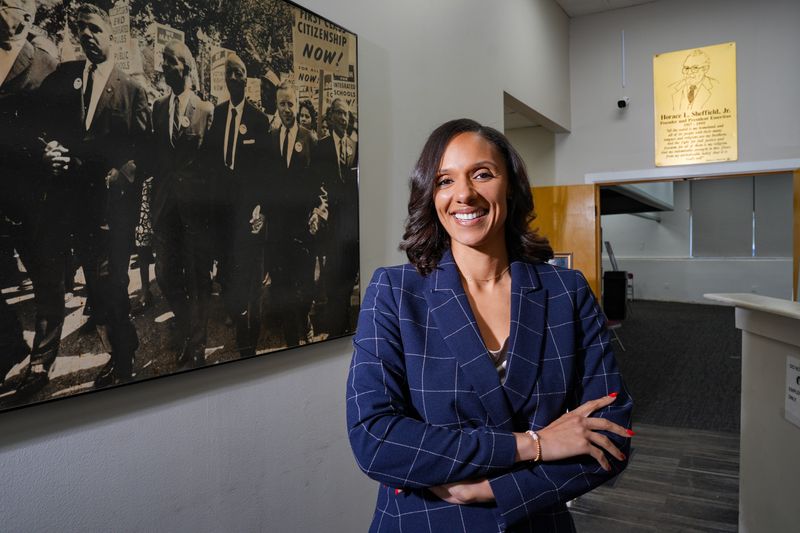
Growing up through her childhood and teenage years, Detroit Mayor Mary Sheffield said she never thought about taking charge as the city’s top leader.
Sheffield’s role in public service began at 26 years old, as the youngest member ever elected to the City Council. And she was continuously reelected to serve for 12 years — the last four as council president. As of Jan. 1, the now 38-year-old hit another milestone: becoming the first woman and first Black woman elected as Detroit’s 76th mayor.

Following her inauguration, Sheffield said she never thought she would be the first woman to serve as Detroit’s chief executive in its 324-year history, but she knew she wanted to continue in public service after realizing the impact a public official can have on the community.
“It was something I never dreamed about or thought about, to be quite honest. Not as a child or growing up, even in high school. It wasn’t until my adult life, when I got into office, my first time serving at 26 in City Council, when it became more clear to me,” Sheffield told the Free Press. “It’s been an honor to serve, I’m excited about this opportunity to really address the issues and priorities that matter to Detroiters.”
And as she moves full-time into crafting the framework of her new administration, she’s already hitting the ground running on ways to improve quality of life issues in the city — with a sharp focus on those who said they have been feeling left behind during the city’s rise.
Housing, poverty among top priorities
Many of Sheffield’s priorities include initiatives aimed at creating safe and affordable housing, along with boosting homeownership, providing home repair grants, investing in neighborhood infrastructure and commercial corridors, and providing quality education opportunities. She released a public survey on these issues to make sure the voices of residents are included in helping her shape her agenda.
Former Mayor Mike Duggan often used metrics to measure his successes, focusing particularly on population growth in the city, which he achieved. Yet, as has been the case for many mayors, the effects and benefits of the city’s growth have largely been confined to the downtown and its surrounding area. Sheffield said her goal is more broadly focused on improving overall quality of life and ensuring Detroit’s resurgence benefits everyone — especially those residents and neighborhoods far removed from the city center.
“I prefer not to contrast me and former Mayor Duggan. I am more focused on building on the foundation that has been laid and filling in some of the gaps so Detroit can continue to rise higher. There’s no doubt that I definitely have a focus and a passion on homelessness, social issues, poverty, and neighborhoods, and those are the things you’ll see me continue to focus on in this administration,” Sheffield said.
Sheffield hosted an inaugural ball on Jan. 9, giving the proceeds from the $100-a-ticket soiree to the Homeless Action Network of Detroit. And on Jan. 12, she introduced the leaders of a new city department created to address homelessness and poverty. The U.S. Census Bureau reported that, in 2024, more than half of Detroit’s children were living in poverty.
“The numbers that indicate how many of our children are growing up in poverty, that is a mark for me I’m really interested in trying to move the needle on, because if our kids are starting off disadvantaged, there’s no way for this city to ever rise higher and be the best that we can be. That is something I really plan to focus more on,” Sheffield said.
“Even amidst the growth and resurgence of Detroit, if we’re not moving the needle on poverty and the impact, and the quality of life of people, to me, it means nothing.”
Sheffield said she is still working out a budget proposal for the new fiscal year, which is typically presented to the City Council between February and March. She said she is eyeing public safety, education and youths as areas she wants to finance.
She already announced one initiative, Rx Kids, which will require a city investment of $500,000 a year for three years. The program aims to ease burdens on pregnant mothers by providing them cash assistance mid-pregnancy, and additional aid for at least the first six months of a baby’s life.
The mayor said she aims to keep some of the city’s current programs funded by one-time federal ARPA — American Rescue Plan Act — grants, like those that help provide Detroiters with homeownership and educational opportunities. Sheffield said she wants to identify other funding sources, whether it means shifting general fund dollars or seeking philanthropic support, to keep certain programs flowing.
“For example, the down payment assistance program was very successful, where 700 new first-time home buyers had accessed that program. We’re going to continue that,” Sheffield said. “We know that Motor City Match has been tremendously successful with supporting entrepreneurs. A portion of that was supported through ARPA (too).”
At least $30 million of ARPA money was dedicated to home repair grants for seniors, low-income households and individuals with disabilities.
“With that money running out, we’re going to see a large gap. We’re already actively working through a working group to try to figure out how we supplement to continue, at least, if not the same level of funding, at least a substantial amount,” Sheffield said.
Sheffield said she knows there’s work to do on affordable housing, and her administration’s immediate focus will be on infill housing and homeownership.
Sheffield said she also wants to identify funding sources for educational programs — Skills for Life and Earn to Learn, among them — that she said provide “wraparound services and direct educational support.”
Residents weigh in
For Clifford Johnson, a northwest Detroit resident, his main priorities include filling vacant housing and structures in his neighborhood and increasing police presence to avert unwanted traffic.
“I’m from the hood hood, over off Fenkell and Hubbell (Avenues),” Johnson said. “My main concern is not so much the crime, it’s more of drugs. We don’t like drugs on our block. We don’t like drugs in our neighborhood because it causes all kind of problems.”
Johnson celebrated the city’s 8,000th home demolition across the street from his home, which he purchased and renovated 15 years ago. However, he said issues loom in his neighborhood. As soon as Cooley High School closed near his street, he said, more vacant houses began to appear.
“I have a concern about that every now and then, at least every two weeks, we have a car parked out front … they don’t live here. They park up front and go inside Cooley,” Johnson said.
He said he hopes Sheffield continues the momentum on improving the neighborhood. But he also wants to see more police presence. Johnson said he struggles with people using and selling drugs on his block, noting that at one point, he was too nervous to let his kids be outside during the summer months.
“We need more police officers riding in our neighborhoods. We see them maybe once a month, they ride down. Their presence will make a difference,” Johnson said. “We’re trying to get a neighborhood watch. We haven’t been successful but we’re still trying.”
According to survey data collected by the University of Michigan and Outlier Media Going in 2024, he’s not alone. At least 39% of Detroiters indicated lowering crime and boosting safety are among their top concerns they want city officials to address, along with repairing roads, maintaining neighborhoods, addressing structural blight and housing affordability.
Richard Clay, president of Detroit Advocates of the Blind, is a 53-year-old who has been blind since childhood. His priorities center on accessibility for individuals with disabilities and he said he hopes Sheffield will push for greater accessibility around transit, voting and the city’s online services.
“Right now, we are just beginning dialogue with (the Detroit Department of Transportation) and the paratransit department about putting in a rideshare service into the paratransit system for people with disabilities,” Clay said. “It would work along and coincide for those who want to operate and use something like an Uber and Lyft, where they would call and use that service and still pay a very, very reduced rate, given their already proven and documented disability status.”
Clay has also struggled with voting machines — voter assist terminals —improperly functioning. His organization has worked with both the Wayne County and Detroit clerk’s offices, he said, but he and others still deal with issues such as the machines not being powered on, sound not playing through headphones, or long wait times for the machines to power up.
“I’ve celebrated the fact that the last two times that I went to vote, I was able to vote on mine independently. One time, it took them about an hour to get it together, but most people don’t have an hour wait,” Clay said, adding that poll workers did not have information on hand to troubleshoot issues.
Another issue he and others with disabilities face is online accessibility through the city’s website, he said, particularly for payments. He uses a voice-synthesized computer that works best with certain programs.
“The city, large institutions, are encouraged to use the programs that will work for us and to not use programs that don’t work. There’s different texts and fonts that they are encouraged to use,” Clay said.
Property taxes under consideration
Reforming Detroit’s property taxes — among the highest in the state — has long been a big issue on Sheffield’s radar, one she said she hopes to achieve by the end of her first term. However, changes would require state legislation. Sheffield met with Democratic and Republican lawmakers in Lansing last month in what she described as a “productive” visit.
“I honestly left very hopeful that there is a path to get things done for Detroit,” Sheffield said. “I’m all about trying to figure out how we can find something that we both align on, that can benefit those that we represent. That is my goal. That is what Detroiters elected me to do. No matter where I went throughout this campaign, that is what Detroiters expected of me.
“They (residents) may not agree with other parties or other people’s philosophies or views, but at the end of the day, they want me to work with who is there (in the Legislature) to make sure that we’re bettering the lives of those here in Detroit. And that is what I will do, bring as many resources back to Detroit as I can.”
State Rep. Tyrone Carter, D-Detroit, said conversations are ongoing in Lansing about property tax relief across multiple communities. But it would require passing legislation, then taking it to the voters, he said.
“We’ve done some reforms in the House since I’ve been there, and I’m in my fourth term. We watched in the city of Detroit, a lot of people lose their houses for back taxes,” Carter said. “Nobody wants to see somebody lose generational wealth that their parents or grandparents worked for because of taxes.”
As for hitting a new milestone as Detroit’s first woman to be mayor, Sheffield has advice for women who wish to lead, but may not know where to begin.
“Just start. Done is better than perfect. There’s never a perfect time. I would just say, be authentic, always. Challenge yourself. Get good mentors and be around people who have experience and expertise in the profession you’re trying to get into,” Sheffield said. “I hope my leadership empowers and inspires other women to step into their purpose and to lead in any capacity.”
Dana Afana is the Detroit City Hall reporter for the Free Press. Contact: dafana@freepress.com. Follow her: @DanaAfana.
This article originally appeared on Detroit Free Press: New Detroit mayor prioritizing neighborhoods, housing, tax changes
Reporting by Dana Afana, Detroit Free Press / Detroit Free Press
USA TODAY Network via Reuters Connect