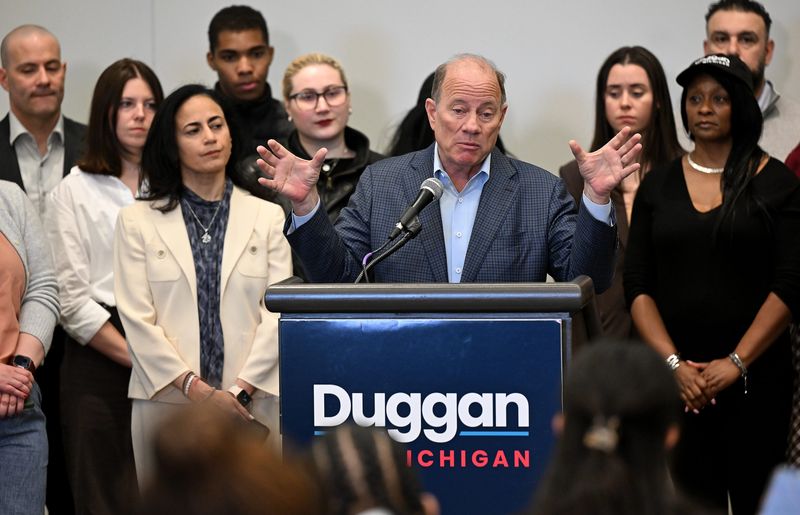
Mike Duggan’s independent campaign to be Michigan’s next governor ran aground Thursday, observers said, because of intensifying focus on national politics and the former mayor’s inability to tap into voters’ changing frustrations.
In the weeks before his decision to end his bid, Duggan’s poll numbers had dropped and his fundraising had taken a hit.

Duggan told his supporters, in a letter, that the mood of the country had also shifted since he launched his campaign on Dec. 4, 2024. Democrats and many Independents had become “unified in anger” as Republican President Donald Trump’s war in Iran dragged on and gas prices rose above $5 a gallon, Duggan said.
“If we were even in the polls and behind in fundraising, we have a path to winning,” Duggan wrote Thursday. “If we were behind in the polls and even in fundraising, we have a path. But we’re behind in both.
“It’s just not right to ask our volunteers, faith leaders, unions, elected officials and donors to continue in a campaign that, in my heart, I no longer feel good about our chances to win.”
A source close to Duggan who requested to speak on the condition of anonymity because of the sensitive nature of the conversations he had with the ex-mayor said Trump had shown no signs of relenting on the war and the 2026 Michigan election had essentially become a nationalized one. In that environment, there was no path for an independent who was attempting to take on the two-party system that defines the national political scene, the source said.
Duggan wanted to talk about topics like education on the campaign trail, but all he’s been hearing about lately has been Iran and gas prices, the source said.
When the former mayor announced he was leaving the Democratic Party to run as an independent, Duggan said many people felt like they didn’t belong in either major party.
“The current system forces people to choose sides and not find solutions. I’m going to see if I can change that,” Duggan said in December 2024.
He made the comments a month after a presidential election in which some voters voiced frustration with their choices: Trump and Democratic then-Vice President Kamala Harris. Now, much of the political frustration has changed to being focused on policy decisions made in Washington, D.C., where Republicans hold the White House and majorities in both chambers of Congress.
“He’s kinda fighting the last war a little bit,” said Adrian Hemond, a Michigan political consultant, of Duggan Thursday.
At a press conference, Duggan told reporters he was seeing anger among voters over what’s happening in Washington, D.C., and was increasingly hearing from people who worried that he was splitting Democratic voters and helping Republicans.
“It’s surging for Democrats nationally,” Duggan said.
Shifting poll numbers
Polling from the Detroit Regional Chamber, which endorsed Duggan’s bid for governor, spotlighted the problems facing his campaign on May 12.
The survey, conducted in late April and early May, asked questions of 600 likely Michigan voters.
In response to one potential three-way matchup, about 34% of voters surveyed said they supported Democrat Jocelyn Benson, the current secretary of state from Detroit, 29% said they backed Republican U.S. Rep. John James of Shelby Township, and 23% said they preferred Duggan. About 14% were undecided.
The margin of error was plus or minus 4 percentage points.
The numbers represented a stark shift from a similar poll from the Detroit Regional Chamber in late January and early February. That survey showed the same three candidates in a dead heat with Duggan at 30%, James at 29% and Benson at 28%.
Amid war in Iran and rising gas prices, the election was increasingly becoming a referendum on Republican President Donald Trump, said pollster Richard Czuba, whose firm, the Glengariff Group, conducted both polls for the Detroit Regional Chamber.
“Those Democrats are now consolidating and voting in one single bloc,” Czuba said of Benson’s strengthening support.
‘Nearly impossible’
Brandon Dillon, former chairman of the Michigan Democratic Party, said Trump sucks up all of the oxygen in the room politically.
“It just makes it nearly impossible for any candidate who’s trying to run up the middle to be successful,” Dillon said of the environment.
Plus, independent candidates have no history of success in modern Michigan political history.
The state has straight-ticket voting that allows people to cast a ballot for all of the candidates from one party with a single swipe and active political party organizations that can bring money and volunteers for their nominees.
Duggan also avoided a populist approach that has benefited some independents in other states. He embraced data centers. He and a nonprofit that funded TV ads supporting him portrayed him as a person who got things done from inside government to improve Detroit and could do the same for the state.
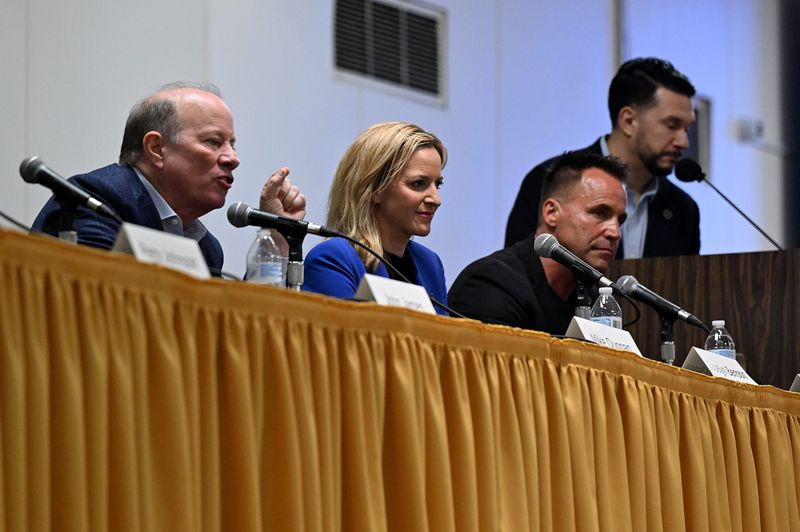
During a forum hosted by the United Auto Workers on Monday, Duggan told the crowd, “I am going to build a bridge across business and labor and represent everybody.”
That remark was in response to a question about accepting corporate political money. The crowd in the UAW hall where the forum took place didn’t applaud as loudly for Duggan as they did for Benson and Democratic candidate Chris Swanson, the sheriff in Genesee County.
After the forum, Benson blasted Duggan, saying he wasn’t the independent candidate but the “corporate candidate.”
A ‘seismic shift’ in the race
Multiple political experts said Duggan’s exit from the governor’s race would ultimately benefit Benson, who’s widely expected to beat Swanson in the Aug. 4 primary election.
Without Duggan, the Democratic nominee will likely have a one-on-one matchup in debates this fall with the Republican candidate. The GOP primary field features James, former Attorney General Mike Cox of Livonia, businessman Perry Johnson of Bloomfield Hills and state Senate Minority Leader Aric Nesbitt of Porter Township.
David Dulio, a political science professor at Oakland University, called Duggan’s decision to end his campaign a “seismic shift” in the race.
“I think Jocelyn Benson is the favorite to win this thing,” Dulio said. “Just because of the political headwinds that Republicans are going to be facing this year.”
Jim Runestad, chairman of the Michigan Republican Party, said voters saw through “a lifelong Democrat masquerading as an independent.”
“Now attention turns to Jocelyn Benson, who still hasn’t answered serious ethical questions, while Republicans will nominate a proven leader focused on Michigan families,” Runestad said.
Michigan’s current governor, Democrat Gretchen Whitmer, can’t run again this fall because of term limits. In 2022, she defeated Republican Tudor Dixon by about 10 percentage points, 54%-44%.
In her own statement Thursday, Whitmer touted Duggan’s focus on bringing people together at a time “when so much in our politics is pulling us apart.”
“Democrats have momentum on our side because Michigan voters want leaders to tackle high costs, create jobs, protect our rights and make Michigan the best place to live and raise a family,” Whitmer said. “That’s what Democrats do. I look forward to helping our Democratic nominee earn Duggan’s supporters’ votes and electing a Democratic governor of Michigan in November.”
Jamie Roe, a Republican political consultant in Michigan, said the math was always going to be difficult for Duggan as an independent candidate.
But Roe said it was too early to say which side would benefit from Duggan’s exit.
“You’ve heard conflicting results in the polling,” Roe said. “Some people say he was taking more from the Republicans than he was taking from the Democrats. Obviously, it eases the concerns for the Democrats in (Detroit).
“It’s hard to tell at this point.”
cmauger@detroitnews.com
This article originally appeared on The Detroit News: National upheaval helped bring demise of Mike Duggan’s campaign
Reporting by Craig Mauger, The Detroit News / The Detroit News
USA TODAY Network via Reuters Connect