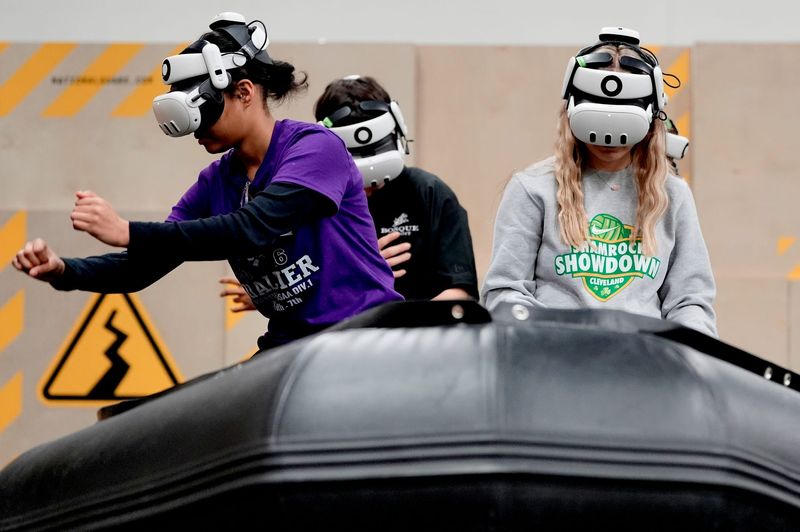
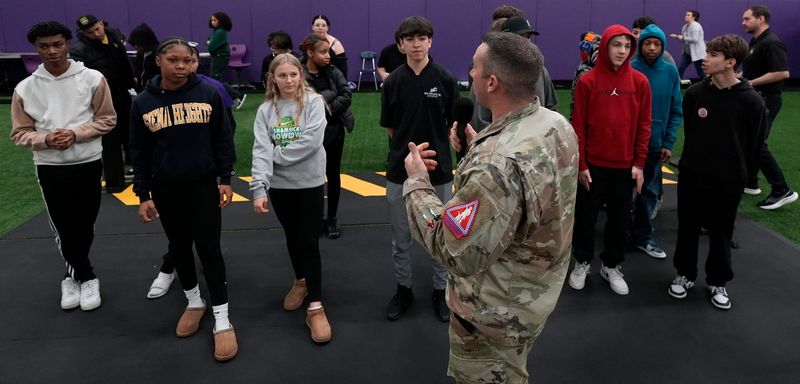
Here, in one of Woodhaven High School’s gymnasiums, it was hard not to watch the teenagers try out some virtual reality technology and see that war, indeed, has a face.
In this instance — on Friday, March 6 — it was a face partly covered by video-game goggles.

Military recruiting events are hardly new, but this one, at the Downriver high school, came amid an expanding Middle East war, the term that President Donald Trump has been using, not one declared by Congress.
The event, dubbed “Disasterville,” was not, however, about warfighting, which the Trump administration has increasingly emphasized. It was aimed, instead, at showcasing, through virtual reality, what else National Guard soldiers might be called to do: saving lives in the face of floods, fires and earthquakes.
“Not a lot of people are raising their hands to serve in the military,” Army National Guard Sgt. 1st Class Brian Cattaneo, a recruiter who was at the school, said. “But a lot of people don’t know what the Michigan Army National Guard is and how we are different from active duty.”
The event’s message was subtle, unlike the pointing Uncle Sam poster, but essentially the same: We want you. More than a dozen men and women — some in their camouflage military uniforms — were on hand to extol the benefits of joining.
Disasterville was one of a series of events making its way across America. The first one was in February in Baltimore, the next, in Washington, DC. From there, it moved to Michigan, visiting schools in Battle Creek and Brownstown Township.
It was planned before Trump ordered the bombing of Iran.
Disasterville’s next stops are in Indianapolis and Omaha, Nebraska. The National Guard said it is still working out exactly where events will be held next, but they probably will be headed west.
Ironically, on Thursday, when the event at Woodhaven High was first scheduled to take place, the school faced its own disaster: A power transformer across the street burst into flames, causing the lights to go out and classes to be canceled.
By Friday, the power — and virtual reality demonstrations — were back on.
What Michigan students experienced inside the VR simulations
In Disasterville, students wore customized Meta Quest goggles and worked in small groups to rescue people in emergencies. It was part game, part simulation, and the less-than-10-minute experiences felt remarkably real.
“It was fun,” Payton Koski, 15, said, after paddling an inflatable Zodiac boat with a handful of her classmates through a terrible flood, trying to rescue rubber ducks representing people who were stranded in the rising water.
The Zodiac crew didn’t go anywhere; but with the goggles, it felt as if they had.
Koski said she had experienced virtual reality before, but never in a scenario to “save people like that.” She also said she hadn’t given too much thought about a career, but engineering seemed promising.
And that’s what the National Guard wants: To connect career aspirations to military service.
In 2020, when the Edenville and Sanford dams broke near Midland, causing widespread flooding, Michigan Gov. Gretchen Whitmer mobilized the Michigan National Guard to help. Soldiers evacuated residents, assisted with traffic control and supported local law enforcement.
The U.S. Army Corps of Engineers also helped with repairs.
Two other simulations showed students what it would be like to fight a wildfire, like the ones Up North in 2022 that burned thousands of acres of forests; and to rescue people in an earthquake, when a bridge collapses.
Many 17- and 18-year-olds think the National Guard presents one — maybe two — career fields in which they envision carrying a rifle or piloting a plane, said Michael Kroll, a Michigan Department of Military and Veteran Affairs spokesman.
People don’t realize, he added, the military can offer other career opportunities.
Pentagon shift toward ‘lethality’ forms the backdrop
Part of the National Guard’s pitch to students was that military service offers benefits that can help students pay for college and offer technical and leadership training that can lead to successful careers.
But while National Guard recruiters are trying to broaden the understanding of what the military can offer, the Secretary of War Pete Hegseth has been attempting to narrow the military’s focus to warfighting.
From the start of his time as secretary, Hegseth — whose position was known as Secretary of Defense until last year — has emphasized the word lethality, the ability to cause damage. He said he intended to bring the “warfighting ethos” back to the Pentagon.
In his words: “Lethality, lethality, lethality; everything else is gone.”
Hegseth, who served in the Minnesota National Guard, was commissioned as an officer in 2003, after graduating from Princeton University, and deployed during conflicts, to both Iraq and Afghanistan.
After the United States launched air strikes on Iran, Hegseth said: “If you kill Americans, if you threaten Americans anywhere on Earth, we will hunt you down without apology and without hesitation, and we will kill you.”
At a more recent news conference, he said, seeming to address American casualties: “When a few drones get through or tragic things happen, it’s front-page news. I get it, the press only wants to make the president look bad — but try for once to report the reality.”
Part of that reality, though, is that seven American soldiers are dead.
The youngest of them identified so far, was Sgt. Declan Coady of West Des Moines, Iowa. At 20, he was only a few years older than some of the kids at the Woodhaven High recruiting event.
He was an Eagle Scout. And, his sister Keira Coady said, he was a gamer.
After the air strikes started on Feb. 28, his sister said he texted home to say he was safe. Then, the messages stopped. By 8 p.m., March 1, someone was at their door to deliver news no family ever wants to hear.
Declan Coady, his sister added, was more than another person who “died in combat.” He was, she wanted others to know, “smart and kind” and “the most amazing brother and son my family could have asked for.”
Saturday, his body arrived at Dover Air Force Based in Delaware.
More American casualties may be coming.
How students see the Guard — and life after high school
By focusing on disasters, instead of combat, the National Guard could avoid conversations in schools about guns and the serious consequences of war, such as loss of life.
In addition to dead American soldiers, Iranian health officials said the American air strikes hit the Shajarah Tayyebeh elementary school, killing some 175 people, many of them children. U.S. officials said they are investigating the origins of the blast and Trump, when asked, said in his opinion “that was done by Iran.”
The National Guard explained how its soldiers are different from those on active duty in the Army or the Army Reserves. The National Guard’s origins go back to militias established by the American colonies, and it is commanded by a state’s governor and the president.
The advantage of joining the National Guard, the military officials said, is that it tends to offer more time to pursue college and careers, and Guard soldiers generally stay closer to home and are less likely to be deployed into combat.
Trump, however, has not ruled out sending more troops to the Mideast.
On Friday, though, no one seemed to want to talk about war.
Perhaps, the ongoing air strikes in Iran were too new, too political, too real. And, perhaps, the students — and even some of the younger recruiters and school’s younger staff — had too limited a frame of reference for that.
American’s most recent war, the Global War on Terrorism, began in 2001.
Still, a variety of students at the recruiting event told the Free Press that the virtual reality simulations were cool, even if they didn’t do much to persuade them to join the National Guard — or the military.
Students said they liked the idea of helping others. One 16-year-old said his father wouldn’t want him to join. And another, also 16, said he feared a military draft was coming.
And while no one has been drafted in more than 50 years, the concern that there may be a draft has been raised by a few news outlets, including KTTV-TV, a Fox News station in Los Angeles.
Whether students were interested in voluntarily serving or not, the high school’s principal said his aim was to offer them a memorable experience that would stay with them and might even urge them to contemplate life after high school.
“If you think back on high school, the things you remember are the fun activities,” Principal Jay Vesperman told the Free Press. “I’m a former math teacher and nothing against the math lessons, but sometimes those aren’t the things you reflect on when you are older.”
Contact Frank Witsil: 313-222-5022 or fwitsil@freepress.com
This article originally appeared on Detroit Free Press: National Guard uses virtual reality to recruit Michigan high schoolers
Reporting by Frank Witsil, Detroit Free Press / Detroit Free Press
USA TODAY Network via Reuters Connect