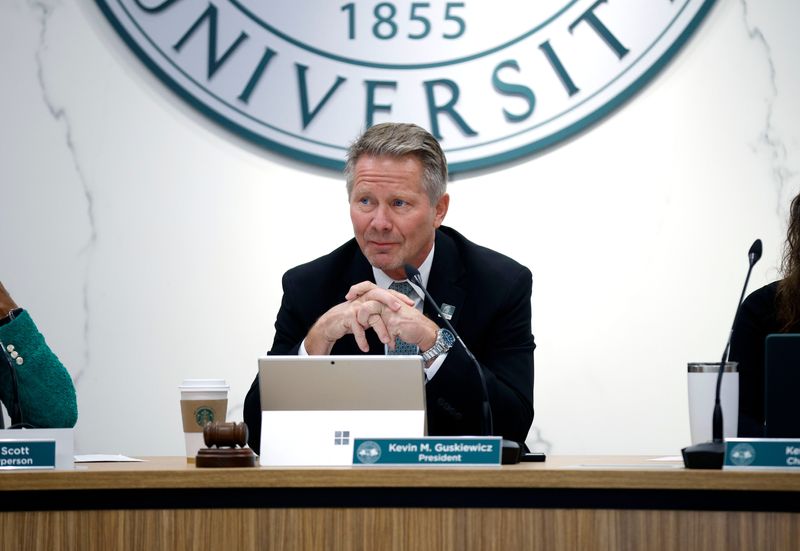
If the relationship between the Michigan State University Board of Trustees and the university’s presidents doesn’t change, MSU will continue being plagued by high presidential turnover after Kevin Guskiewicz’s departure on Wednesday, experts told The Detroit News.
Guskiewicz was the sixth president in six years at Michigan State when he started in March 2024 and just the second permanent president since Lou Anna Simon resigned in the wake of the sentencing of serial sexual abuser Larry Nassar in 2018. The Michigan State board will now be searching for its seventh leader in eight years after Guskiewicz on Wednesday was named the president of Clemson University.

Even a $2 million annual salary couldn’t convince Guskiewicz to remain at the university after a little over two years amid his increasing frustrations and disagreements with the board. He agreed to a $1.216 million base annual salary at Clemson, although there are incentives built into his five-year contract.
This said something about the board’s governance that it couldn’t ignore, said Demetri Morgan, a professor of higher education institutions at the University of Michigan.
But there might not be a simple fix for MSU’s issues, and individual trustees might not be to blame, the experts said. Instead, the issue might lie with the development that universities are increasingly complex institutions that are dealing with outside and internal pressures that cannot be solved overnight, Morgan said.
Guskiewicz said in a goodbye message to the campus that the university’s ability to make “meaningful progress” was hampered by certain trustees, whom he didn’t name, opposing what the majority of the board and his administration wanted for the university. But a 5-3 majority on the board voted in a special May 17 meeting to approve the salary hike as well as a revised code of ethics and conduct aimed at creating unity.
Instead, the board should take time before initiating another presidential search that will likely cost hundreds of thousands of dollars, the experts said. The chance to reevaluate what the university needs and how the board can work together going forward is critical to avoid another short-lived presidency that catches the university by surprise, said Nick Down, the associate director of external affairs at the American Council of Trustees and Alumni.
“I really do think this is a great time for the board to take stock and critically think about what they want going forward,” Down said.
Faculty Senate Chair John Aerni-Flessner told The Detroit News he also believed the latest departure would allow the board to take a step back and figure out how it could better serve the institution going forward, and find a president who would stick around.
“We need to focus on who can be a custodian for the long term for MSU,” Aerni-Flessner said. “If that means we hire a boring dean from the Midwest, who doesn’t want to be a global thought leader and just wants to run an institution, I think people would welcome that. … We should be looking for someone who cares about the institution and the mission and is willing to provide long-term stability.”
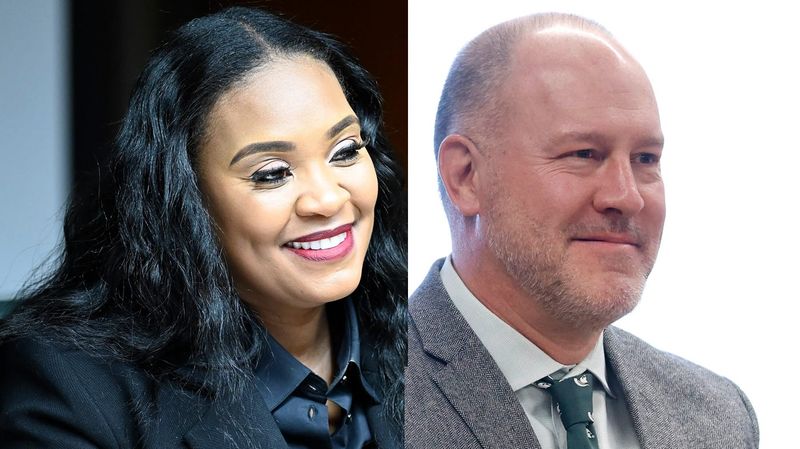
MSU board Chair Brianna Scott, D-Muskegon, when approached by The Detroit News on Mackinac Island, did not immediately have time Wednesday to take questions. Instead, she issued a statement.
“We greatly value these past two-plus years under President Guskiewicz. His leadership has set the university on a positive trajectory and one that we can continue during this transition,” Scott said. “Michigan State University has demonstrated resilience throughout its history, and the institution’s strength has never depended on any one individual. The university’s mission, talent and momentum continue just as they have for nearly 175 years.”
The board president said the board will soon provide information on its transition plan as it looks “forward to aligning our shared visions over a productive summer in anticipation of a busy and prosperous academic year.”
Guskiewicz, who was the chancellor at the University of North Carolina-Chapel Hill before coming to MSU, joins a pattern of high-profile Michigan university presidents who have resigned or been fired less than two and a half years into their tenure.
He is the third president of a major Michigan research university to depart their university in the last year and the fifth since 2022. He follows the resignation of Wayne State University President Kimberly Andrews Espy in September and the University of Michigan President Santa Ono in May 2025.
The rift between the trustees and Guskiewicz was clear, said Víctor Rodríguez-Pereira, a Spanish professor and president of Local 1855, which represents non-tenured teaching faculty and MSU Extension workers. The staff hoped the tensions would be resolved without such a major departure, he said.
“I don’t think any of us expected this to happen or for it to happen so quickly,” Rodríguez-Pereira said Wednesday. “A lot of us were hoping that we would continue to have a certain sense of stability for a longer period of time.”
But MSU has been involved in presidential controversies before.
In 1990, MSU President John DiBiaggio fought with the board when it decided, over his objections, to make football coach George Perles the athletic director as well. While Perles was eventually forced to resign as football coach to maintain his athletic director’s title, DiBiaggio left in 1992 for private Tufts University.
Special meeting provided ‘flare gun’ for next MSU president, expert says
Guskiewicz was “surprisingly forthright” in his goodbye message to the campus community Wednesday morning, Morgan said.
In the message, Guskiewicz said his decision to leave was directly tied to the behavior of certain trustees, whom he did not name. He said the university’s ability to make “meaningful progress” was hampered by certain trustees opposing what the board’s majority and his administration wanted for the university.
The resolution calls for a “duty of loyalty” and asked the trustees to raise concerns before the board takes action and protect the integrity of the board’s “deliberations and processes.” After the board votes, trustees will not “undermine” and will support the majority decision of the board even if they disagree.
Trustees Rema Vassar, D-Detroit; Dennis Denno, D-East Lansing; and Mike Balow, R-Plymouth, had opposed the revised code. Balow and Vassar did not sign the pledge of loyalty as part of the new code, and their credentials to the Detroit Regional Chamber’s Mackinac Policy Conference were revoked.
“Michigan’s popularly voted elected constitutional officers do not surrender their First Amendment rights as a condition of service,” Vassar said at the May 17 special online meeting. “A prior restraint on the political speech of elected trustees on matters of direct concern is constitutionally suspect on its face and it demands independent review.”
“That was a flare gun for the next person to take the job,” Morgan said. “It tells them that they better get (the relationship with the board) figured out before you step into this space.”
Judith Wilde, a research professor at the Schar School of Policy and Government at George Mason University in Fairfax, Virginia, and an expert in university presidencies, said the fact that Guskiewicz “left so much on the table” regarding a potential payout also reflected how badly he wanted to leave.
Boards and presidencies navigating uncharted waters make it hard to find common ground and handle difficulties, Wilde said. One of the biggest sticking points between Guskiewicz and some board members included some of his initiatives that weren’t common in higher education, such as the nonprofit athletics fundraising arm, Spartan Ventures, that he developed alongside MSU Athletic Director and longtime colleague J Batt.
These new initiatives raised concerns among several trustees, including Balow, who argued it was their fiduciary duty to oversee the university’s financials. Wilde said that in these situations, where there’s no clear playbook to follow, boards and presidents need to increase transparency and communication.
“It takes sitting down and taking the time to talk about issues in more depth,” she said. “It can be difficult to define boundaries between the president and the board. A lot of the issues they’ve had have been in areas that are uncharted, where there needs to be more discussion and work done.”
What can be done to fix Michigan State’s leadership woes
Wilde said Michigan State may get a long-term president again. The job is still lucrative and isn’t significantly different from other university presidencies.
Morgan said the board might have been trying to signal to other institutions with sitting presidents interested in the job that they would be willing to work with them by raising Guskiewicz’s salary and implementing the revised code of conduct.
“The board’s rush was to see if (Guskiewicz) could stay, and also to signal to others in the presidential job market that they are willing to work with them on fair compensation and willing to work on improving board governance,” Morgan said. “Two million dollars is now in the conversation for the president’s salary. They’ve shown they need you more than you need them.”
Morgan, who’s been following the MSU board infighting the results of a 2023-2024 investigation into a couple of trustees was released, said he believed the board was genuinely trying to improve, if not in the most effective way. Vassar and Denno were disciplined in 2024 by the board and their removal was sought, but Gov. Gretchen Whitmer declined to do so after a year of study.
“The No. 1 job of a board is to appoint, recruit, retain a president,” Morgan said. “When the board is inhibited from doing that, it should move the trustees into a conversation to try to make change. … The problem is that this is reactive change, not proactive change that puts the trustees in the position to work together.”
For the board to make real, lasting change, the trustees cannot be defensive when told their actions aren’t working and must be willing to hear concerns, Down said. He suggested the board hold townhalls or sessions where members of the public could speak openly with the trustees.
“As elected officials, they need to answer to the taxpayers and the community,” Down said. “There needs to be a fix. … There needs to be some sort of leadership that should be held accountable for what happened here.”
satwood@detroitnews.com
Staff Writers Carol Thompson and Beth LeBlanc contributed.
This article originally appeared on The Detroit News: MSU needs changes by board, president to create stability, experts say
Reporting by Sarah Atwood, The Detroit News / The Detroit News
USA TODAY Network via Reuters Connect