Washington — A prominent pro-Israel political group is responsible for a significant share of the donor base for Haley Stevens’ Democratic U.S. Senate bid, despite not showing up by name in public disclosures, a Detroit News analysis of campaign finance records shows.
The American Israel Public Affairs Committee, or AIPAC, previously spent openly and bundled donations for Stevens during her successful U.S. House campaigns. That included more than $5 million between campaign donations and independent expenditures by an affiliated group in 2022, the last time Stevens faced a competitive primary.

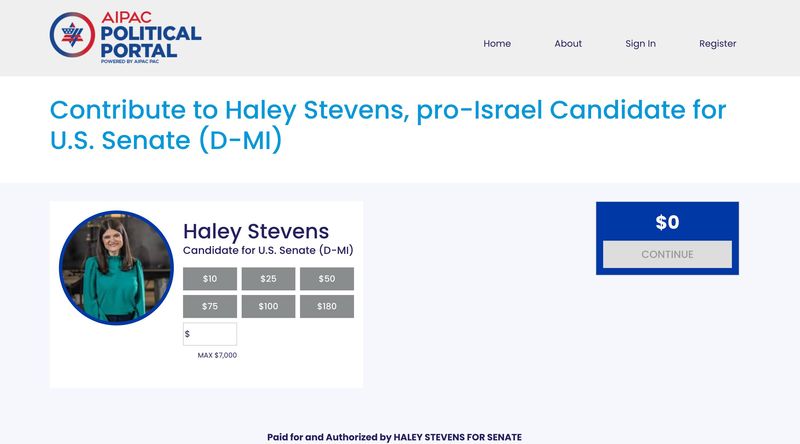
That number — officially — is $0 so far in Stevens’ bruising three-way Senate primary against state Sen. Mallory McMorrow of Royal Oak and former public health official Abdul El-Sayed of Ann Arbor, but not because AIPAC has wavered in its support for the reliably pro-Israel congresswoman.
The group has instead found less detectable ways to back Stevens at a time when support for Israel and AIPAC’s role as a powerful campaign bankroller are among the most divisive issues in both Michigan and national Democratic politics. AIPAC’s brand among Democrats has suffered as progressives have slammed the group over its support for Israel’s military campaign in Gaza against Hamas and for right-wing Israeli Prime Minister Benjamin Netanyahu.
AIPAC has influenced the Michigan U.S. Senate race in recent months by launching fundraising appeals that direct donors to support Stevens’ bid in a way that avoids linking the contributions to the group by name. The practice is legal and permitted under campaign finance laws.
The exact dollar amount flowing to Stevens of Birmingham from such appeals is not publicly available, but clues from campaign filings point to support from AIPAC’s donor base.
For one, about 31% of donors (1,172 of 3,728) who gave at least $200 to Stevens’ Senate campaign also donated to AIPAC since the start of 2025, according to disclosures through March 31. That is well above her current primary opponents and her own benchmarks from prior U.S. House bids, though the numbers could shift as this year’s primary and general elections draw closer.
Her campaign has also seen a recent uptick in fees paid to Democracy Engine LLC, a donation-processing platform used by AIPAC. Those payments suggest a rise in donations from individuals who use Stevens-approved AIPAC fundraising websites.
Stevens has not disavowed the support from AIPAC, but she has avoided discussing the group directly while looking to stave off challenges from McMorrow and El-Sayed, who have both built sizable donor bases of their own.
In a Wednesday interview, the four-term lawmaker said she is not trying to distance herself from AIPAC or worried about the pro-Israel group’s impact on her candidacy in the Democratic primary.
“I’m not hiding anything from voters,” Stevens told The Detroit News at the Mackinac Policy Conference. “I’m not breaking FEC laws by any stretch of the means. In fact, I’m compliant with FEC laws with what’s gone on here.”
The topic of Stevens’ alliance with AIPAC could come up again on Thursday during a scheduled Democratic primary debate at the Detroit Regional Chamber’s annual policy conference on Mackinac Island.
“Haley is squarely focused on the unique needs of Michiganders and Michigan’s economy: creating good-paying manufacturing jobs, stopping Donald Trump’s abuses of power, and taking on his reckless tariffs that are causing prices to rise and hurting Michigan’s auto industry,” campaign spokesperson Arik Wolk said in response to a detailed list of questions about Stevens’ fundraising.
“Our regularly filed campaign finance disclosures detail all of the required information, so the public has full transparency into who supports our campaign,” Wolk added.
Donors’ individual attributes, such as name, address and occupation, are still listed in Stevens’ public quarterly filings to the Federal Elections Commission. Also, it is ultimately up to political groups like AIPAC — not the campaigns — to choose which mechanism they use to raise money for the candidates they support.
AIPAC did not respond to questions about its support for Stevens.
Stevens is in a conundrum, a political strategist says
Democratic U.S. Sen. Elissa Slotkin of Holly, when asked about AIPAC’s method of fundraising for Stevens, said politics is “a cynical business.”
“There are all kinds of groups spending money in this race. There will be even more once we get to the general election,” Slotkin said in a phone interview. “But AIPAC is hardly the only group spending money in this race, and spending it through — I don’t know what to call it — through different means.”
Slotkin, the only Jewish member of Michigan’s congressional delegation, has said she stopped accepting money from AIPAC and affiliated groups over their support for candidates involved in inciting the Jan. 6, 2021, riots at the U.S. Capitol.
The senator continued: “I understand that (AIPAC) has become a flash point. But they have a right, like all these other groups, to get involved in these races. We’ve seen plenty of money in my race back in 2024, the governor’s race.
“There’s unfortunately way too much money in politics, and this is why we need campaign finance reform.”
Stevens doesn’t want to talk about getting support from AIPAC because it’s become “very toxic” in Democratic primaries in other states, said Democratic strategist Chris DeWitt, who isn’t involved in the Senate primary contest.
“Stevens is in a bit of a conundrum. She doesn’t have fundraising grassroots support, so she needs the money to be able to run her campaign. And AIPAC is a problem, but it’s the only source of money she has. In the end, it’s damned if you do, damned if you don’t,” DeWitt said.
How pro-Israel group uses ‘loophole’ to obscure support for Haley Stevens
In past years, AIPAC has given to Stevens’ campaign directly and through a process called bundling. Both methods came with a clear label of the group’s involvement.
“Bundling campaign contributions enables special interests to curry favor with lawmakers. Special interests often use bundling to gain clout with members of Congress,” said Michael Beckel, a researcher with the campaign finance reform group Issue One. His organization advocates for policies meant to limit the role of money in politics.
“Once upon a time, special interests literally collected bundles of checks. Nowadays, bundlers typically receive credit for the electronic contributions they steer to a candidate,” Beckel added.
AIPAC bundled close to $700,000 in individual donations to Stevens in 2022, when she faced off against then-U.S. Rep. Andy Levin of Bloomfield Township in a House primary pitting two incumbents against each other. The pro-Israel group bundled about $55,000 for Stevens two years later when she coasted to easy primary and general election wins.
The last time AIPAC made a bundled donation to Stevens was in the first quarter of 2025, when it sent $334,000 to her House campaign committee. She launched her Senate bid shortly thereafter.
Since then, AIPAC has eschewed bundling and direct contributions to Stevens, instead employing a method that does not require its name to be attached to the cash.
The group is openly pushing for its backers to support Stevens as a “pro-Israel” candidate for U.S. Senate, hosting a fundraising page for her on its website that’s paid for and authorized by Stevens’ campaign. The donations are processed by Democracy Engine, a third-party vendor, which transmits money on behalf of AIPAC, according to the page.
The donations do not have to be bundled because Democracy Engine merely acts as a pass-through that never deposits the cash in its own account.
“Encouraging contributions via this third-party donation processing platform appears to exploit a loophole in current disclosure rules around bundling,” Beckel said.
The campaign finance watchdog pointed to news reports highlighting past instances in which AIPAC routed donors through Democracy Engine to avoid disclosure requirements. He also noted a 2022 advisory opinion from the Federal Election Commission that allows the payment processor to provide real-time data to political action committees on who is contributing and how much.
Donations made via the processor, however, are not specifically labeled as such on public disclosures. AIPAC did not respond to a Detroit News request for internal data on how much money it has raised for Stevens via Democracy Engine-powered websites.
The only public footprint by Democracy Engine on Stevens’ campaign finance reports is roughly $135,000 in processing fees paid to the organization since the launch of her Senate bid. Given the group’s stated fee structure of 3.75% to 6%, that means Stevens has raised between $2.2 million and $3.6 million of her nearly $9 million in Senate fundraising so far via the platform.
An unknown share of that money could come from groups other than AIPAC because groups like Give Green, Women Count and the National Retail Federation PAC also use Democracy Engine. (The payment processor’s website omits AIPAC from its list of partners.)
All three other major candidates in the Michigan Senate race, including Republican former U.S. Rep. Mike Rogers of White Lake Township, have also used Democracy Engine so far in the 2026 election cycle, albeit far less than Stevens has.
Rogers has paid about $6,000 in fees to the group. His top processor has overwhelmingly been WinRed, a widely used platform for GOP candidates. He has spent $127,000 in fees for that platform.
McMorrow and El-Sayed have spent about $6,000 combined in fees to Democracy Engine. The vast majority of their processing fees have gone to ActBlue, the typical platform for Democratic candidates. They have also relied somewhat on alternative payment processors like Numero, a platform that supports progressive candidates.
Stevens uses ActBlue as the donor processor on her official website, but her campaign had paid more in processing fees to Democracy Engine as of March 31 than any other platform. The fee breakdown suggests that outside groups like AIPAC have played a larger role in facilitating her fundraising than they have for other candidates in the race.
Smart for Stevens to stay quiet on AIPAC?
Israel isn’t a top issue for most Democratic primary voters, according to recent statewide polling in Michigan, so it makes “perfect sense” why the Stevens campaign wouldn’t want to do interviews on it or why AIPAC would not want to be as public about bundling for her, said Adrian Hemond, a Democrat and CEO of the firm Grassroots Midwest.
“Basically, there is never any upside for a candidate to talk about where you raise your money. Voters hate that part of politics,” he added.
Hemond also noted that bundling by large interest groups is on the decline, in part because it’s more efficient to do so in other ways.
“Why go through the hassle of having to file with the FEC when you can just set up a website, get commitments from people and then they just go make a direct donation with a credit card?” Hemond said.
DeWitt, the other Democratic strategist, disagreed with Hemond that the candidates’ positions on Israel won’t sway primary voters in August.
“I think it’s going to get out there that Haley Stevens is bought and paid for by AIPAC, and Dem primary voters aren’t going to like that,” he said. “I don’t think voters in general like candidates who are financed by one particular special interest group.”
AIPAC’s critics have long complained that the group, which is partly funded by Republican donors, is meddling in Democratic primary contests. AIPAC has maintained that its mission in those contests is to build robust support within the Democratic Party for the U.S.-Israel relationship ― a historically bipartisan priority.
The group has become known for obscuring its activities through the use of shell political action committees to participate in primaries where many voters might be opposed to the group’s brand.
Craig Holman, an ethics and campaign finance advocate for the money-in-politics watchdog group Public Citizen, said AIPAC is “using a multitude of vehicles to cover up the source of their funding and their influence in American politics.”
“They’ve not only found this Democracy Engine vehicle,” he said. “But they’ve also found laundering all kinds of money through other nonprofits under the guise of educational forums, and they hire social media voices to basically repeat Netanyahu propaganda.”
AIPAC’s brand has been damaged further in the eyes of some Democrats, as the group has supported “MAGA” Republican candidates in primary challenges against GOP incumbents like Kentucky U.S. Rep. Thomas Massie, who had stood up to President Donald Trump on Israel, the release of the Epstein files and other key issues.
Massie lost his primary last week and called out AIPAC’s support for his opponent during a concession speech, the Louisville Courier-Journal reported.
AIPAC also recently sent out an email asking donors to support both Stevens and Maine Sen. Susan Collins, a Republican up for reelection in a state that Democrats are targeting as they look to regain the Senate majority. The appeal to “stop anti-Israel candidates” labeled the views of El-Sayed and Democratic Maine Senate hopeful Graham Platner as a “direct threat to the U.S.–Israel relationship.”
“A contribution right now to defend Haley Stevens and Susan Collins will send a clear message that we will not let extremists rewrite the future of this relationship,” the email says.
The Stevens-Collins juxtaposition set off a firestorm among Democrats because it appeared to be a joint fundraising effort across party lines. Stevens’ campaign insisted that she did not authorize the effort, was unaware of it and does not support Collins.
DeWitt called out the episode as an indicator of Stevens’ troubles around the pro-Israel group. “The Stevens folks had AIPAC pull that down because they knew how much of a problem that would be,” he said. “Dems aren’t going to go for that.”
Opponents call out AIPAC reliance
El-Sayed regularly hits Stevens for her AIPAC support. He has bashed AIPAC as a “cancer” on the Democratic Party and claimed the group and its “MAGA-funded” super PAC are dedicated to sending taxpayer dollars abroad to “drop bombs on other people’s kids” and hospitals, “while communities here at home watch their schools and hospitals fail.”
He posted on social media this spring: “Proud to be one of AIPAC’s biggest targets in 2026. Because our politics should be about America and our needs, not the interests of a genocidal foreign government.”
Israel has argued in court that it is fighting a legitimate war of self-defense against Hamas and that opponents routinely take Israel officials’ comments out of context to make the assertion. Supporters also have noted that Israel is the only democracy in the Middle East.
El-Sayed has also criticized McMorrow for privately drafting an “AIPAC position” paper last year that one pro-Israel donor deemed “outstanding.” McMorrow has since claimed that she did not intend to seek AIPAC‘s support or endorsement.
“But I believe in meeting with everybody, because we have been able to have these difficult conversations and bring together what is a shared goal of a permanent ceasefire of the violence, ending of the killing,” she said at an October forum.
At public forums, El-Sayed and McMorrow often point out that they’ve never accepted money from AIPAC, which has supported Netanyahu’s government and the war in Iran.
Both did so, for example, when the issue came up in late April at a forum hosted by the Council of Baptist Pastors of Detroit and Vicinity, where Stevens was given the opportunity to reply to the criticism and deflected.
She did highlight her votes in Congress to rein in the U.S. military campaign alongside Israel in Iran and slammed those “going along with Donald Trump’s war.”
“That is wrong, and these Michiganders are paying for it. It is unacceptable,” Stevens said.
AIPAC previously spent big for Stevens when she faced Levin in a Democratic primary in 2022. “I had no answer for that,” he said of the spending blitz in a recent phone interview.
Levin, who is Jewish, had voted for security assistance to Israel and did not support the movement to boycott, divest and impose sanctions on Israel. He did support a two-state solution and had criticized Israel for settlement building and human rights abuses against Palestinians.
In his statement conceding the race, Levin said he was the target of a “largely Republican-funded campaign set on defeating the movement I represent, no matter where I ran.”
Other Jewish groups weigh in on Senate race
AIPAC is not the only Jewish or pro-Israel group that has waded into the Michigan Senate race. J Street, which describes itself as a “pro-Israel, pro-peace” organization and made headlines this spring when it opposed continued U.S. military aid to Israel, endorsed McMorrow in March.
The group has bundled $48,000 for her campaign and plans to hold a fundraiser for her on June 29.
In 2022, the J Street Action Fund aired an ad criticizing Stevens for taking donations from AIPAC. The ad made no mention of Israel but showed footage of the Jan. 6, 2021, Capitol attack and noted that AIPAC supported over 100 Republicans who voted to overturn the results of the 2020 presidential election.
The Jewish Democratic Council of America, a national group representing Jewish voters supporting Democrats, announced last week that it was endorsing both Stevens and McMorrow.
“Democrats have to ensure that this seat remains blue, and we have two objectives in this race: one is to make sure that the strongest Democrat emerges from this primary to beat Mike Rogers in November, and the second is to make sure that that person is not Abdul El-Sayed,” said Halie Soifer, the group’s CEO and a Michigan native.
She called out El-Sayed for “equivocating” after the March attack on Temple Israel in West Bloomfield Township instead of “unequivocally” condemning it as an act of violent antisemitism.
“Nothing justifies the heinous attack that we saw on Temple Israel,” El-Sayed said in the wake of the attack. “I also think it’s just critical for us to understand that hurt people do hurt people, and the circumstances happening 6,000 miles away can affect the lives that we live here, and if we stand against violence, we’ve got to stand against violence, all violence.”
Soifer distinguished the Jewish Democratic Council of America from AIPAC by noting that the council only supports Democrats and, while pro-Israel, is broadly concerned with the interests of Jewish Americans. She also said her group would label all of its spending in support of particular candidates, unlike AIPAC.
The Democratic booster also pointed to a new poll from her group showing that majorities of Jewish voters are concerned about Israel’s conduct in Gaza, have an emotional attachment to Israel and disapprove of Netanyahu.
“We as a community are grappling with a very complex moment,” she said.
Soifer demurred when asked if she was concerned that a dual Stevens-McMorrow endorsement could split the pro-Israel or Jewish vote in the August primary and clear an easier path to victory for El-Sayed.
“I certainly hope that that’s not the case.”
gschwab@detroitnews.com
mburke@detroitnews.com
Correction: This story has been updated for the proper spelling of the Jewish Democratic Council of America’s CEO.
This article originally appeared on The Detroit News: Pro-Israel PAC uses ‘loophole’ to quietly fund Stevens in Dem primary
Reporting by Grant Schwab and Melissa Nann Burke, The Detroit News / The Detroit News
USA TODAY Network via Reuters Connect