More than 10,000 Michigan residents have been diagnosed with the parasitic infection cyclosporiasis, according to the latest daily update from Michigan’s Department of Health and Human Services.
There have been 10,077 reported cases of cyclosporiasis reported in Michigan — and in 70 of 83 counties — as of Wednesday morning, July 29, the MDHHS Infectious Disease Outbreaks webpage shows. Officials counted 9,680 cases on Tuesday, July 28.

Wayne County recorded 1,036 cases, which was the highest number in the state. Washtenaw County had the second highest number at 773 cases, according to the latest available data for the cases per county.
Other high concentrations of with cases were reported in Calhoun, Clinton, Eaton, Genesee, Ingham, Ionia, Jackson, Lenawee, Livingston, Kalamazoo, Macomb, Monroe, Muskegon, Oakland and Shiawassee counties.
The cases per county in Michigan will be updated again on Thursday, July 30.
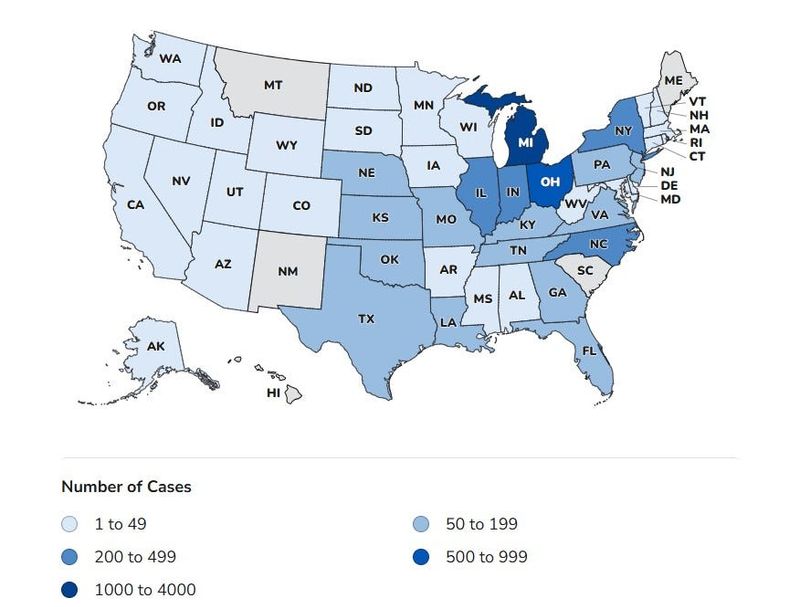
Cases of cyclosporiasis have now reached 45 states. There have been 6,707 laboratory-confirmed cases of the illness since May 1, the Centers for Disease Control and Prevention said in its weekly update on Tuesday, July 28, a more than 2,500-case increase since its last report on July 21.
More than 11,500 additional cases, primarily in Michigan and Ohio, have not yet been confirmed by laboratories, the CDC said.
There have been 423 hospitalizations and no deaths, the agency said.
“Cyclosporiasis cases may not be limited to these states with known cases,” according to the CDC update. “The true number of people sick with cyclosporiasis was likely higher than the number reported. This is because some people recover without medical care and are not tested for Cyclospora.”
The source for the multistate outbreak remains under investigation by the U.S. Food and Drug Administration and the U.S. Centers for Disease Control and Prevention. Officials previously linked the outbreak to Taylor Farms iceberg lettuce grown in central Mexico. The Taylor Farms iceberg lettuce issued a nationwide voluntary recall on July 17.
Residents can reduce their risk of getting sick by avoiding foods that have been linked to the infection in the past, such as, bagged salad mixes or kits, fresh cilantro, fresh basil, raspberries, snow peas and green onions, according to the MDHHS.
Cyclosporiasis is a foodborne illness caused by a microscopic parasite called cyclospora cayetanensis. The parasite can contaminate fruits and vegetables that come into contact with feces. The illness is most common in tropical and subtropical regions of the world.
The prominent symptom is watery or explosive diarrhea in addition to stomach cramps, loss of appetite, weight loss, nausea, fever or possibly vomiting, per the MDHHS.
To reduce your risk of ingesting the parasite, residents are urged to wash their produce and hands thoroughly before cooking or eating.
Which Michigan counties have reported cases of cyclosporiasis?
To track cyclosporiasis cases in Michigan, MDHHS officials update the case numbers daily Monday through Friday on the department’s Infectious Disease Outbreaks webpage.
As of July 23, (the latest available data) here are the case numbers in Michigan per county/jurisdiction:
How can I reduce the risk of getting sick with cyclosporiasis?
Here are ways to avoid ingesting the parasite, cyclosporiasis, according to MDHHS and the CDC:
What are the health risks to getting cyclosporiasis?
Cyclosporiasis is treatable with antibiotics, and it is not considered a life-threatening illness. Those experiencing symptoms of cyclosporiasis should seek medical attention to manage the symptoms.
The risks of cyclosporiasis include severe dehydration, electrolyte imbalance and the loss of fluid volume in your body, according to the Cleveland Clinic.
Contact Sarah Moore @ smoore@lsj.com
This article originally appeared on Lansing State Journal: More than 10,000 in Michigan sickened. Where cyclosporiasis is worst
Reporting by Sarah Moore and Jenna Prestininzi, USA TODAY NETWORK / Lansing State Journal
USA TODAY Network via Reuters Connect

By Sarah Moore and Jenna Prestininzi, USA TODAY NETWORK | USA TODAY Network