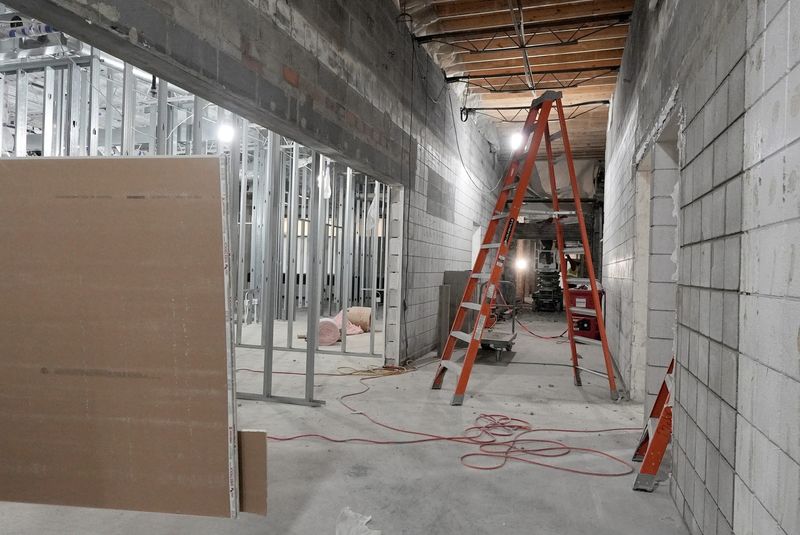
What remains. The walls, charred to black from the smoke. The beams, exposed now because the ceiling was burned beyond repair. The window frames, taped over with heavy plastic, after the glass was shattered to free imperiled children trapped inside.
“Some of these rooms didn’t have an emergency exit,” Rabbi Jen Lader recalls as she walks past the now empty space, shaking her head at the memory, “so the police had to shoot through the windows to get the kids out.”

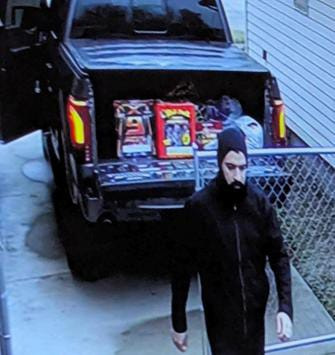
What remains. The damaged hallway where the truck caught fire. The entrance where that truck backed itself up, then plowed ahead, engine revving. The parking lot, where the that truck sat waiting, for two hours, filled with 35 gallons of gasoline, 300 rounds of ammunition, enough fireworks to light it all up and an AK-47 meant to, as the driver wrote in a text to his sister, “kill as many of them as I possibly can.”
What remains. The haunted memories of Jewish children whom the attacker had targeted. The recurrent nightmares of Jewish teachers who bravely fed breakfast cereal to infants while planning to throw their bodies on top of them should the shooter break through. The tortured flashbacks of Jewish staffers who, despite the gunfire, decided to run out once the black smoke descended, because, as Lader says, “they thought it was better to be shot than burn to death.”
What remains. Here, in this scorched and skeletal structure, is the chilling aftermath of a terror attack two months ago at Temple Israel in West Bloomfield, the largest reform synagogue in the U.S.
This place was, until that fateful Thursday afternoon of March 12, 2026, a sprawling hive of faith-based activity, energized education, community involvement and history. A place of smiles and hugs that boasted 12,000 members and hundreds of daily visitors, including people from surrounding areas who needed food.
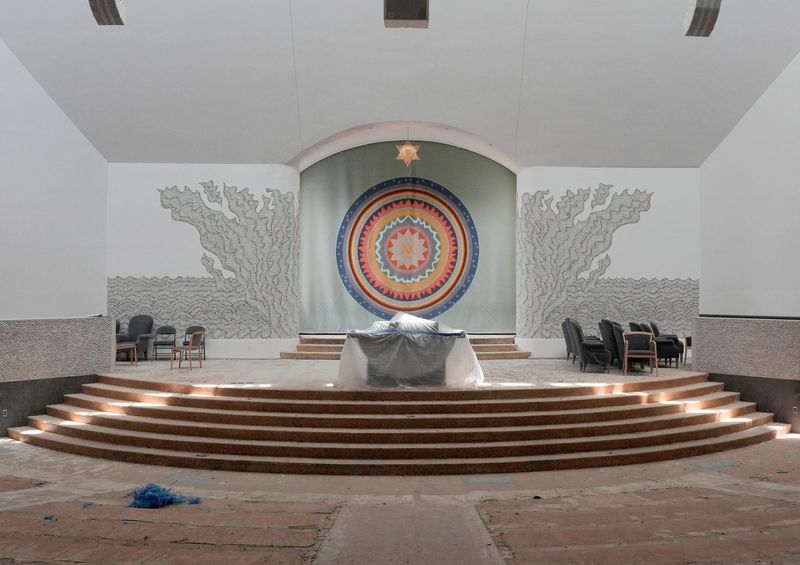
Now, only construction workers pass through the chairless sanctuary, gutted by water damage. They wear yellow vests and hard hats where congregants once wore Sabbath suits and tallit, the Jewish prayer shawls. The parking lot, once packed with visitors, is now blocked by stanchions, cones and a police car that halts any visitors. Balfor, the massive damage restoration company, has a makeshift Command Center in the parking lot, under the banner “National Disaster Team.”
But this was not a national disaster. This was a national tragedy, another horror notch on the antisemitic belt, made worse in the weeks that followed by the frequent indifference and occasional glee from those opposed to Israeli military action in the Middle East.
“The most traumatizing thing for me has been the comments and the vitriol from some of our neighbors,” Lader admits. “[People who] live in this community, who are bemoaning the fact that nobody was killed, and celebrating the fact that we somehow ‘got what was coming to us.’
“This conflation between little Jewish kids in a preschool and a war that’s happening in a country across the ocean has been shocking. And terrifying.”
She repeats the last word, more softly now.
“Terrifying.”
What remains.
Displaced amid fear
What adjusts. Every Friday night candle lighting. Every Saturday morning Torah reading. Every Sunday morning minyan service. Every demonstration of Jewish faith once housed inside Temple Israel’s sprawling 46-year-old building now has been moved to other synagogues in the area, some near, some not so near. The location of Sabbath services, which continue each week, “is something we don’t publish,” Lader says. “Because we’re afraid.”
What adjusts. Every wedding. Every luncheon. Every bar and bat mitzvah celebration. Every invitation that used to carry the synagogue’s address that had to be moved — to country clubs, to community centers, to other temples. No exceptions. No one spared.
During the attack, Rabbi Harold Loss, who’d joined Temple Israel’s clergy more than 50 years ago, was having lunch with his grandson, Miles, to mark Miles’ upcoming bar mitzvah, scheduled for that Saturday.
By evening, they were scurrying for other plans. Their temple was a crime scene. The rabbi’s own grandson, whose planned speech was to begin with something like, “This is the altar where my mother stood and where my grandfather stood,” had to pivot on short notice.
What adjusts. Every artifact. Every souvenir. Every photograph of the synagogue’s confirmation classes, that dated back more than 80 years, destroyed by the fire and smoke.
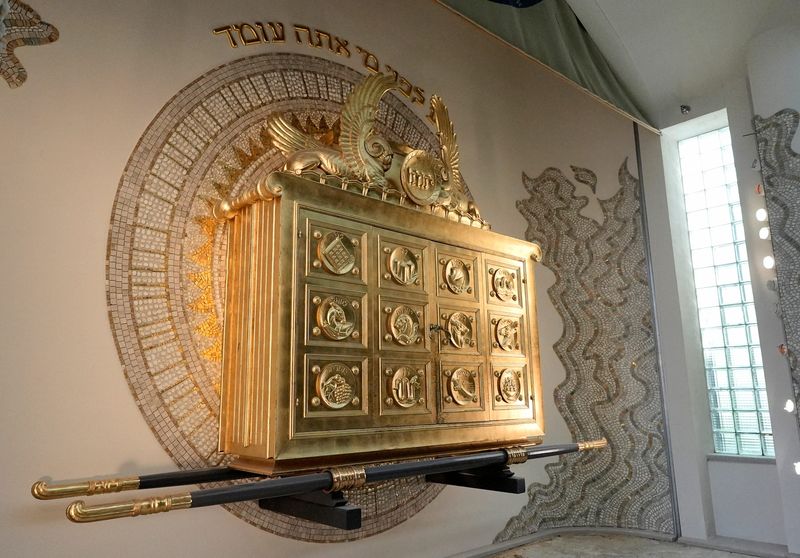
And every Torah scroll — the handwritten Hebrew of the five books of the Old Testament — which by Jewish tradition is the most sacred object in any synagogue. There were 13 of them at Temple Israel, Lader says. They all must be housed elsewhere now. Amongst them is a Torah that had survived the Holocaust in Europe. Today it is being stored in, of all places, the Zekelman Holocaust Center in Farmington Hills.
“The irony of that is so sad,” Lader says. “We kept that Torah in our ark because we don’t want it in a museum. That was the goal of the people who tried to kill us.”
They were trying to kill Jews in the 1930s and ’40s. They are trying again in the 2020s.
Different hate groups. Same hate.
What adjusts.
Seeing hate through children’s eyes
Lader, a Texas transplant who joined Temple Israel’s staff 14 years ago, stops her tour of the vast reconstruction, one that is expected to continue into next year and will cost many millions of dollars. She wants to share a story.
She was on her way to the synagogue that day when she stopped at her house to grab a banana.
“That banana may have saved my life,” she muses.
Had she not stopped, she likely would have been on site when Ayman Mohamad Ghazali, 41, a naturalized U.S. citizen from Lebanon whom the FBI identified as being “inspired by Hezbollah’s militant ideology,” drove his truck through the school entrance just after noon, when he knew the largest amount of people would be inside. Before he did, he made a video foretelling his plan: to kill as many Jews as possible.
Lader, on her way to work, got a text describing an “active shooter” situation. She sped up. Her car was already on Walnut Lake Road when she suddenly spotted countless ambulances and fire trucks. Sirens wailed. Traffic clogged.
She pulled over and ran from the car. She ran toward the danger, not because that made sense, but because, in an emergency, your heart takes you where your heart belongs.
She kept running, with the sirens getting closer, and suddenly she was running beside others, including a fellow rabbi named Josh Bennett, all of them gasping breath, wondering who was shooting, who was being shot, until police stopped them and steered them across the street to the Shenandoah Country Club, the largest Chaldean country club in America.
In the minutes that passed there, it is safe to say Lader and many congregants, especially parents with children in the school, feared the worst, and burst into tears at the sight of the first children being rushed their way.
What they didn’t know was that Ghazali’s truck had wedged in the narrow hallway of the school, which kept him from opening the doors, getting out, and firing his AK-47 as planned. Had he stopped a few feet shy, he could have done that.
On such small distances are lives spared or lost.
Instead, Ghazali, trapped in his vehicle, reportedly set off the fireworks, exchanged gunfire with the temple security forces, and eventually killed himself.
An incredibly brave man named Danny Phillips, hired last year as Temple Israel’s security director, was hit by Ghazali’s vehicle. It shattered Phillips’ leg, yet he somehow managed to crawl to a classroom where babies were being tended and bolted the door shut before collapsing.
Fire from the burning truck sent black plumes down the halls and triggered the smoke detectors. Sprinklers exploded all over the building, soaking the chemicals from the smoke down into the carpets and furniture, Lader says.
Finally, with the attacker neutralized, police began evacuating those inside, including more than 100 children and around 50 staff. These included infants under 12 months old, and schoolkids younger than 5. They were mostly brought across the street to the Shenandoah Country Club.
“We were grabbing kids from the SWAT team and pulling them in the building and we were just so relieved to see them,” Lader recalls. “The kids were so great. So brave. I remember this one little girl, she just turned 5 — I married her parents, I did her baby naming — and she said, when she saw me, “That was such an adventure.’ And I just grabbed her and said, ‘Yes, that absolutely was such an adventure.’
“And then she said, ‘I don’t think I want to do that adventure again.’’’
‘Devastating for us’
What continues. The vitriol. The dogma. The hate that inspired Ghazali. The twisted justifications of antisemitism under the guise of standing up for Palestinians or Gazans.
What continues. The physical attacks. The property terror. In the two months since the Temple Israel event, there have already been synagogue arsons in London and Argentina, the shooting up of three synagogues in Canada, the vandalizing of a Holocaust center in Estonia, even a café in Vietnam boasting a sign “We Don’t Serve Zionists” with the “Z” in the shape of a Nazi swastika. You can’t keep count of the weekly reports of antisemitic actions, assaults, defamations or voluminous social media hate.
What continues. The apathy. The shrugging. The seeming lack of concrete action taken by anybody outside the Jewish community.
“I think people hear a car hit a building and nobody died, and it’s like, ‘What are you complaining about? It’s not that bad,’’’ Lader says. “But the aftermath is devastating for us. It will be for a really long time.
“All these calls the last two years for ‘globalizing the intifada.’ People were so adamant that it wasn’t a call for violence. But it has become very clear that the intifada has been globalized. Every day there’s an attack in Toronto, or in London, or in Detroit, or antisemitic graffiti scrawled all over a Jewish school, or, Nazi stickers stuck to a kid’s locker …
“This isn’t OK. This is a perilous moment for American Jews, and we need our government to keep us safe. We are not safe. People say, ‘Oh, it’s just words, it’s just social media, it’s just free speech.’ But it’s evident that words turn to action pretty quickly, and that we are at the point now where it feels like we are dangling off the edge of the cliff.
“We need people who aren’t Jewish to throw us a rope and pull us back in.”
What continues.
Forging forward, seeking light
And, finally, what survives. The beams. The studs. The walls, charred but repainted. The duct work, ruined but replaced. The sanctuary, gutted but rebuilding, rising.
What survives. The budget for security was already crazy high at Temple Israel, around $800,000 a year. It will be more now, Lader says. The sanctuary will have an upper-level walkway where armed security guards will look down over the 1,100 seats. There will be a new security office. Guests will be better vetted. Classroom doors will be equipped with steel stoppers that can be quickly inserted in case of an attack.
But it will reopen, Lader says, piece by piece, classrooms first, then maybe the sanctuary, hopefully in time for high holiday services.
What survives. The people. The congregants. The staff and teachers who endured that awful afternoon. They were all offered to take time away, to even leave their jobs and be welcomed back later.
Every teacher came back.
What survives. Community. Outside kindness. “So many places have called us offering their facilities,” Rabbi Loss says. “Not just the Jewish community. The African American community. The Christian community. Various churches. They’ve reached out and it’s been a great help.”
What survives. The Hebrew word for synagogue is Bet Knesset, which translates to “House of Assembly.” The beleaguered members of Temple Israel are proving you can assemble anywhere, and you can practice your faith wherever your feet are planted.
“We are refugees,” Lader says. “We are traumatized. We’re displaced. We want to go home.
“But we are proving that Temple Israel is more than just a building. It’s our people, our clergy and our spirit.”
It is hope, and hope is always what remains, no matter where it has to go to find the light.
Contact Mitch Albom: malbom@freepress.com. Check out the latest updates on his charities, books and events at MitchAlbom.com. Follow @mitchalbom on x.com.
This article originally appeared on Detroit Free Press: Mitch Albom: Temple Israel rebuilds with hope, heartache after attack
Reporting by Mitch Albom, Detroit Free Press / Detroit Free Press
USA TODAY Network via Reuters Connect