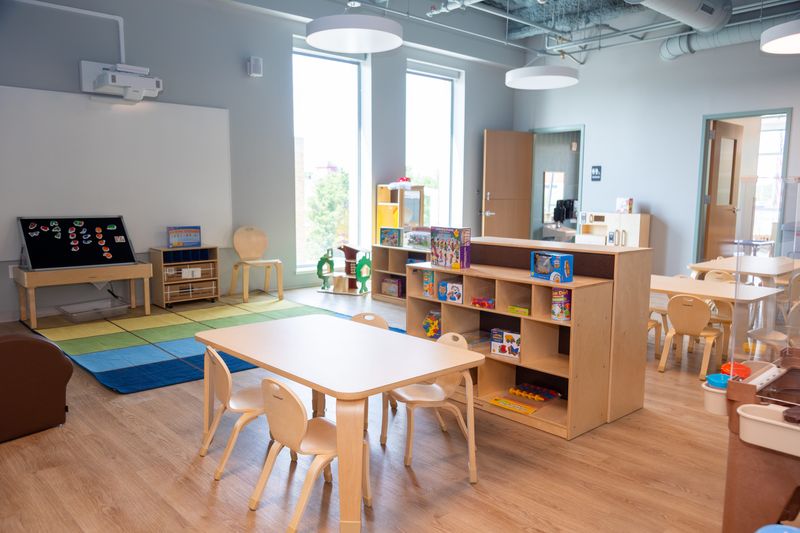
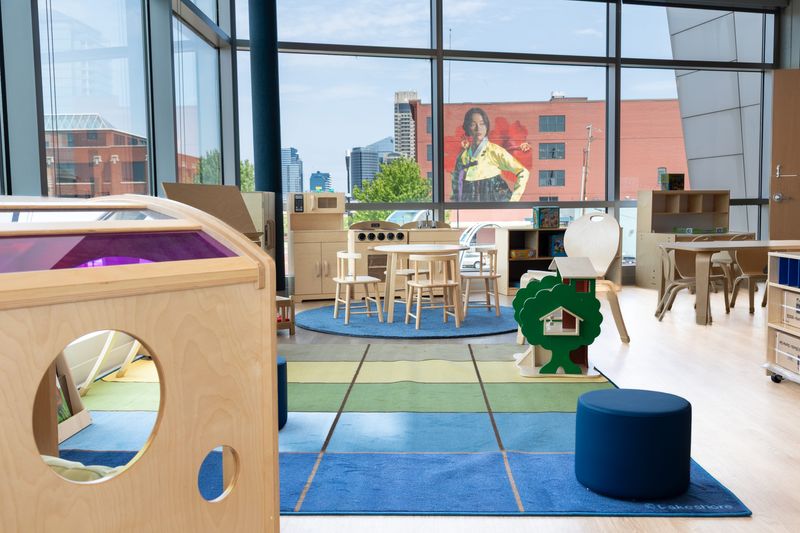
Four years ago, a 12,000-square-foot commercial space inside of Grand Rapids Central Station, the area’s main bus hub, lay vacant.
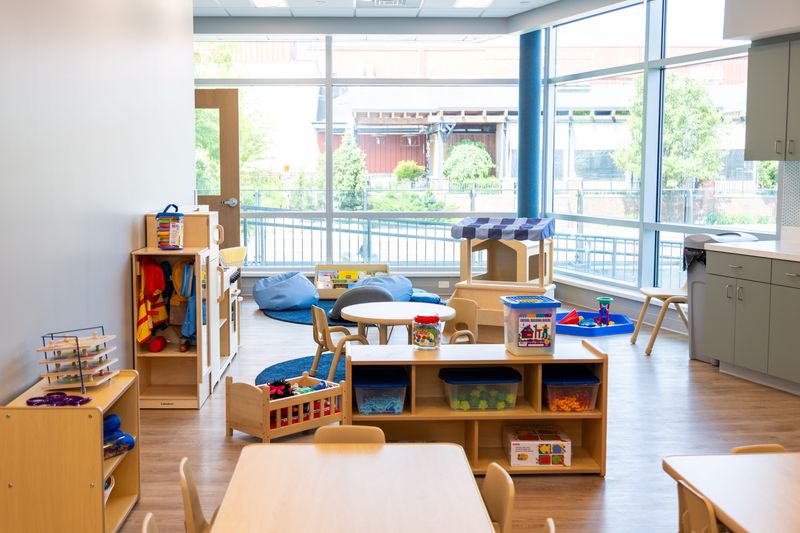
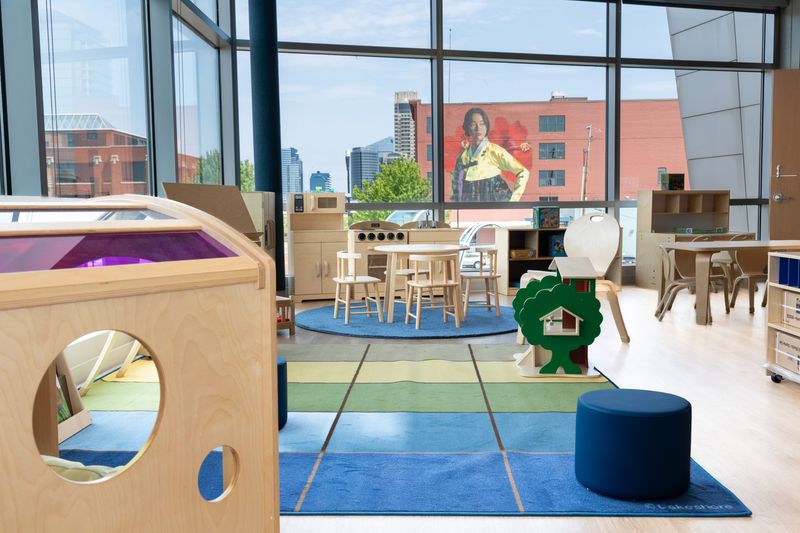
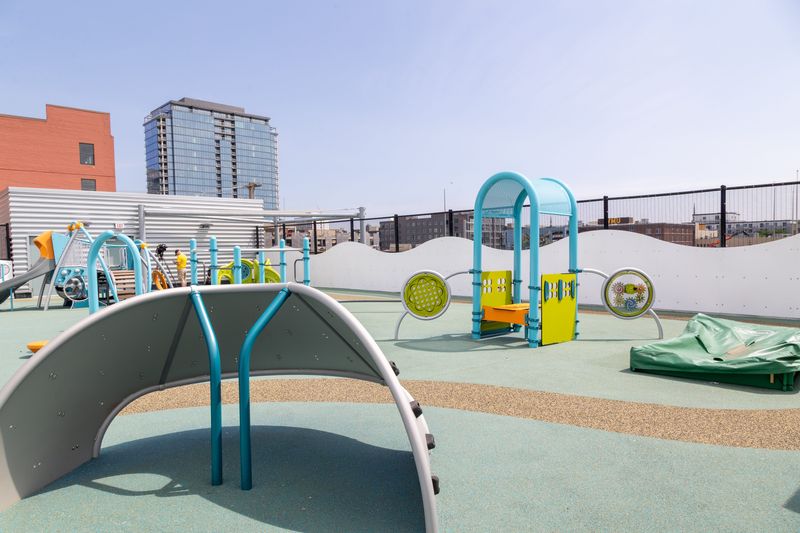
Today, it’s a childcare center.

Equipped to serve around 100 kids, the facility prioritizes slots for those with parents who ride the bus to and from work. The goal is reducing an over 7,000 gap of available childcare spots for kids birth through 5-years-old in the area. It’s also meant mainly to make life easier for working parents, said Deb Prato, CEO at The Rapid, which operates public transportation in metro Grand Rapids.
“We’re trying to show up in a way that’s meaningful, that makes this space useful and elevates the possibility of a working family or single parent to be able to knock out two barriers,” said Prato. “Going to school or going to my job and who will watch my kid. … I can’t think of a better way to use the building.”
A ribbon-cutting ceremony marking the opening of the childcare transit-hub was held at the site on June 8 and enrollment has officially opened for families to apply, but the center won’t be accepting families until around late August or the beginning of September, once licensing authorities give their final approval, according to project leaders.
The center, costing $9.1 million and carried out by a local coalition of organizations and funded primarily by private foundations, represents another first of its kind childcare solution cropping up in Michigan this summer. It’s the second in a series of unique potential childcare solutions the Free Press is highlighting.
And similar to the Battle Creek program we previously reported on, the childcare center in the Grand Rapids bus hub intends to be a blueprint, paving the way for future endeavors of its kind across the state that address transportation and childcare under one roof.
“We hope it’s a road map that inspires other community leaders to look at their public spaces and think about how they can benefit children and families in their own communities,” said Tracee Coffman, program officer at the W.K. Kellogg Foundation, which spearheaded fundraising for the project and published a case study documenting what it took to open the site.
The ease of available childcare on one’s route to work could mean the difference between keeping a job or not. It could also mean less stress and more time spent together, said Megan Owens, executive director at Transportation Riders United [TRU], a transit advocacy organization in metro Detroit.
A few years ago while working on a TRU campaign to improve the city’s bus service, Owens remembers speaking with a Detroit-based mom who spent six hours a day on the bus, getting her two kids to childcare and school, and then herself to work.
“The idea of the daycare at the transit hub could literally mean a few hours more in somebody’s life that they could have back,” Owens said. “Time they could be spending with family.”
Two birds with one stone
Grand Rapids has the highest gap for available childcare slots for kids birth through 5 years old in Kent County, according to a 2023 study.
The high need is a result of many factors, including the fact that the city’s childcare infrastructure is made up of a “patchwork of nonprofits, churches, and mom and pop and in-home” childcare sites without the capacity to meet the vast childcare need, said Scott Lewis, president and CEO of the YMCA of Greater Grand Rapids. The majority of larger centers equipped to serve higher numbers of kids are concentrated in the suburbs, he said.
Lacking childcare for this population showed up in a survey done by Kellogg Foundation of 500 Rapid transit riders, around 70% of which were either fully or part-time employed. Of survey respondents, 33% said they had to care for at least one kid between birth and 6 years old. For those needing childcare, 42% of respondents said they met current childcare needs through an unlicensed family member or friend and 26% said they were unable to meet their childcare needs.
And 92% of respondents listed “proximity to work/school” among the top three considerations for taking their child to a center, alongside cost and safety and security.
The survey results, shared with the Free Press, served as a mandate for the Grand Rapids Central Station Early Childhood Center’s creation, which was carried out through a partnership between five organizations: The Rapid, YMCA of Greater Grand Rapids, the Kellogg Foundation, Head Start of Kent County and Grand Rapids Public Schools.
Nearly 40% of riders have to transfer on their way to work or school, said Prato. The idea is that parents riding the bus bring their child with them on their way, drop them off at the Grand Rapids Central Station Early Childhood Center and then walk back to the platform to transfer lines to their final destination — later, they reverse the trip, picking their kid up on their way home.
Robert Fishman, professor emeritus of architecture and urban and regional planning at the University of Michigan, who spent his career studying the history of cities and urban planning and policy, called the project “a brilliant move” in bringing services together where they’re most needed by families in the city. But he wondered about accessibility — how many parents live walking distance to a bus line, for example, or how reliable the bus service would be for parents needing to pick up their kid on time. Right now, the center is slated to be open from 6 a.m. to 6 p.m., though hours may be extended, depending on parent needs.
Some of these questions are still being worked out, Prato said, like figuring out how to align the bus routes with parents getting off at the transit center to pick up their kids and coming back to get on the second leg of their journey. Prato herself has measured the journey during multiple test runs: 15 minutes on average, she said. On average, The Rapid buses run on time 88% of the time, though 90% is The Rapid’s goal. Construction has been a challenge as of late.
The Rapid may end up needing to knock back bus schedules by a few extra minutes so parents can make their connections, she said, which they’ve done in the past at the busiest times. But once families enroll, The Rapid will have more information to work off and will adjust for childcare and transit operation issues.
“We’re committed to making it work,” she said.
Turning vacant space into childcare in Michigan
Part of the purpose of the project is to serve as proof of concept that old buildings can be revamped and turned into a childcare site. Doing so requires dedicated partnership — a notion that was reiterated from the organization leaders involved in the project.
This is in part because childcare is a large issue that no single sector can address alone, Coffman, of the Kellogg Foundation, said. In the case of bringing the Grand Rapids Central Station Early Childhood Center to fruition, it wasn’t just childcare providers that were part of the effort — the Downtown Development Authority, the transit authority and the public school system all saw value in the project funded in large part by local foundations, which did too.
But the other reason partnership is important in projects like these is because of the sheer force it takes to push to the finish line when costly and time-consuming barriers come up along the way, like regulations and high costs.
“Nobody got cold feet, nobody felt this was taking too long, everyone was so committed to innovation and uniqueness of this project that four years was worth the journey for everyone,” Coffman said.
And there were opportunities for cold feet during the four years, including a new fire safety measure required by the state licensing authority that set the project back by a year and added significant cost to the project, said Lewis.
Transforming existing buildings for childcare is not something licensing authorities are keen to do because of safety concerns, said Reed Fenton, CEO at EIG14T, a national childcare developer based in Oakland County.
“A lot of these childcare licensing agencies don’t like urban or multistory [developments] because of child safety,” said Fenton who noted transforming existing space is much more popular in states with denser urban areas, like Chicago and New York City, since there’s not much more land left to build on. “Their concerns are going to be getting children off of the second or third floor in an emergency, so it’s generally frowned upon.”
Fenton said his company hasn’t seen huge cost savings from renovating existing buildings into childcare sites as opposed to building from the ground up because though building new childcare sites is expensive, so is meeting state safety guidelines in old buildings.
But because of the business model’s tight margins, new builds aren’t likely outside of childcares run by larger corporations able to front the cost. Lewis believes making it easier to transform buildings, especially public ones like the transit hub, a federal building, will be a key piece of helping solve the childcare crisis in Michigan.
High costs like those the Grand Rapids team faced make this kind of project less plausible in other areas, like rural communities without the amount of local money and resources available to pour into it.
Lewis hopes the Grand Rapids project also starts a conversation with state regulators, serving as an example that “transforming an old building into a childcare can be done and it can be done safely,” he said.
How it works
When can I enroll and when does the center open?
The childcare center, which will be run through the YMCA of Greater Grand Rapids, is now open to families for enrollment at https://www.grymca.org/central-station-child-care/.
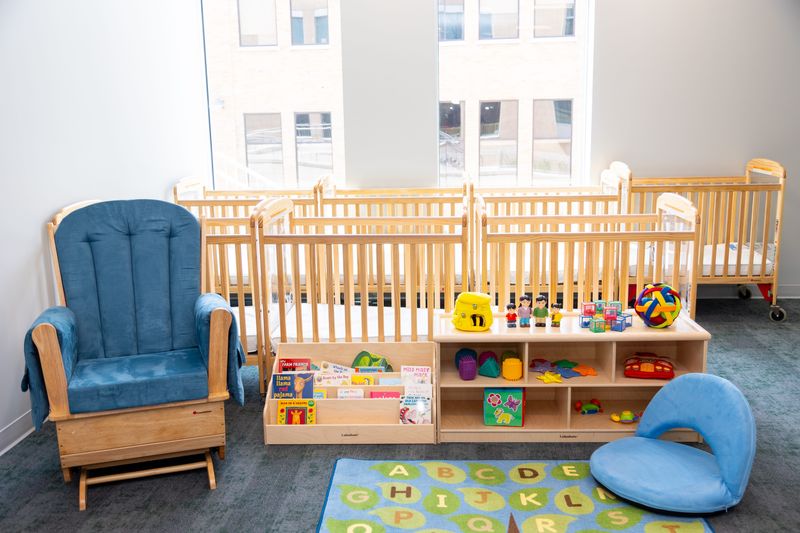
The center will accept children ages 6 months through 5 years old.
While enrollment will be open to the general public, the YMCA is prioritizing registering parents who use the transit system to get to and from work, said Scott Lewis, president and CEO of the YMCA of Greater Grand Rapids.
While an official date is not yet set, once final licensing inspections wrap up, the center aims to open between late August and early September, he said.
Will the center accept the state childcare subsidy or have Head Start or GSRP slots available?
The purpose of the center is not only to open up available slots but also to make them accessible to families who make up The Rapid’s ridership, which is heavily made up of hourly wage workers, said Prato.
The center will accept parents using the state’s child care subsidy [known by parents as the Child Development and Care subsidy or the DHHS subsidy] and will have both Head Start slots available in addition to two state-funded free pre-K classrooms open, run through Grand Rapids Public Schools.
Funds from local donors will also be made available for additional childcare assistance for parents who either still can’t afford the co-pay with state childcare subsidy assistance or make too much to qualify for the subsidy, but still can’t afford the cost of tuition.
What will the hours be?
Currently, the Grand Rapids Central Station Early Childhood Center will be open from 6 a.m. to 6 p.m., said Lewis. However, as parents enroll and work hours become clearer, the center’s hours may adjust to meet their needs.
“There’s the possibility that they’re open until 7 p.m. because that really makes it easier for many parents with pickup,” said Lewis. “Those are things we’ll continue to ask our users.”
If you know of or are involved in solutions addressing issues with childcare in Michigan, we’d love to learn more. Email rsanmartin@freepress.com with ideas.
Beki San Martin is a fellow at the Detroit Free Press who covers childcare, early childhood education and other issues that affect the lives of children ages 5 and under and their families in metro Detroit and across Michigan.
This fellowship is supported by the Bainum Family Foundation. The Free Press retains editorial control of this work.
This article originally appeared on Detroit Free Press: Michigan’s first transit-hub childcare opens in Grand Rapids
Reporting by Beki San Martin, Detroit Free Press / Detroit Free Press
USA TODAY Network via Reuters Connect
By Beki San Martin, Detroit Free Press | USA TODAY Network