

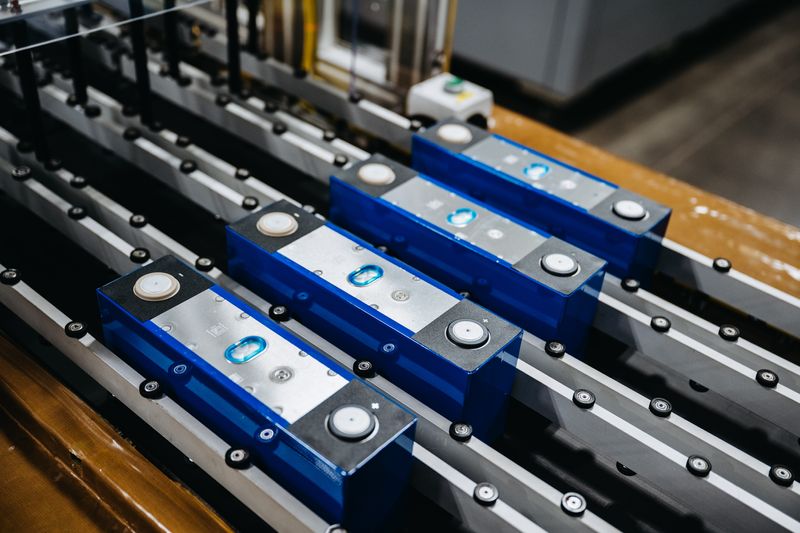
Ford Motor Co. recently marked a major milestone toward its next-generation electric vehicle platform with the start of production of its first full prismatic cells: from slurry to coating and formation, all the way through aging and final inspection.
The launch puts the Dearborn automaker on track to be the first to deliver lithium-iron phosphate batteries made in the United States for mainstream consumer automotive use. That, executives have said, will pave the way for a more resilient supply chain and safer, more affordable EVs that could be competitive with low-cost Chinese products if built under similar conditions in the United States. It, however, isn’t being accomplished without some help from the Chinese.

BlueOval Battery Park Michigan now employs more than 500 people. It’s ramping up production of “D-sample” cells made with production-intent material that will be used for testing and validation. Throughout the spring, the plant was making “C-sample” cells that used some prototype content to train and qualify machines. D-sample manufacturing began earlier this month after those parts passed safety and quality testing.
The step puts the plant on track to launch before the end of the year production-ready cells for the new Universal Electric Vehicle platform, whose first vehicle is an electric midsize truck coming in 2027.
“We’ve been really building our team, building up all of our processes and everything, preparing us for launch,” BlueOval Battery Michigan CEO Scott Davis said.
To accomplish the speed of delivering the LFP batteries, Ford licensed technology from Contemporary Amperex Technology Co. Ltd., the world’s largest EV battery manufacturer. Although the development of LFP technology originated in the United States, further advancement and patenting of the technology happened in China.
Unlike other automotive-battery company partnerships, this is not a joint venture. Operations and employees are all under Ford alone, though CATL employees are helping to train the workers on the technical process of LFP battery manufacturing, and Ford is using CATL quality standards in its preparation for launch of production batteries. Nonetheless, the company has received criticism from some Republican lawmakers for the agreement. Ford has said it has allowed it to reshore a supply chain that otherwise would come from China.
“We have been able to create a supply chain that does not require nickel and cobalt,” Charles Poon, Ford vice president of vehicle hardware engineering, said about the goals in selecting the LFP chemistry for the UEV. “We’ve been able to do that free of foreign entity of concerns and to be able to produce that in Marshall. Our first prototypes have been delivered, and the vehicles are in fact really fun to drive.”
He recalled sitting almost four years ago in the Glass House, Ford’s former world headquarters in Dearborn now slated for demolition. There were debates about whether LFP would be the right move.
“Seeing that cell coming off the line was that validation that all of that hard work and all of the decision-making was definitely the right move,” Poon said, “because we now have that cell production in the U.S., and it’s out of our facility there, and so far the performance of that cell has been in line with our expectations.”
Foreign LFP batteries have been used in the Mustang Mach-E. Competitors like General Motors Co. and Tesla Inc. also have sourced foreign LFP batteries, including from CATL. Domestic automakers also have been developing lithium manganese-rich batteries that offer similar cost-saving measures for commercial launch later this decade.
“Ford should be the first to produce LFP cells for EVs in North America,” said Sam Abuelsamid, vice president of market research at auto communications agency Telemetry. “The plant is not just producing the cells, but producing the complete battery packs. It’s a structural battery pack. They’re doing it in a way that certainly is new for a legacy automaker. Not new totally. Most of what they are doing has been done by Tesla and expanded by Chinese manufacturers.
“Probably most notable, though, is all of that combined should significantly reduce the manufacturing cost of the vehicles starting with the pickup, but a number of vehicles coming off that same platform. That should give Ford a notable cost advantage compared to anyone else producing EVs in North America right now.”
In addition to operators, Ford supervisors and engineers are being trained on the equipment, Davis said. There are four levels of training, and almost 90% of employees have reached at least the second level, which means they’ve completed classroom work and can use the equipment with guidance. Employees are expected to reach Level Three, where they can perform the functions of their job without assistance. Level Four are employees equipped to train others
By the end of the year, Ford expects to employ 800 people at the plant with the goal of employing 1,700 people there in the future. It’s received more than 11,500 applications, and hires largely with fall within 60 miles of Marshall. More than 70% live in the city, Battle Creek or Albion. Production operator wages begin at $27.20 per hour, and technicians start at $46.25 per hour.
“This project brings world-class battery technology to our state and positions us to bring even more auto and battery manufacturing back from overseas,” Gov. Gretchen Whitmer said in a statement. “Michiganders will build the batteries that power a new generation of affordable electric vehicles, giving consumers more choices while supporting our workers.”
Employee Andrew Charameda, 25, of Battle Creek joined Ford in January from a job as an inventory control specialist at a dairy company. He jumped at the chance to get his foot in the door at a major employer after seeing the plant rise while visiting his grandparents near Marshall.
“I like hunting and fishing and golf, and those are three things that I will never master in my life,” Charameda said. “So, I agree that my career should be just like that. These machines are very complicated, and once you figure out how to master one, there’s another one right to the left of it, or to the right of it, that I can also master. These machines are very complicated. But with time, everything becomes a little bit easier, but nothing you will ever master.”
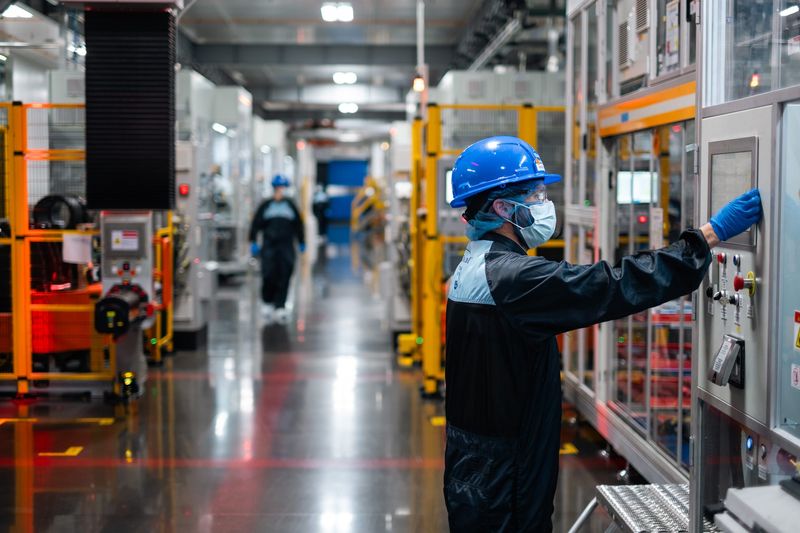
Charameda has enjoyed working in what he describes as a “futuristic” environment. The plant is highly automated, with many operators interfacing with touchscreens to monitor and control machines and materials traveling by autonomously guided vehicles and overheard transfer.
Charameda works in the winding department, where anode, cathode and separator materials are joined into a “jelly roll,” he said, for cell production.
This is a part of the cleanroom part of the plant where contaminants and humidity are highly controlled. Employees have to walk through air showers to remove particles on them and wear special suits, hats and shoe covers. Quality anomalies for batteries are measured in parts per billion — compared to the parts per million that typically permeate automotive supply discussions. Optical automated cameras help check quality after stations along the manufacturing process.
“The culture there is around cleanliness as the highest standard,” Poon said. “We like to think that you can basically eat off of the machines that are on the on the floor of the facility: If you’re not able to eat off of it, then it’s not good enough for battery manufacturing.”
Charameda said he’s had to wear similar personal protective equipment for other manufacturing jobs, but the Marshall plant takes it to a new level.
Initially a culture gap created “a bit of tension” during the training process, Charameda said. Employees since have downloaded translators to ease communication with CATL representatives and have gotten to know each other on a more personal level.
“We’re all human,” Charameda said. “Some people may look at them differently for culture or how they do things over there, but at the end of the day, we’re all working together, and we’re all here to do one thing, and they’re here to teach us, and that’s what we’re here to do. I love working with them.”
In his own life, Charameda says he feels one step closer to buying a home with a wraparound porch he’s always dreamed of and potentially look toward going into human resources one day.
“Some jobs are very stagnant, and I can only see the moon and the stars here,” he said. “I know if I hold myself accordingly, and if I hold myself correctly, and make sure that we understand how to fix problems, then it’s only up from here.”
bnoble@detroitnews.com
@BreanaCNoble
This article originally appeared on The Detroit News: Ford Michigan battery plant ramps up hiring, cell manufacturing for EV
Reporting by Breana Noble, The Detroit News / The Detroit News
USA TODAY Network via Reuters Connect
By Breana Noble, The Detroit News | USA TODAY Network
