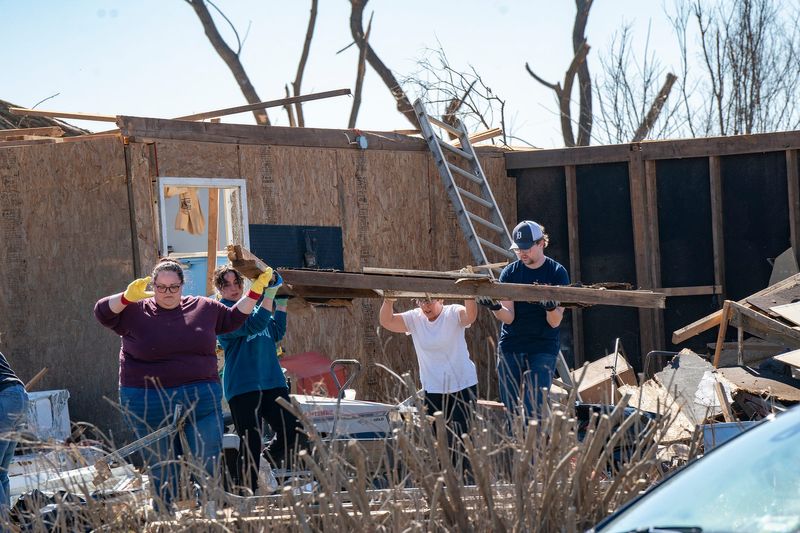
At least eight tornadoes swept across southern Michigan in the past week. A deadly March 6 tornado in Union City that killed four people and left some two dozen others injured was the earliest EF3 tornado on the 1-5 Enhanced Fujita scale, an international tornado strength measurement, in Michigan history. The tornado’s wind speeds maxed at 160 mph, according to the National Weather Service.
Spring is when most tornadoes occur

Tornadoes are a reality in Michigan and the Midwest, and spring is the time in which they are most frequent. Tornadoes can happen any time of year, but spring and early summer are the most active periods in the Midwest due to the alignment of atmospheric conditions that favor severe thunderstorms and tornado formation. On average, April, May, and June account for about 52% of all U.S. tornadoes, with May typically seeing the highest number, averaging around 260 tornadoes per year. April and June follow with averages of 202 and 186 tornadoes, respectively.
The Midwest experiences tornadoes in spring because warm, moist air from the Gulf of Mexico moves northward and collides with cooler air from Canada, creating strong instability. The jet stream, a fast-flowing, narrow air current in the upper atmosphere, often dips southward during spring, providing wind shear that helps thunderstorms rotate and form tornadoes. This combination of moisture, instability, and wind shear is less common in summer, which is why tornado frequency declines after early summer.
Supercells are super-drivers of tornado activity
According to the National Oceanic and Atmospheric Administration, most tornadoes form as a result of supercell thunderstorms, weather events bringing together severe wind shear, lift, atmospheric instability and moisture.
“The supercell is considered the engine of the most efficient storms,” said said Chris Roller, a meteorologist with the National Weather Service’s Northern Indiana office in Syracuse, Indiana. “It has the updraft separated from the downdraft, and that can keep the thing going a lot longer as opposed to just a regular (storm) cell.”
A supercell is a rotating thunderstorm, and the rotation means the updrafts, the sucking up of air into the storm, can be stronger and last longer, said John Allen a meteorology professor at Central Michigan University. “It basically organizes the thunderstorm, so it doesn’t just peter out because of the precipitation associated with it,” he said.
Scientific evidence shows Michigan’s springs are getting warmer and arriving earlier. Climate change is also expected to bring more extreme weather events to the region. But is climate change causing more tornadoes in Michigan? Not yet at least.
Warming climate, changing springs could change tornado activity
Jeff Masters, a Highland resident, meteorologist with the nonprofit Yale Climate Connections and co-founder of Weather Underground, pointed to data for all EF1 or stronger tornadoes in Michigan since 1950, which shows an increase in the number of twisters over the last few years when compared to the immediate years preceding, but generally fewer tornadoes than Michigan saw in the 1970s and ’80s.
“There’s no evidence we are seeing more of them − the strong ones, anyway,” he said. “We are definitely seeing earlier springs, that is well documented. And spring is when you tend to get severe weather. So if you are going to have an earlier spring, then you are going to push the severe weather season earlier in the year.”
Though most tornadoes form from supercell thunderstorms, there are other tornado types as well. Strong lines of thunderstorms, referred to as “quasi-linear convective systems,” also called squall lines, can cause tornadoes to form.
Landspouts and waterspouts are also types of tornadoes. They can form during thunderstorm formation, rather than from a supercell storm that is already rotating strongly. Dust devils are different from landspouts, and although dust devils can be damaging, they are not a type of tornado, according to NOAA officials.
“Scientists still have unanswered questions about tornadoes: Why do most supercell thunderstorms not result in a tornado? How exactly do tornadoes form? What are the causes of wind shear that lead to rotation?.” NOAA officials said. “NOAA scientists are working to learn more about tornado formation and improve forecasting.”
Contact Keith Matheny: kmatheny@freepress.com.
This article originally appeared on Detroit Free Press: Michigan tornadoes aren’t increasing — but spring risk arriving sooner
Reporting by Keith Matheny, Detroit Free Press / Detroit Free Press
USA TODAY Network via Reuters Connect