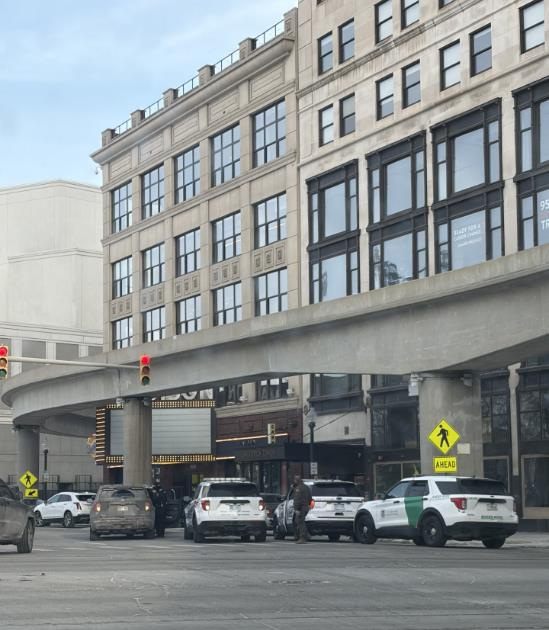
The police department in Canton Township, a racially and ethnically diverse metro Detroit suburb, says it doesn’t enforce immigration laws.
Still, in August, when an officer stopped a man who gave him a Mexican driver’s license that was allegedly invalid because it hadn’t been translated to English, he did not simply issue the driver a ticket, but called U.S. Immigration and Customs Enforcement.

The call was to verify the license, a standard Canton police practice, said Chief Joseph Bialy. The officer went on to deem the man’s license invalid and took him to Canton’s lock up, where he was picked up by ICE on an alleged immigration violation and put on the path to possible deportation.
Police officers’ calls to immigration authorities to verify identity and documents during traffic stops are a common way Michigan state and local law enforcement agencies have aided President Donald Trump’s deportation effort, experts said and a Free Press review of ICE detainees found.
Many police agencies say they can’t enforce federal immigration law and have policies limiting cooperation with ICE and U.S. Border Patrol. Yet almost none bar identification‑related calls, experts said, and several departments told the Free Press the calls are approved and routine.
Police officials say calling immigration authorities for help with identification is needed to ensure the capture of anyone wanted for a crime or who may be committing one, noting that ICE and Border Patrol have additional identifying information beyond what appears in state and local law enforcement databases.
But immigrant and civil rights advocates say the calls carry high stakes in the deportation push revived by Trump last year. When local officers loop ICE or Border Patrol into a traffic stop with ID questions, they say, immigrants are now almost always arrested, frequently detained without bond, and pushed toward deportation – even when they have pending immigration cases.
Driving without a valid license is a misdemeanor under Michigan law, punishable by up to $500 in fines or 93 days in jail. Advocates say that, at most, that should mean a ticket and court case – not a call to federal immigration agents that can escalate a traffic infraction into months in detention and possible deportation.
Local law enforcement officials already have the tools they need to enforce traffic laws and can legally only hold people during traffic stops for as long as it takes to resolve the violation, said ACLU of Michigan staff attorney Ramis Wadood.
If officers “have questions about the validity of [an] ID … they should be talking to their actual supervisor, which is not Border Patrol” or ICE, Wadood said. “If they [contact immigration authorities] in the course of a traffic stop, every minute that passes that doesn’t have to do with that traffic stop – these local officers are racking up liability for a potential constitutional violation.”
Bialy, the Canton Township chief, told the Free Press in March that his officer’s August call to ICE was in line with department policy and practice because it was not made to determine whether the driver was a citizen, but for identification verification.
Still, he said he’s concerned by “the sheer Fourth Amendment violations” that can arise when someone is detained for longer than necessary during a traffic stop and has ordered a review of his agency’s immigration coordination with a focus on constitutional policing. Officers are still instructed they can contact ICE in the case of suspected crimes, he said.
Driving confusion
Police said they contacted immigration authorities about noncitizens because they lacked the conventional identification many other drivers in the state carry.
Because legal presence in the U.S. is required to obtain a Michigan driver’s license or state ID, many noncitizens instead carry foreign driver’s licenses from their home countries. Those are valid for driving in the state, but they must be translated – either with an international driving permit issued by their home country or a separate, similar document with their photo and the same information in English, the Michigan Secretary of State’s Office said. Some noncitizens may have no identification at all.
Local law enforcement agencies have long escalated identification issues arising from traffic stops to federal immigration agencies – particularly U.S. Border Patrol, experts said, which can exercise arrest powers throughout the state given its boundaries with Canada and the Great Lakes.
Nearly half of Border Patrol apprehensions between 2012 and 2019 began with traffic stops initiated by state or local law enforcement agencies, according to a report by the ACLU of Michigan. Michigan State Police led in calls to the federal agency, followed by the Macomb County Sheriff’s Office and the Detroit Police Department. Identification assistance was a top reason for the contacts, the ACLU found.
Christine Sauvé, a spokeswoman for the Michigan Immigrant Rights Center that has fielded thousands of calls from detainees in the past year, said local police coordination with immigration authorities on the roads appears to have increased since. While previous police coordination with ICE centered on “detainer” requests when someone was booked into jail and flagged as being in the U.S. unlawfully, it has now “expanded exponentially to involve traffic stops.”
“The federal encouragement, the federal rhetoric has resulted in local agencies becoming more aggressive in their posture towards immigrants,” Sauvé said.
A recent Free Press analysis of 104 immigrant detainees in Michigan who sued the government for their release since August found at least 15% were arrested by local and state law enforcement agencies who called immigration authorities about them. The agencies included Michigan State Police, Detroit police, Grand Rapids police, the Macomb County Sheriff’s Office, Fraser police, Troy police, Canton Township police, Romulus police, Van Buren Township police, Gaylord police, Clay Township police and Kentwood police.
Identification issues were the primary reason the local law enforcement agencies called immigration authorities, according to court filings and statements from police agencies involved. Police described calling immigration authorities for clarity after receiving a general ID from a foreign country that they weren’t sure whether covered driving, an unfamiliar looking international license later deemed fraudulent, and when people lacked identification altogether.
License question leads to months in detention
In Clay Township, a town of 8,000 on Lake St. Clair, police chief Michael Koach said “nothing looked right about” the international driver’s license he said a Mexican woman presented during a routine traffic stop in July.
“Our officer was not sure exactly what to do with it,” he said. So the officer called Border Patrol, as the agency’s officers have historically done.
The federal agency responded and determined the woman’s paperwork was “fraudulent,” Koach said. She was taken and eventually detained by ICE for nearly three months before a federal judge ruled her detention unlawful because she’d never been given a bond hearing.
The woman was never charged with a crime for having an invalid or fraudulent ID, Koach said.
While the outcome for the woman was unfortunate, as “everybody is due their day in court” and “it’s kind of terrible if you gotta wait months for something, especially if … you’re just driving without the proper paperwork,” Koach said the officer had no choice but to call Border Patrol.
“Obviously we don’t enforce anything federally, but … who else do we call to try to get answers?” he said.
ICE and Border Patrol have access to identifying information beyond what’s available to local police through the Law Enforcement Information Network, he said, citing green card and other immigration program-related information.
Identity verification is not a step officers can skip, he said. In the town along the Canadian border, Koach said he’s seen “cases where people are detained and it turns out they’re wanted in other countries for homicide.”
Christine Sauvé, a spokeswoman for the Michigan Immigrant Rights Center, called the Clay Township call to Border Patrol an all too common example of needless coordination with immigration authorities.
“Officers should be trained in how to just look and evaluate a form of ID without needing to contact border protection,” said Sauvé. “If they see the person doesn’t have a license, then they can issue [a ticket] on the spot in the field because it’s a violation of Michigan law.”
Border Patrol was also called by Detroit police in February, during a routine traffic stop in which officers held a Venezuelan man who lacked identification for more than an hour as a lieutenant told them to contact the federal agency, according to body camera video of the encounter. A sergeant at the center of the case – who was later suspended by the department for violating policy, a claim she disputes in a lawsuit – said in the body camera video that it was crucial to identify the man because he could be “Pablo Escobar.”
The ACLU’s Wadood questioned why lacking valid identification has resulted in heightened scrutiny of immigrants.
“If someone’s name is not coming up in a database, that is not reason to believe a crime is being committed,” he said. “That is not constitutionally a reason to continue prolonging the stop.”
Sauvé and Wadood described Michigan police agencies as insufficiently trained in evaluating permissible forms of ID and said they’ve seen cases in which officers even contacted immigration authorities about people with valid identification.
Sauvé said identity verification can be used by officers as “an excuse” to enforce immigration laws, citing a December traffic stop in Fraser, where a Detroit high school student from Venezuela was driving without a driver’s license with his mother inside a car.
In body camera video of the encounter published by Outlier Media, the officer is heard calling U.S. Customs and Border Protection and saying “I have someone that doesn’t speak English … He handed me a passport. I just want to verify his status.”
Fraser Director of Public Safety Samantha Kretzschmar did not respond to a request for comment. A city official – councilmember George-Michael Higgins – vouched for the call to CBP at a public hearing, saying he felt officers were trying to “enforce our traffic laws.”
‘Not enforcing immigration laws’ but collaborating with ICE
Since Trump’s return to office, many Michigan police agencies have said they do not conduct immigration enforcement, often citing a lack of resources and jurisdictional limitations.
“Our primary focus is reducing crime … and for me to split our [energies] doing immigration enforcement, it’s just not going to happen,” said Canton Township chief Bialy, adding that most immigrants are not a danger to the public.
Local police “do not have the authority to enforce federal law,” said Clay Township chief Koach. “We can only enforce state and local ordinances.”
Only a handful of Michigan law enforcement agencies have formal partnerships with ICE to conduct some immigration enforcement functions, in what are known as 287(g) agreements. They include the Taylor Police Department, the Village of Oakley Police Department, and sheriff’s offices for Jackson, Berrien and Calhoun counties.
Some agencies have written policies that spell out the prohibition on immigration enforcement and restrict additional contacts with ICE and Border Patrol. Detroit, Canton, and other agencies bar officers from using immigration authorities for language translation services and reject some ICE “detainer requests” to hold noncitizens in jail for ICE to pick them up.
Agencies that told the Free Press they do not conduct immigration enforcement also said it’s practice for officers to contact immigration authorities for identification.
Van Buren Township – where an officer in October contacted Border Patrol about a man with an allegedly expired Michigan driver’s license and Mexican ID card – has “historically utilized Border Patrol as a resource to confirm the validity of a driver’s license to legally operate a motor vehicle” before arrests for driving without a valid license or when verifying licenses issued by other countries, said Deputy Chief Joshua Monte.
Monte said during the stop, the officer also inquired about the man’s citizenship status “in an attempt to ascertain why his Michigan license had been expired for 15 years.” Department policy bars officers from asking people about their immigration status, but Monte said the move did not violate policy because there’s an exception when investigating crimes, and driving without a valid license is a crime.
The Macomb County Sheriff’s Office said a deputy who in August pulled over a man who could not produce a valid Michigan driver’s license due to what the man told the officer was his citizenship status “contacted the Border Patrol as we would in any matter in that nature,” said Commander Jason Abro.
Abro later added, “But we want to make it very clear, when it comes to immigration enforcement we are not enforcing immigration laws.”
Wadood said the message that local police don’t enforce immigration laws obscures their daily informal collaboration with federal immigration authorities.
“Sure, local officers aren’t going door-to-door and investigating immigration laws on behalf of the federal government, but they are providing information and assistance behind the scenes,” he said. That could mean honoring ICE detainer requests, “reaching out for interpretation assistance or identity verification, [and] providing back up if there is an enforcement,” said Wadood.
More restrictions needed, advocates say
Michigan law enforcement agency policies need “to be tightened up significantly” when it comes to coordination, Wadood said, including by barring calls for identity verification, requiring training around the issue and specifying disciplinary action for violators.
Wadood could point to only Livonia as an agency that curbs calls to ICE during routine traffic stops.
In a Jan. 30 press release posted to Facebook, the agency said it was in the process of formally updating its policies in light of “the national debate surrounding immigration enforcement” and that it would immediately implement rules to prevent officers from contacting “federal immigration authorities, including ICE and/or Border Patrol, during calls for service, traffic stops, or other routine police activity, unless a valid warrant or court order exists and is signed by a judge who has jurisdiction in Livonia.”
The update came after the agency reported 63 immigration arrests after Trump’s reelection, the second-most of any Michigan law enforcement agency – up from just 2 from 2021 – 2024, according to a March analysis of public records by Outlier Media.
Livonia police did not respond to a Free Press request for comment.
In a general statement about police contacts to ICE and Customs and Border Protection, Michigan Association of Chiefs of Police executive director Ron Wiles said “law enforcement officers have a responsibility to accurately identify individuals they encounter during lawful police activity” and the Department of Homeland Security has immigration information they lack access to.
Sauvé said the Michigan Immigrant Rights Center encourages noncitizens to protect themselves to the best of their ability by carrying valid ID. Detroit, Kalamazoo and Washtenaw County offer jurisdictional ID cards for people who lack documentation to obtain state-level identification. Foreign driver’s license translations are offered by some community groups and do not require verification, she said.
But Sauvé says the legal aid service for immigrants also advises noncitizens that even if they do everything properly, “their rights might still be violated.”
This story was updated to correct Ron Wiles’ title and add additional context around his quote.
Violet Ikonomova is an investigative reporter at the Detroit Free Press focused on government and police accountability. Contact her at vikonomova@freepress.com.
This article originally appeared on Detroit Free Press: Michigan police say they don’t enforce immigration — then call ICE, CBP
Reporting by Violet Ikonomova, Detroit Free Press / Detroit Free Press
USA TODAY Network via Reuters Connect