The Michigan House of Representatives this week voted to ban the consumption and distribution of kratom and its synthetic variations and sent to the Michigan Senate for further consideration.
“What we are experiencing with kratom is a crisis,” Michigan rep. Cam Cavitt, R-Cheboygan, who introduced the bill, said in a March 18 release. “These products are being marketed towards our kids, and many parents aren’t even aware that it’s happening. Our children are being poisoned by products that they can easily purchase at gas stations.”

The bill, which passed the House 56-48, says, “a person shall not grow, synthesize, sell, offer to sell, give, import or distribute kratom or a synthetic variant of kratom.”
Kratom is produced from an Asian plant, Mitragyna speciosa, while 7-OH, which stands for 7-Hydroxymitragynine, is a chemical byproduct. Kratom may be consumed for anti-stress or pain purposes, or for those who are battling withdrawals. Some products are made with the entire plant, while others are formulated specifically with high concentrations of 7-OH.
Here’s more on kratom’s standing in Michigan:
Is kratom legal in Michigan? What are the penalties?
Kratom remains legal in Michigan. The bill passed on March 18 — House Bill No. 5537 of 2026 — would ban Kratom in Michigan if also approved by the Senate and signed by Gov. Gretchen Whitmer.
The bill would make use or distribution a misdemeanor, which could include jail time of up to a year and $20,000 in fines.
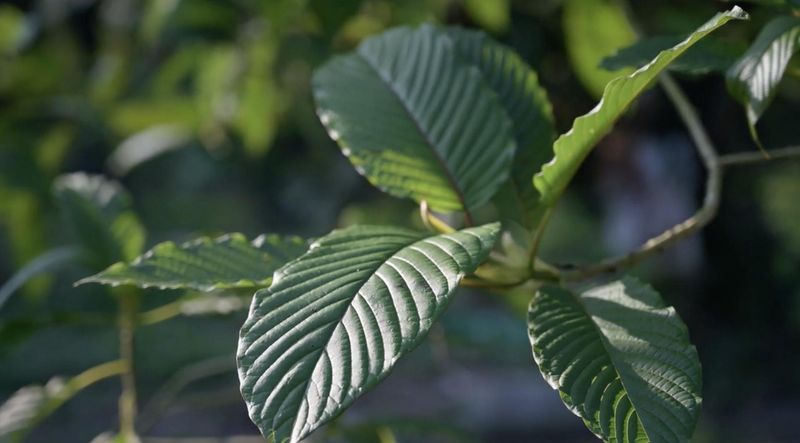
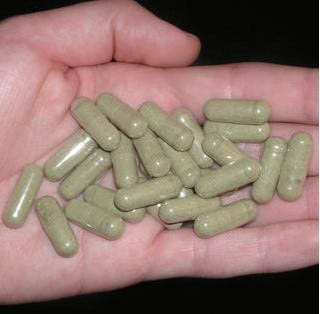
What does kratom look like?
Kratom is an ingredient that comes from a tree, Mitragyna speciosa, that grows in Southeast Asia. It’s often marketed as an herbal supplement that promotes relaxation and boosts energy, according to the Mayo Clinic.
The leaves are crushed up and brewed in tea or other drinks, inserted into a gel capsule or smoked.
People consume it in varying dosages which could either relax or energize a person. In addition, it has been consumed as a method to ease the symptoms of opioid withdrawals.
“Consumption of its leaves produces both stimulant effects (in low doses) and sedative effects (in high doses), and can lead to psychotic symptoms, and psychological and physiological dependence,” according to the U.S. Drug Enforcement Administration.
What is 7-OH?
7-OH, which stands for 7-Hydroxymitragynine, is a chemical byproduct of kratom, according to the U.S. Food and Drug Administration.
Why is kratom a problem?
In recent years, Kratom consumption has been under investigation on a state and federal level in the U.S.
Officials say kratom products and its synthetic versions (such as drinks sold at gas stations) are understudied and pose a risks for addiction.
A February 2026 Michigan Medicine article detailed how an individual got addicted to 7-OH pills by taking a free sample from a local smoke shop.
“Kratom packaging emphasizes its plant-based nature, while 7-OH products often have colorful packaging, a candy-like appearance and fruity flavors,” according to the medical article. “7-OH, which is made in a lab and not from the kratom plant, is 10 times more potent and addictive than the main active component of kratom, and has been associated with fatal overdoses.”
The U.S. Drug Enforcement Administration has listed kratom as a Drug and Chemical of Concern — meaning, the agency does not regulate the substance, but does believe there are risks to individuals who abuse it.
Where is kratom legal in the U.S.?
Here’s a breakdown of Kratom’s status nationwide, according to Sprout Health Group (a program for personalized drug addiction treatment):
Kratom is illegal to buy, sell or possess in the following states:
Kratom is legal/regulated in the following states:
Contact Sarah Moore @ smoore@lsj.com
This article originally appeared on Lansing State Journal: Michigan House passes kratom ban. Now what happens?
Reporting by Sarah Moore, Lansing State Journal / Lansing State Journal
USA TODAY Network via Reuters Connect