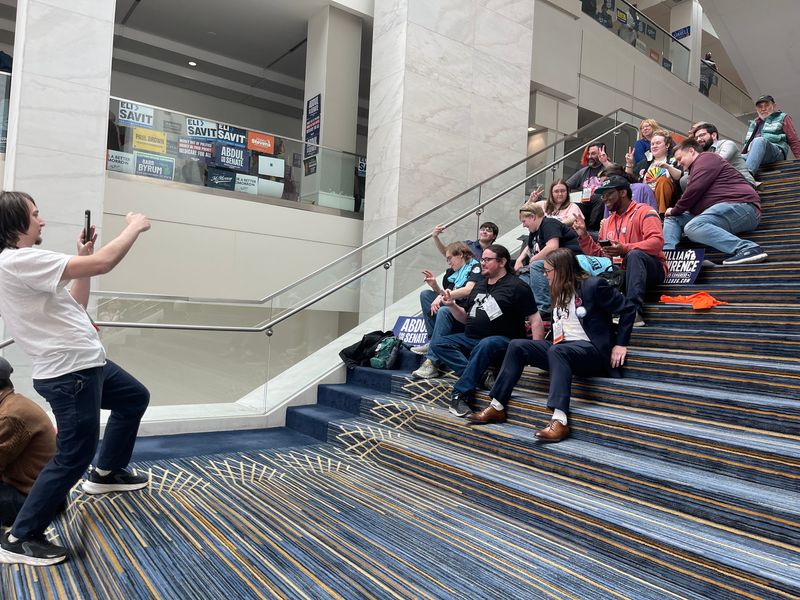
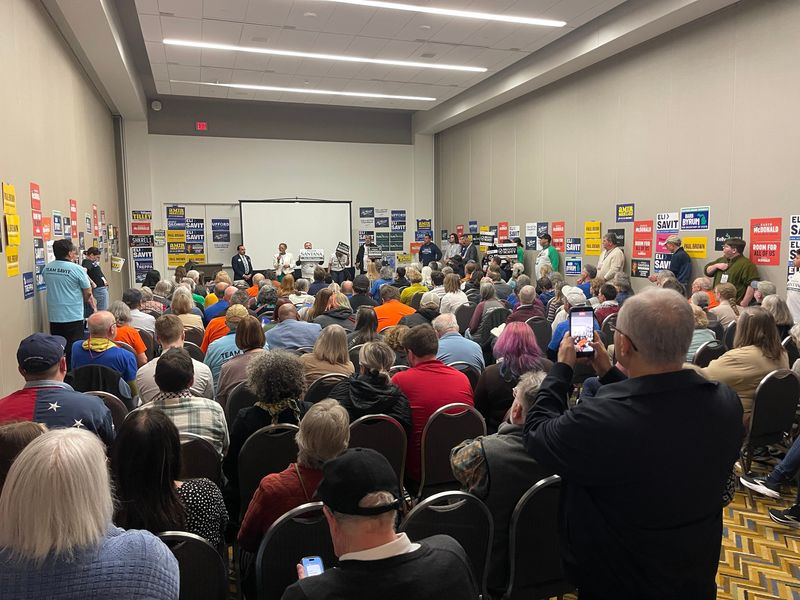
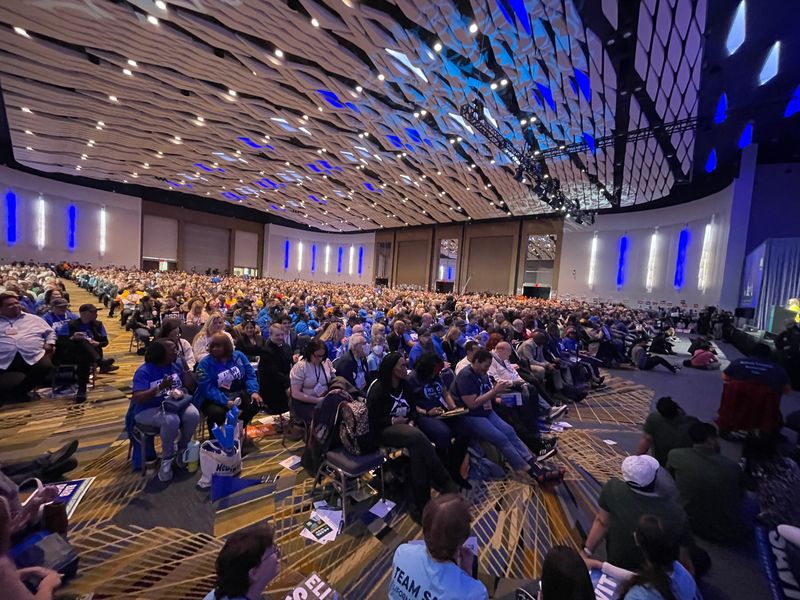
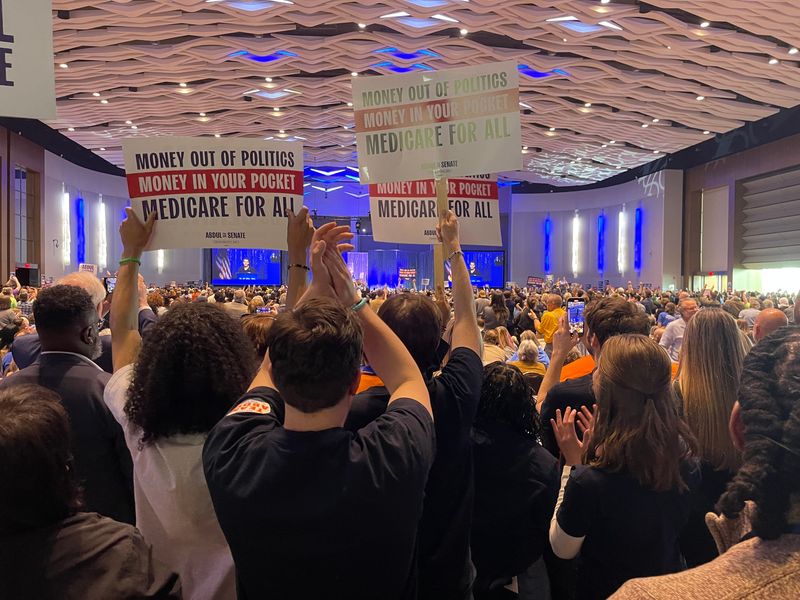
The Michigan Democratic Party put up a big tent for their endorsement convention. And a circus broke out.
I don’t know about you, but I like circuses — even though this one was all donkeys and no elephants.

More than 7,000 Democrats filled the riverside end of the sprawling Huntington Place in downtown Detroit on Sunday, April 19, meeting in small groups, listening to candidates as they went room to room making their pitches, and swirling around the convention center in colorful T-shirts promoting their candidates and causes.
Some hopefuls, like Secretary of State candidate Suzanna Shkreli, took campaigning to the next level by sending out supporters with electronic billboards that resembled giant cell phones strapped to their backs. Congresswoman Haley Stevens even brought in a Ford Mustang to boost her bid for the seat being vacated by retiring U.S. Sen. Gary Peters by underscoring her role in the federal auto bailout that saved GM and what is now known as Stellantis almost 20 years ago.
Unlike the Michigan Republican Party, which charges delegates to attend and vote at their endorsement convention, Democrats got to mingle under the big top for free. That, as well as more candidates competing for Attorney General, Secretary of State, the governing boards of the University of Michigan, Michigan State University and Wayne State, drew more than three times as many Democrats to their convention than the Republicans attracted to their confab last month at the Vibe Credit Union Showplace in Novi.
Another notable difference between the conventions was the amount of energy and intrigue.
Republicans in recent years have developed a reputation for fighting each other with as much ferocity as they used to reserve for Democrats. This year, however, their endorsement convention finished drama-free. And on-time.
Democrats had Huntington Place buzzing Sunday: Starting with a rumor that a high-profile candidate failed to make the endorsement ballot; followed by supporters of one U.S. Senate candidate almost drowning out another candidate when she took the stage; and capped by fans of a U-M Board of Regent candidate who were so obnoxious that the person chosen to nominate another candidate appeared to conclude his remarks early with the cryptic ad-lib: “Obviously, some people haven’t learned that fat meat is greasy.”
I didn’t see any Republicans at the convention, but that didn’t stop them from monitoring events via social media — and, as Jordyn Hermani of Bridge Michigan noted, trying to score political points by posting photos of some Democrats waiting in long lines to cast their ballots.
The implication was clear: If Democrats can’t run their own elections well, why should we trust them to run elections for the rest of us? Conveniently left unsaid in the GOP nitpicking points were the long lines, long waits and calls for recounts at recent Republican conventions.
By the time the last delegate departed: We had seen an incumbent defeated; a presumed favorite upset; a late-comer to a contest win a surprisingly easy victory; and signs that Michigan Democrats may continue to struggle with the same fallout from the fighting in Gaza that cost Democratic presidential nominee Kamala Harris any chance of winning Michigan in her race against Donald Trump in 2024.
We’ll start our look back at the convention by diving into one of the most extraordinary moments I’ve ever seen at a political party event before we get to the winners and losers — including one who made a noble pledge he may live to regret.
If, by now, you’re feeling left out because you didn’t get to help choose either party’s nominee for Attorney General or Secretary of State, join the club. Michigan is one of only three states where party members choose the nominees for major statewide offices.
The exception is governor: Every registered voter in Michigan will get a chance to choose the Republican and Democratic gubernatorial nominees in the Aug. 4 primary. The winners will select their lieutenant governor running mates at yet another round of conventions later this year. We’ll pick the penultimate winners in the Nov. 3 General Election.
Sheesh!
“Knock-Down Drag-Out”
The last time I spent so much time working in the big circular meeting space at the Huntington Place, it was known as Cobo Arena and I was working as a vendor at a Weezer concert. The punky purveyors of irony and alternative music played “Knock-Down Drag-Out” on that night more than 20 years ago, and even though that song didn’t make the Democrats’ setlist Sunday, it should have.
Things started out sedately enough, though, with Secretary of State Jocelyn Benson taking the stage to promote her gubernatorial campaign and help kill time while party officials determined who garnered enough support over the weekend to qualify for Sunday’s endorsement ballot. Genesee County Sheriff Chris Swanson, who also is running for governor, addressed an equally complacent crowd a little later.
It was what happened between those relatively standard stump speeches that had people talking for the rest of the night — and beyond.
First, state Sen. Mallory McMorrow, of Royal Oak, took the stage for a few minutes to tell the packed house she was the best candidate for U.S. Senate because she is a fighter who will stand up to Trump and who can win. McMorrow said she would send putative GOP U.S. Senate nominee Mike Rogers back to Florida, where his luxurious waterfront home became an issue in 2024 when he ran unsuccessfully for Senate against Elissa Slotkin.
Enthusiastic and polite applause followed, offering no sign of what came next.
The crowd erupted when U.S. Senate candidate Abdul El-Sayed, a former top health official for Detroit and Wayne County, took the stage and began his populist pitch with a bit of call-and-response.
El-Sayed said he was running for Senate to help pass universal health care, to stop giving foreign nations money to wage war, and to abolish ICE, the federal immigration enforcement agency that has been embroiled in controversy for forcibly removing suspected illegal immigrants from their homes and engaging in violent encounters with protesters that left at least two people dead.
El-Sayed has been critical of Israel, comparing its actions in Gaza to the terrorist organization Hamas. He drew cheers when he criticized AIPAC, a pro-Israel political action committee, but made sure to mention that he loved his “Jewish sisters and brothers” as he loves his “Palestinian sisters and brothers.”
I’m pretty sure El-Sayed spoke for longer than his allotted time — he acknowledged as much before concluding his remarks — but the energy and enthusiasm he generated created a charge like static electricity that hung around after he left the stage.
I don’t know whether Stevens was just unlucky for having to follow El-Sayed — or paid the price for being the Senate candidate most closely associated with AIPAC — but a large contingent in the crowd nearly drowned Stevens out as she tried to introduce the union members who joined her on stage.
Struggling to be heard over the din, Stevens gamely crisscrossed the stage with a wireless microphone, sticking to her talking points. She called herself a “daughter of Michigan, fighting for Michigan” and said she saved jobs by working on the auto industry bailout during the Great Recession.
In an apparent concession to the crowd, Stevens shouted: “Democrats, I love you even when we disagree. Because I put my hand up and fight!”
Many in the crowded hall were struck by the spectacle of Democrats trying to drown out a Democratic member of Congress. I spoke to state Democratic Party Chairman Curtis Hertel about it after the convention and again Monday afternoon. Each time he expressed concern about the disrespect directed at Stevens.
“That’s a code of conduct violation,” Hertel told me outside Huntington Place Sunday night. “We’ll be talking to members about it for sure.”
El-Sayed told me he was gratified by the response his campaign received after a year of working on a grassroots movement to “build a politics that will work for them.”
Still, he said, Monday morning he was disappointed by the way Stevens was treated.
“I know what it takes to run for office,” El-Sayed told me. “I know how much people give to this. And even if we have profound disagreements on politics and policy, I don’t want to see anyone booed like this.”
He said he sent Stevens a text message telling her he disagreed with the way the crowd reacted to her, and that his team had nothing to do with it.
Stevens’ spokeswoman, Joetta Appiah, told me the congresswoman was too busy to speak with me, but referenced her comment from the stage about loving Democrats even when they disagree.
“Her words speak for themselves and reflect where she stands and how she approaches moments like these,” Appiah said.
Even though McMorrow, El-Sayed and Stevens were allowed to speak at the convention, the winner of their race won’t be decided until the Aug. 4 primary. Their role Sunday was mainly to keep delegates engaged and entertained while party operatives worked behind the scenes to confirm which of the statewide candidates qualified to compete for endorsement.
Bias under the big top?
Stevens wasn’t the only candidate to face the wrath of the crowd. The speaker who nominated Jordan Acker for a second term on the U-M Board of Regents was nearly drowned out, too.
Acker, who is Jewish, has supported Israel in its war on Hamas in Gaza after the terrorist group attacked Israel on Oct. 7, 2023. Acker also has opposed calls for U-M to divest from Israel, has supported prosecuting pro-Palestinian student protesters, and has said “antisemitism runs rampant on our campus.”
Acker has said he and his family have paid a price for his support of Israel, after vandals attacked his law office and then his home, leaving anti-Israeli and pro-Palestinian graffiti. Both incidents received extensive news coverage — Gov. Gretchen Whitmer even called for Michiganders to “remain united in calling out hatred of any kind.” But Acker’s critics in the crowd seemed to give that little consideration.
By contrast, Amir Makled, seeking one of the Democratic Party’s two spots on the ballot for U-M regent, was cheered by a vocal contingent in the audience, even though The Detroit News reported earlier this month that Makled “reposted, and later deleted, praise for Hezbollah and antisemitic remarks on his social media account” last summer.
It’s tempting to pull these pieces together and say that the Michigan Democratic Party has an antisemitic streak running through it: The vocal support for two pro-Palestinian candidates, combined with the disrespect shown to two candidates closely aligned with Israel, makes a powerful circumstantial case. Throw in how Makled’s successful underdog campaign to win an endorsement for one of the party’s two nominations to the U-M board will end up costing Acker his seat on the board, and the case gets even stronger.
I’ve been surprised many times since Hamas’ Oct. 7 attack on Israel by the number of progressives I’ve heard express hostility toward Israel. The 2024 election results strongly indicate that tens of thousands of Democrats in Michigan refused to vote for Harris because of then-President Joe Biden’s handling of the situation in Gaza. While some Michigan Democrats simply didn’t vote for a presidential candidate, many others voted for Green Party candidate Jill Stein or Trump, despite his close ties to Israeli Prime Minister Benjamin Netanyahu, the architect of Israel’s attacks on Gaza.
But, at least in the U-M regents race, there are more factors worth considering.
Summit Louth, the U-M student body president who gave Makled’s nominating speech, passionately expressed the hostility many students feel toward Acker and his fellow regents for approving a surveillance program in which undercover agents observed student protesters. Makled also won the enthusiastic support of many young delegates for his work defending U-M students who were prosecuted for protesting.
Acker also made many enemies of his fellow Democrats for supporting U-M’s acquiescence to Trump’s call for universities to end diversity, equity, and inclusion programs or risk losing millions in federal funding.
Timing can play a big role in political campaigns, and for Acker, there could not have been a much worse time for a story to break accusing him of making “obscene sexual comments about a Democratic party strategist” and “lewd comments about a female U-M student and a picture of her with her friends.”
The Guardian news outlet published its report on Friday, April 17 — two days before delegates would decide Acker’s fate. It said “the messages were shared with the Guardian just days before a heated primary convention election.”
The Guardian reported that Acker’s lawyer expressed “doubts about the authenticity” of the messages, a squishy response that I suspect did little to contain the damage to Acker’s candidacy.
Regardless of whether an antisemitic streak runs through the party, Sunday’s events could be used to portray Democrats as hostile to Jews — a narrative Trump has been pushing since 2024.
When I asked Hertel Monday if he is concerned the treatment of Stevens and Acker could impact his party’s prospects, he told me: “I’m not trying to downplay what happened yesterday. I thought that, again, it was wrong, and hate and division is not what the Democratic Party needs.
“We will always stand up against antisemitism, anti-Islam and hate wherever it comes from.”
He also pointed out that Eli Savit, the Washtenaw County prosecutor who won the party’s endorsement for Attorney General, is Jewish.
The road ahead
By now, you’ve probably read my colleague Arpan Lobo’s excellent account of the winners and losers. But if you’re still reading, you can’t get enough of political scuttlebutt.
So, here are some quick takes:
Savit’s victory may have been the convention’s biggest surprise. Oakland County Prosecutor Karen McDonald had significant support from unions, who still play a major role in Democratic party politics. McDonald was so well-funded that her campaign sent literature to my house on two occasions weeks before the convention. That’s significant because there are no registered Democrats at my house, and most statewide candidates don’t have the dough to pump out propaganda until after they’ve secured the nomination.
Lt. Gov. Garlin Gilchrist’s victory in the Secretary of State race was noteworthy, not so much because he was the last major candidate to enter the contest or because his supporters were less visible than Shkreli or Barb Byrum’s backers, but because he won on the first ballot. Expectations were so high that no candidate would get the requisite 50% in the first round that Hertel got on stage to urge delegates to stick around until after the votes were counted in case there was a second round in the Secretary of State race.
Gilchrist told reporters he won nearly 60 % of the vote, but that’s hard to verify because Democrats, unlike Republicans, don’t reveal vote totals or victory margins. Hertel told me that every candidate had tabulators in the counting room, and that there’s a certification and an appeals process.
As someone who’s been hearing conspiracy theories and allegations of rigged elections even before Trump made it de rigueur, I humbly suggest that Michigan Democrats reconsider their policy and give transparency a try.
While Savit was one of many progressives who prevailed, he sought to avoid being pigeonholed.
“I don’t think we fit neatly on a political practice,” he told me as he met with reporters on his way out of the convention hall. “We’re gonna be making our case to voters across the political spectrum.”
Less than 24 hours after Savit made those comments, Michigan Republican Party Chair Jim Runestad tried to shove him back into the progressive box, saying: “Savit’s long record of championing so-called progressive causes will only endanger our communities and empower criminals.”
Runestad, like Gilchrist’s Republican opponent Anthony Forlini, criticized Gilchrist for skipping almost all of the state Senate’s session days in 2025. The Detroit News reported that the lieutenant governor missed 94% of the upper chamber’s sessions, where the lieutenant governor traditionally serves as presiding officer.
“Michiganders will now have the opportunity to put up Gilchrist’s failed record, where he was effectively a no-show as lieutenant governor, against the successful record of Anthony Forlini, a family man and public servant with a track record of delivering results for taxpayers,” Runestad said.
Gilchrist declined an opportunity to address that shot directly, instead telling reporters that he would use his engineering background to improve operations — including the Secretary of State’s troubled campaign finance website where the public can examine how politicians and political action committees raise and spend millions of dollars.
He also criticized the influence of dark money, which are funds raised and spent by nonprofits to influence elections, that do not have to be disclosed in detail to the public.
When I asked Gilchrist if he would disavow the use of dark money to support his campaign, he told reporters: “I think that people should spend money transparently. I think that we should tell who the donors are, that it’s the best way to be able to trust it. So, no, I disavow that.”
If Gilchrist keeps that pledge, it’s one he may come to regret, given the rise in the amount of untraceable money being spent on billboards, mailings, television and online advertising — and who knows what else. Of course, it also would be great if Forlini, who is the Macomb County Clerk, and every other candidate could also agree to disavow dark money.
I’ll do my best to ask them, and report back what they say.
In the meantime, the circus has packed up and left Detroit. But don’t worry about missing out; it is almost certainly coming to a town near you.
M.L. Elrick is a Pulitzer Prize- and Emmy Award-winning investigative reporter, director of student investigative reporting program Eye On Michigan, and host of the ML’s Soul of Detroit podcast. Contact him at mlelrick@freepress.com or follow him on X at @elrick, Facebook at ML Elrick and Instagram at ml_elrick.
This article originally appeared on Detroit Free Press: Michigan Democrats put up a big tent — and ended up with a circus
Reporting by M.L. Elrick, Detroit Free Press / Detroit Free Press
USA TODAY Network via Reuters Connect