Michigan’s Board of Regents held its monthly meeting on Thursday, July 16, in Traverse City and, after a week of speculation, did not acknowledge a nearly $12 million investigation into the turmoil in its athletic department.
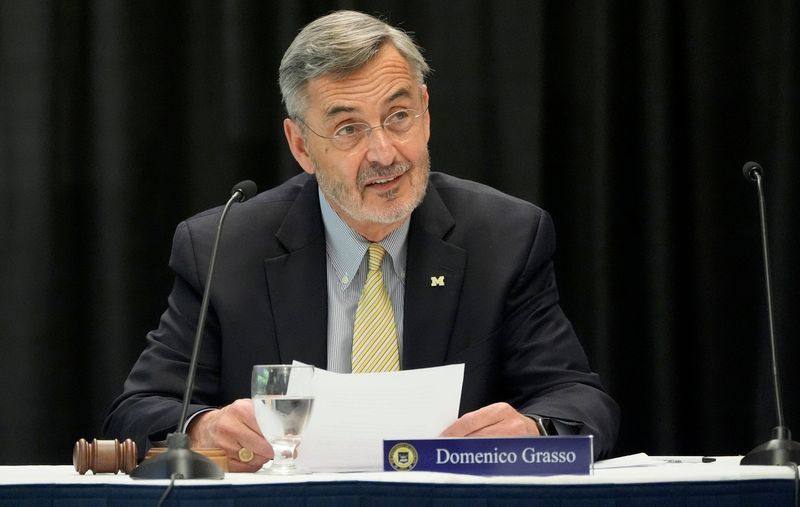
Michigan President Domenico Grasso concluded his opening remarks without any direct reference to the tumult of the athletic department. However, while acknowledging the departure of three leaders from other departments − including general counsel Tim Lynch − he suggested U-M is larger than any leadership change in any one program.

“Change can be disruptive and unsettling, yet our university has never been defined by an individual leader or a singular program,” he said. “Rather, we are defined by our mission, impact and commitment to the public good.”
It was not immediately clear if there was any separate mention of the investigation, as the livestream experienced notable technical issues with audio and video over a significant portion of the proceedings. Just more than half an hour into the meeting, the YouTube video of the stream ended while the livestream on Michigan’s site shared a message: “The live stream is either down or has ended.”
However, following the meeting’s conclusion, a Michigan spokesperson released the following statement:
“The meeting has ended and athletics were not discussed at all during the meeting. All items on the published agenda were approved.”
Although the regents didn’t discuss the investigation during their meeting, some details have started to emerge from the probe into the athletic department by Chicago-based law firm Jenner & Block.
The investigation was intended to determine who may have known about former Michigan football coach Sherrone Moore’s alleged affair with his executive assistant, Paige Shiver, and was expanded to conduct an analysis into the culture of the athletic department as a whole.
Early findings have brought trouble for Michigan, but there is allegedly no written report to speak of at this point, as U-M higher-ups were recently presented with an oral briefing but nothing written, seemingly to avoid Freedom of Information Act requests.
In light of the oral briefing, there have been discussions surrounding a potential buyout for Manuel, however the Free Press was told that Grasso remains in support of him at this time and nothing is imminent.
Moore was fired and later arrested on Dec. 10, 2025 and originally charged with a felony before he reached a plea deal for lesser charges and received 18 months probation. Moore went to Shiver’s apartment after he was fired. Police and prosecutors say he barged in, picked up butter knives and backed her into a corner. He also threatened self-harm before leaving. Police records say Moore did not dispute the affair, but denied ever threatening or harming Shiver.
When U-M announced the investigation in mid-December, Grasso sent out a video to the U-M community which stated the firm will delve deep into the department’s conduct and take “whatever steps are necessary” to ensure nothing of the sort happens again. He went as far as to say the investigation will leave “no stone unturned” and explained any further action taken will be based on “credible evidence and findings through a rigorous investigation.”
Manuel spoke earlier in the week on WTKA-AM (1050) with Sam Webb and did not outright deny discussions of a buyout but did defend his decade-long tenure as U-M’s athletic director.
“I don’t know what the future is going to be and how long I’ll be in this position,” Manuel told Webb. “I do know that I’m here today and I do know that I’m going to be here tomorrow. And I do feel confident in the things I have done here at Michigan. Not for me, not for Warde — but on behalf of the University of Michigan, our student-athletes, our coaches, our staff, our fans, our donors, to drive success with our student-athletes academically and athletically.”
When asked why the findings of the review had not been released, a Michigan spokesperson said they “were commissioned to strengthen the department and ensure it reflects the standards of leadership, integrity and accountability we expect.”
“Documents related to these attorney-directed investigations are privileged and confidential and protected by attorney-client privilege,” Paul Corliss continued in a statement. “Maintaining the confidentiality of these documents preserves the integrity of the investigative process, protects the privacy of those who participated and helps safeguard those individuals from potential retaliation.”
Later that day, Corliss sent an update stating, “The university will determine the appropriate time and manner to communicate the results of the athletics investigation and any actions taken in response to its findings in the near future.”
In addition to the Jenner & Block investigation, Michigan has also recently been sued by Shiver for hiding public records, citing five separate instances Shiver and her lawyers filed requests with U-M for documents only to be denied.
Meanwhile, former linebackers coach Chris Partridge sued U-M for “wrongful termination” back in March, then updated his federal lawsuit in June to include new accusations. Partridge said in his lawsuit Michigan had “evidence of an advanced scouting scheme that went beyond former football program staff member Connor Stalions … and involved one or more members of the football coaching staff” and that former president Santa Ono allegedly directed a handful of key people – including Manuel – to take no notes or any other records of their meeting with the law firm when it presented the findings of its investigation.
Tony Garcia is the Wolverines beat writer for the Detroit Free Press. Email him at apgarcia@freepress.com and follow him on X at @RealTonyGarcia.
This article originally appeared on Detroit Free Press: Michigan Board of Regents does not discuss athletics in meeting
Reporting by Tony Garcia, Detroit Free Press / Detroit Free Press
USA TODAY Network via Reuters Connect
By Tony Garcia, Detroit Free Press | USA TODAY Network