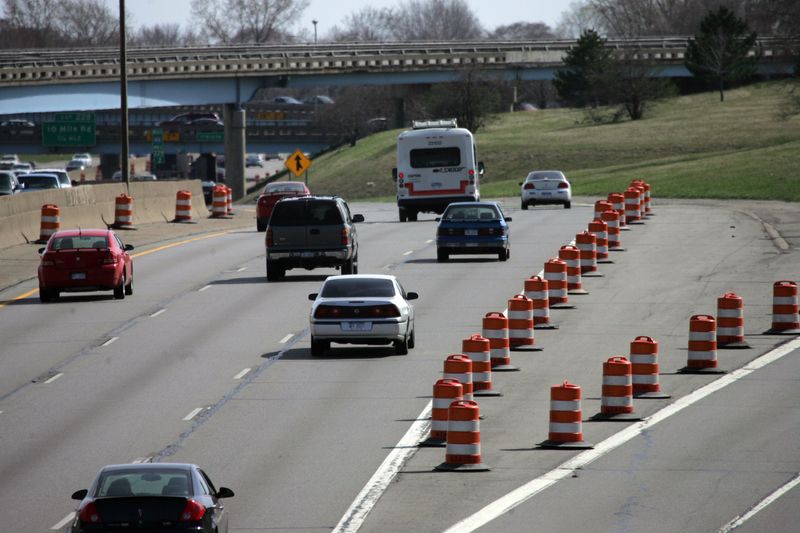
On highways across Michigan, federal immigration agencies have placed surveillance cameras in undisclosed locations that can capture images of vehicles and their license plates, raising concerns from civil rights advocates who fear they could be used to target immigrants and others.
The Michigan Department of Transportation has approved requests from Department of Homeland Security agencies for construction permits for several locations on highways over the past two years, according to state documents reviewed by the Free Press. The placement of the license plate readers started under the administration of President Joe Biden and has increased since Donald Trump became president, records show.

Two of the license plate readers were placed in Wayne County, one on Interstate 75 and the other in Huron Township on I-275; one in Macomb County on I-94; one in Wexford County in northwest Michigan on U.S. 131; one in Branch County on I-69 near Coldwater, and one in Berrien County in the southwestern border area of Michigan on I-94. The exact locations of the cameras were redacted in the documents provided to the Free Press by the transportation department. A spokesperson for U.S. Customs and Border Protection said they can’t disclose specific locations for security reasons.
The use of the secret cameras has caused concern among immigrant advocates, who question why state officials are approving these cameras at a time when the United States is cracking down on immigrants and racially profiling communities in some cases, according to activists.
“They have the authority to deny these requests, and they could have done so,” Christine Sauvé, a manager at the Michigan Immigrant Rights Center, said of state officials. “By approving them, they are really just amplifying and giving a green light for agencies to do possibly unlawful stops, violating Americans’ and Michiganders’ rights under the Constitution. With these units by Border Patrol, this can affect a wide swath of people. And so it does seem like the state played a role in that, and they could have taken a different position.”
But state and federal officials said the cameras are legal. The state department of transportation said it can’t restrict what federal law enforcement does as long as they follow general state and federal guidelines.
“MDOT (Michigan Department of Transportation) is not an enforcement agency,” Jocelyn Garza, deputy director of public affairs for communications and media relations at the state department of transportation, told the Free Press. “Our responsibility lies within reviewing and granting permits dependent on if they meet state and federal specifications.”
The Michigan Department of Transportation granted the permits for the highway cameras to two agencies that are part of the Department of Homeland Security: U.S. Customs and Border Protection (CBP) and Homeland Security Investigations (HSI), which is part of U.S. Immigration and Customs Enforcement (ICE). In July 2024, a memorandum of understanding for “trunkline construction permit projects” was reached between the two agencies and the state department of transportation, the permits show. “Trunkline” refers to highways and the area around them. The memo said the two federal agencies would pay for all the construction and be responsible for their maintenance. It was signed by the chief patrol agent for the Detroit sector of U.S. Border Patrol, which is part of CBP; Special Agent in Charge of the Detroit branch of HSI, and a state transportation department official on behalf of the director.
After the memo was signed, the first placement of the cameras with license plate readers was done in 2024 on the median of I-69 in Branch County. The existence of the cameras was first reported by the Associated Press and later confirmed with additional details by the Free Press.
Border Patrol defends use of highway cameras
A spokesperson for Customs and Border Protection (CBP) defended the use of the cameras that contain license plate readers, saying it’s part of their mission “to detect illicit activity while supporting lawful trade and travel.”
“As part of that approach, CBP uses license plate readers — often the same systems employed by state and local law enforcement nationwide — to help identify threats and disrupt criminal networks,” the spokesperson for the immigration agency said.
The CBP spokesperson said they can’t disclose the specific locations or number of license plate readers in Michigan “for operational security reasons … as that would enable drug smugglers and other bad actors to circumvent detection and tamper with LPR (license plate reader) equipment.”
Advocates say cameras raise constitutional concerns
There has been growing concern raised about the use of license plate readers by law enforcement agencies and how the data obtained from them is used.
“ALPR (automated license plate reader) technology can be used to target drivers who visit sensitive places such as health centers, immigration clinics, gun shops, union halls, protests, or centers of religious worship,” said the Electronic Frontier Foundation, a group that advocates for civil liberties and studies the use of technology by law enforcement.
Sauvé, an immigrant rights advocate, is concerned about how the data obtained by the cameras will be used, fearing they could be shared with other law enforcement agencies to target drivers, including U.S. citizens.
“It really raises serious constitutional questions for everyone, because, as Americans, we all have the right to live free of unreasonable searches and seizures under the Fourth Amendment,” Sauvé said. The technology of the cameras often relies on faulty algorithms that end up targeting innocent people, resulting in vehicles being pulled over for searches that are used as a pretext to detain immigrants, she said. For example, a person could get pulled over based on their driving patterns.
“This could affect lots of people, not just immigrants, based on how they’re using them,” she said. “So I have a lot of concerns about that, and would hope to get more details to see how it’s playing out.”
It’s unclear how Border Patrol and ICE could use the data learned from the license plate readers and with whom they would share it. There has been an ongoing concern about local law enforcement cooperating with federal agencies on immigration enforcement. Michigan State Police 1st Lt. Michael Shaw referred questions from the Free Press about whether state police would be able to use data from the CBP cameras on Michigan highways to CBP.
Another issue is that almost all of the state of Michigan falls under a 100-mile border zone because of its proximity to Canada; under the law, this gives Border Patrol extra powers to search and stop people in Michigan. The border zone, coupled with the new cameras, could be used to aggressively target people. The CBP spokesperson said that while Border Patrol “primarily operates within a 100-mile zone, Border Patrol has the right under the Immigration and Nationality Act “to operate anywhere in the United States.”
Garza, with MDOT, said that the federal immigration agencies had to agree to certain conditions before getting the permits for the cameras. She said CBP and HSI were required to sign a standard letter before getting the permits that says they must agree to several conditions: that the permits are for law enforcement purposes only; the data will not be used, sold or transferred, for any purpose other than law enforcement; they follow state and federal laws for privacy protections, and the location for the cameras must comply with MDOT standards for design.
Garza emphasized that MDOT does not operate as a law enforcement agency, but added that in the future, the department could place cameras in some places to monitor speeding vehicles in work zones after new legislation that was signed into law in 2024. These potential future cameras are not related to the construction permits the department approved for immigration agencies to place the Border Patrol cameras, she said.
Border Patrol cameras on highways across state
After the license plate reader was placed by Border Patrol in Branch County in 2024, the state department of transportation approved later that year a camera to be placed on the left side of the road on I-75 in Wayne County. The time period for the construction permits granted was generally over a one-year period. For example, the approval for the one on I-75 in Wayne County in 2024 was from Sept. 5, 2024, to Sept. 5, 2025.
The other four cameras with license plate readers from Border Patrol are: I-94 in Berrien County, placed in 2025; U.S. 131 in Wexford County on the left side, approved in March 2025; I-275 in Huron Township in Wayne County on the south side of the road, approved in July 2025; I-94 in Macomb County on the left side, approved in February 2025.
It’s unclear whether there are other cameras placed by CBP aside from those in the documents reviewed by the Free Press or whether more are planned for later. State documents also show that MDOT has had lease agreements with the U.S. government through the General Services Administration over the past decade for property at the Blue Water Bridge in Port Huron, where Border Patrol has offices. The bridge connects Michigan to Canada.
Contact Niraj Warikoo: nwarikoo@freepress.com
This article originally appeared on Detroit Free Press: Michigan approves Border Patrol surveillance cameras on state highways
Reporting by Niraj Warikoo, Detroit Free Press / Detroit Free Press
USA TODAY Network via Reuters Connect