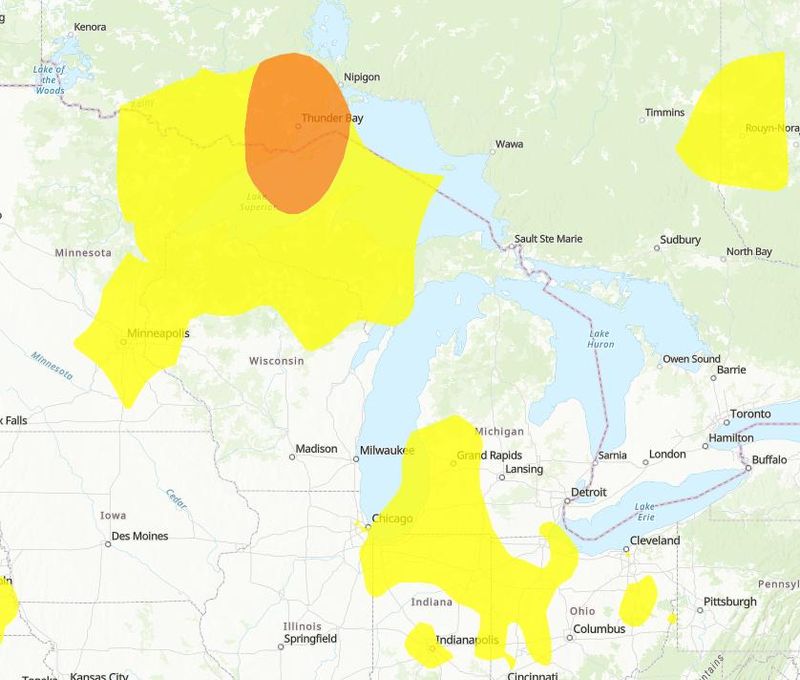
That National Weather Service has issued an air quality advisory for most of Michigan’s Upper Peninsula, southern Michigan and southeast Michigan from Friday, May 30, into the morning of Saturday, May 31.
A cold front moving down from Ontario will bring wildfire smoke in the provinces of Manitoba and Saskatchewan into Michigan, according to the NWS.

The smoke will move into southeast Michigan late in the afternoon and into the evening Friday, May 30.
The air quality levels could rise into unhealthy for sensitive groups (orange) or unhealthy (red).
Although Michigan’s ozone season generally runs between the warmer months of March and October, particle pollution from sources like power plants, vehicle emissions and industry can reach unhealthy levels year-round. Some of these pollutants are so small, PM2.5, they can be inhaled into your lungs and can even enter your bloodstream with serious health consequences. Other sources of particle pollution include unpaved roads, construction sites and wildfire smoke, like the spate of unhealthy air days Michiganders experienced in the summer of 2023 when Canadian wildfires darkened Detroit’s skyline.
Michigan’s current air quality
The map below displays the current air quality at monitoring sites in the U.S., Canada and Mexico. Air monitoring sites are color-coded based on the pollutant (ozone or particulate matter) with the highest value. Particles that are less than 10 micrometers and 2.5 micrometers in diameter are called PM10 and PM2.5, respectively.
An AQI of 50 or below means the current air quality is good. The shaded areas of the map show the approximate boundaries where air quality is available and listed as anything other than good. The information is updated hourly.
Air Quality Index guidelines (ozone and particle pollution)
Some people are more sensitive to air pollution because of their age or health. People who are active or work outdoors are also at higher risk when the air quality is poor. Health concerns related to poor air quality may include difficulty breathing, coughing or wheezing and more serious health effects such as lung damage, asthma attacks, heart attacks and stroke.
Here’s how to interpret the Air Quality Index values, according to the U.S. EPA:
For more information about air quality, visit AirNow.gov.
Free Press reporter Kylie Martin contributed to this report.
Kristi Tanner is a data reporter. Contact her at ktanner@freepress.com. Follow her on Twitter: @midatalove.
This article originally appeared on Detroit Free Press: Michigan air quality map: Check if it’s bad today in your area
Reporting by Kristi Tanner and Tanya Wildt, Detroit Free Press / Detroit Free Press
USA TODAY Network via Reuters Connect