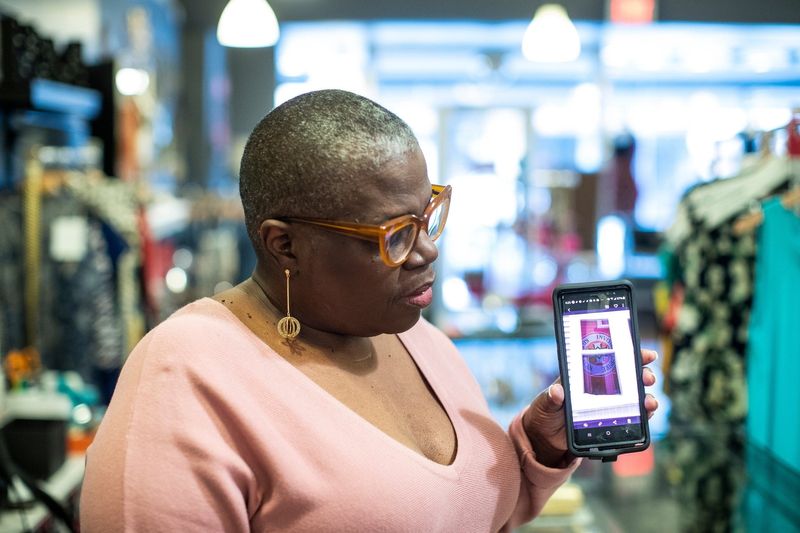
It’s been an arduous five-year process, but JeDonna Dinges is finally getting some relief.
Back in 2021, Dinges’ neighbor, Ryan Wilde, hung a Ku Klux Klan flag in his window facing her Grosse Pointe Park home. The police said nothing could be done, and the neighbor’s actions didn’t meet what was, at the time, the standard for charges of ethnic intimidation. Dinges and her daughter, India, sued, and on Thursday, May 14, a settlement was announced in their federal civil rights lawsuit against Wilde.

“I’m relieved that we’re done with the case. It was a long journey,” said Dinges, who won an undisclosed amount in a settlement that’s subject to a non-disclosure agreement.
“It was very difficult, but it was necessary because we wanted to get a measure of justice and we wanted to also send a message to people who decide to do things like put up a Klan flag that this type of behavior is not acceptable. This is our way of saying ‘You cannot dehumanize us.'”
Dinges has done what few others have accomplished after experiencing such a horrific incident. She not only followed through on holding Wilde accountable for his actions, she made it easier for others by spearheading the workgroup that changed the ethnic intimidation law in Michigan.
‘True heroes’
Dinges’ actions are a testament to her strength and mental fortitude not to let the incident fade from the public’s eye.
Her persistence has led to substantial change.
The federal lawsuit alleged violations of a Reconstruction-era civil rights law designed to protect Black Americans from racially motivated threats from groups such as the KKK. Dinges filed the case in 2023.
“JeDonna and India Dinges are true heroes,” said Ku’Juana Quinn, a student attorney with the Civil Rights Litigation Initiative at the University of Michigan Law School who represented the mother and daughter. “They bravely stepped forward and fought for justice not just for themselves but for everyone in Michigan.”
Dinges’ story hit local and national news in Feb. 2021, after her next-door neighbor in Grosse Pointe Park displayed a KKK flag in a side window facing Dinges’ home. The neighbor is white. Dinges is Black.
The neighbor said then that he hung the flag to protect his privacy when Dinges installed a security camera after someone left a full gas can in her closed recycling bin.
Dinges suspected the neighbor, who had been antagonistic before, but police said nothing could be done, and advised her to install that security camera. The neighbor eventually replaced the flag with a white drop cloth that was provided by the Grosse Pointe Park police.
But then her neighbor threatened to put the KKK flag back up. That’s what led Dinges to double check to see if her doors are locked every night, something she didn’t do for the decade prior to the incident in her quiet Grosse Pointe Park home.
It was May 8, 2021, that I outlined how Dinges and her daughter were coping in the aftermath of the incident. She and her daughter, India, worried about the neighbor breaking in.
They didn’t feel safe enough to open the curtains in their dining room. Daylight would have to wait.
“I don’t know how we get on the other side of it,” Dinges said in 2021, in the middle of another crisis, the COVID-19 pandemic. “What I know for sure is that there’s no singing of Kumbaya; that’s not going to happen. People need to stop asking Black people to accept apologies that have not been offered, not been given and that aren’t sincere. I don’t want an apology.”
At the time, I didn’t know that I would have a front-row seat to watch Dinges confront open racism daily – and its aftermath.
There was Wayne County Prosecutor Kym Worthy, who did not file charges against Wilde because there was insufficient evidence and the law lacked teeth; there was political wrangling over legislation that held up its passage for more than a year, and finally, there was this federal lawsuit against Wilde.
Dinges ultimately worked to get Michigan’s ethnic intimidation law changed, and has secured a settlement in federal court.
Through experience, she now understands the political and judicial process better than most.
On the flip side, every deposition or appearance in court over about a three-year period was triggering, because it was a constant reminder of what she and her daughter endured.
‘You can stand up and fight back’
JeDonna was the family spokesperson, and India was a young adult during this tumultuous time. India has grown tremendously.
In 2021, India had to put on earphones while her mom talked during our initial interview. The incident was so traumatizing that India struggled with her mental health and needed to drop her classes in college. Now, India is approaching 27, and earned a 4.0 this past semester. She’s become wiser, even media savvy enough to pipe in that a portion of our talk Tuesday night was off the record.
Likewise, JeDonna has changed from having a normal life to one where she’s recognized while running simple errands such as grocery shopping. The recognition makes her uneasy, because she’s constantly watching her back, she said.
“We’re not the same people that we were before that flag went up. We will never feel the sense of safety we felt prior to this incident,” Dinges said. “We’re forever changed … You can never fix what was broken. You can never restore our sense of safety.”
Five years may seem like a long time, but in some ways our country has regressed. That’s the scary part.
The important lesson to take from JeDonna Dinges is much like lessons from those in the past who fought against racism, primarily in the South. Sitting at lunch counters and boycotting buses wasn’t about the individuals themselves, but for others coming behind them. Average Americans can make a difference. It was never a position Dinges signed up for, but one she’s endured.
“That’s why it was important for us to do this, not just for ourselves, but also to send a message to other people that you can fight back,” Dinges said. “If we can stand up and fight back, you can stand up and fight back. India and I are not attorneys (or) legal scholars. We’re just regular people, living our lives, not bothering anybody, just existing in our own skin in our community.”
Darren A. Nichols, named one of Michigan’s most recognized media figures, is a contributing columnist at the Free Press. He can be reached at darren@dnick-media.com or his X (formerly Twitter) handle @dnick12. Submit a letter to the editor at freep.com/letters, and we may publish it online or in print.
This article originally appeared on Detroit Free Press: Man’s KKK flag antagonized Grosse Pointe family. They sued. | Opinion
Reporting by Darren A. Nichols, Contributing columnist / Detroit Free Press
USA TODAY Network via Reuters Connect