Even though the Rouse Simmons sank in 1912 in choppy Lake Michigan waters, its legacy continues to live on every holiday season.
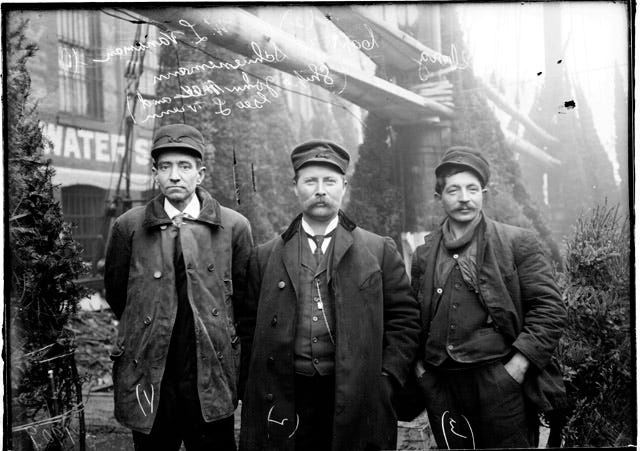
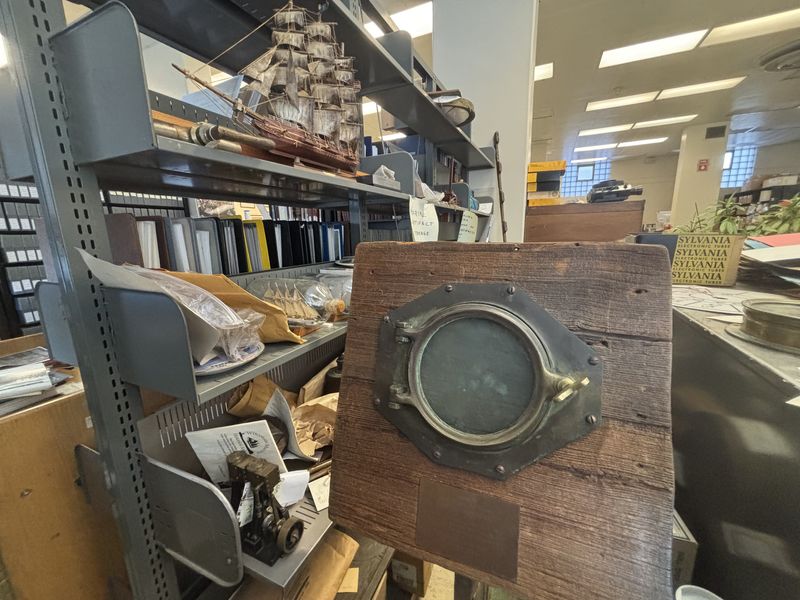
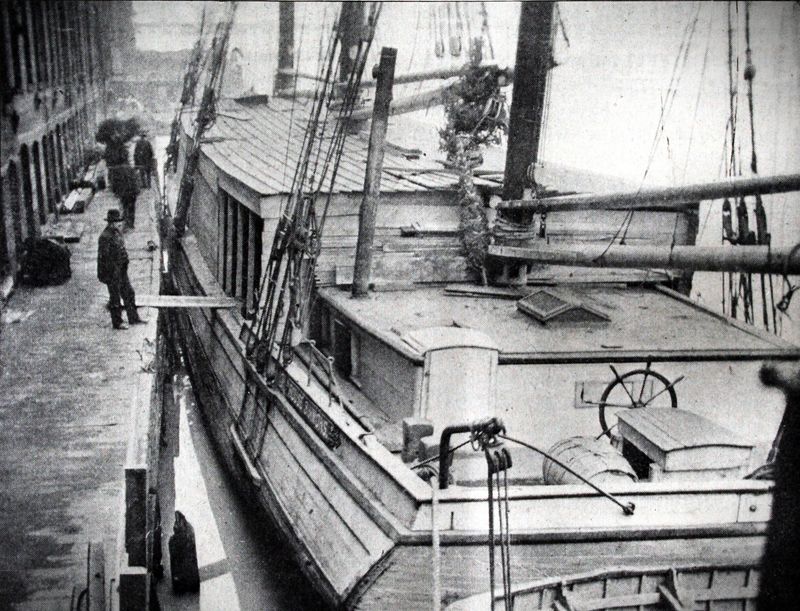
In the early 1900s, Wisconsin native Herman Schuenemann captained a Great Lakes lumber shipping vessel called the Rouse Simmons, a three-masted schooner known affectionately as “The Christmas Tree Ship.”

While most ship captains who dabbled in the Christmas tree business sold their trees to middlemen wholesalers and grocers, Schuenemann sold directly to Chicago residents dockside by Clark Street Bridge. His insistence on keeping prices low and his tendency to give away 10% of his trees to families who could not afford them earned him the title “Captain Santa.”
“’The Christmas Tree Ship’ and ‘Captain Santa’ were Windy City heroes,” said George V. Kisiel, chairman of Chicago’s Christmas Ship Committee. “Their arrival became a Christmas tradition, with crowds gathering and waiting at the dock. Folks would watch the parade of masts at the busy port, waiting for that glorious sight, a mast with a Christmas tree lashed aloft, appearing over the horizon, soon followed by the overwhelming scent of pine needles.”
Unfortunately, ship captains who supplemented their usual spring, summer and fall lumber shipping income with Christmas tree runs at the end of the year did so at great risk. Great Lakes weather worsens dramatically in late autumn, and by Thanksgiving, ship-wrecking storms can be a weekly, sometimes daily occurrence.
“Transporting a cargo of 5,000 trees lashed to the deck of a wooden three-masted schooner was a hazardous enterprise,” said Kisiel. “Capt. Schuenemann had lost his brother to the lake and was well aware of the dangers of the inland seas in November and December. Unfortunately, Schuenemann and the Rouse Simmons met their end the night of Nov. 23, 1912. The ship and its cargo foundered in a winter gale off shore between Kewaunee and Two Rivers, Wisconsin. Captain and crew were all lost.”
According to Kisiel, the sinking of The Christmas Tree Ship had a deeply painful impact on Chicago. On Nov. 24, 1912 as the usual crowd waited at the Clark Street Dock, hours passed without the arrival of the ship. The crowd gradually dispersed until only a lone child and her father remained. Ruthie Erickson held out hope for the ship’s arrival, and when her father tried to convince her to return home, her sad refrain echoes to this day in Chicago maritime folklore: “Dad,” she said. “Without a Christmas tree, there is no Christmas.”
A Christmas tradition reborn
Eighty-eight years after the sinking of the Rouse Simmons, the tradition of The Christmas Tree Ship was brought back to life.
Kisiel tells us the revival was one part perfect timing and two parts a whole lot of luck.
“In July of 2000, a group of Chicago mariners were aboard the United States Coast Guard Cutter (USCGC) Mackinaw for the start of the annual Chicago-Mackinac sailboat race,” Kisiel said. “A discussion ensued about the turn-of-the-century schooners that brought Christmas trees to Chicago. The mariners began tossing around the idea of recreating the voyage and delivering Christmas trees to disadvantaged Chicago families.”
The idea sounded nice, but the obvious question remained: How could they bring back a tradition that ended partly because of how dangerous it is to sail on the Great Lakes during November and December?
That is where the United States Coast Guard comes in, because unlike most commercial and recreational Great Lakes vessels, the Coast Guard operates ships that are capable of tackling the inland seas year-round.
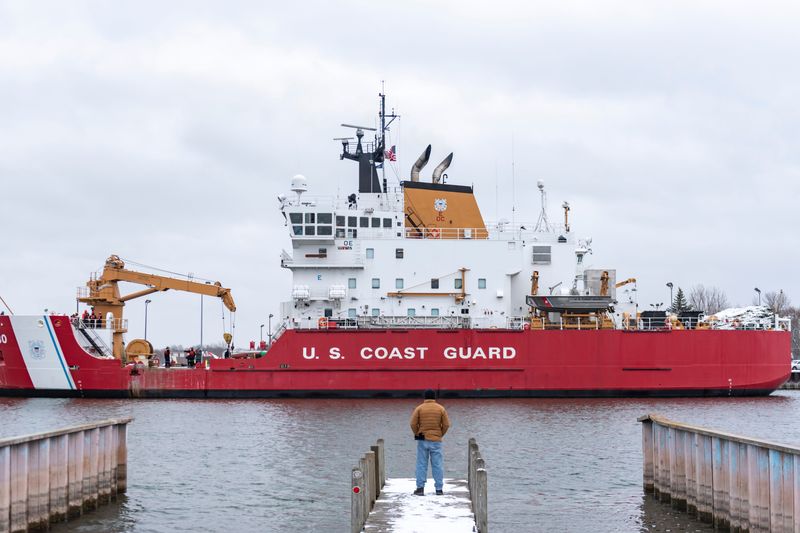
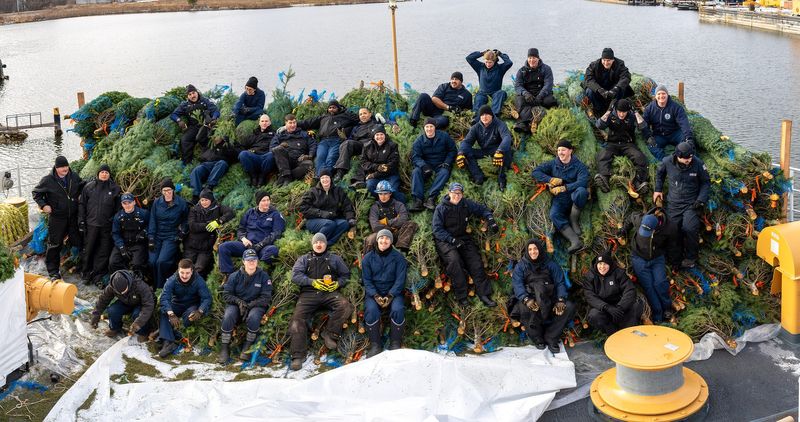
Every year around Thanksgiving, the USCGC Mackinaw, a 240-foot icebreaker vessel, leaves its port in Cheboygan and makes its way through the Straits of Mackinac and down through Lake Michigan, on a mission to examine and remove buoys in preparation for winter. In 2000, its captain was John Nickerson, and between him, Captain Dave Truitt (who would soon become the first chairman of Chicago’s Christmas Ship Committee), and a few others, it was decided that the Coast Guard vessel would begin bringing Christmas trees down to Chicago.
“They were already headed that way anyway,” Kisiel said with a chuckle.
Cheboygan embraces its “Coasties” and their annual Christmas mission
Cheboygan-stationed Coastguardsmen have been transporting hundreds of Christmas trees to Chicago every year without fail since 2000. Even when the USCGC Mackinaw was unavailable in 2011 due to maintenance needs, another Coast Guard cutter, the Alder, was quickly dispatched to pick up and deliver the trees.
Since 2018, the Coast Guard’s efforts have been greatly assisted by Cheboygan’s Coast Guard Connection Committee, of which Joanne Cromley is co-chair. According to Cromley, the committee’s mission is to help make Cheboygan feel like a home away from home for some 60 Coast Guard service members during their tour serving on the Mackinaw.
“We want the Coasties to feel that Cheboygan is a welcoming place and that we appreciate their service time here,” Cromley said. “Further, the Coast Guard Connection welcomes the families of service members and works to make the adjustment of moving to a new post as comfortable as possible.”
To Cromley, a big part of how the community comes together and works with the Coast Guard is by adding a volunteer and organizing component to the Christmas tree event.
First, the Christmas Ship Committee in Chicago fundraises throughout the year and procures donations to order 1,200 trees from Dutchman Tree Farms in Manton, Michigan. The trees are delivered to Cheboygan via 18-wheelers, and from there, Cheboygan volunteers take over.
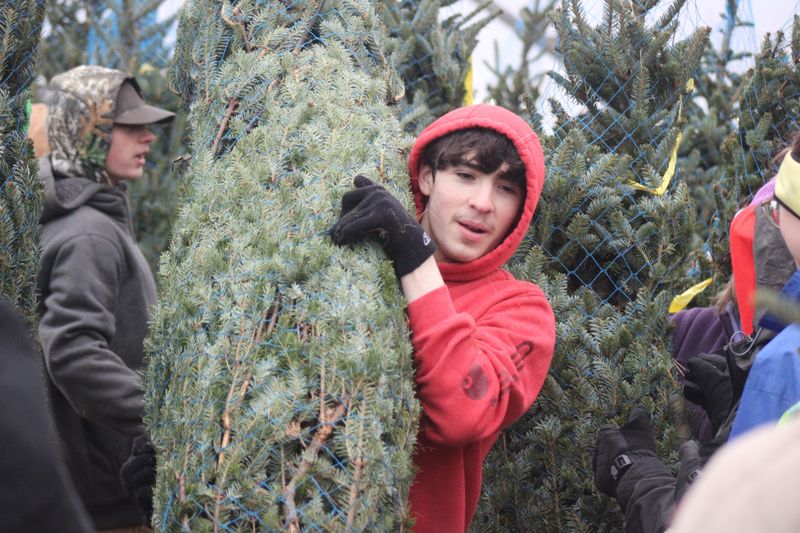
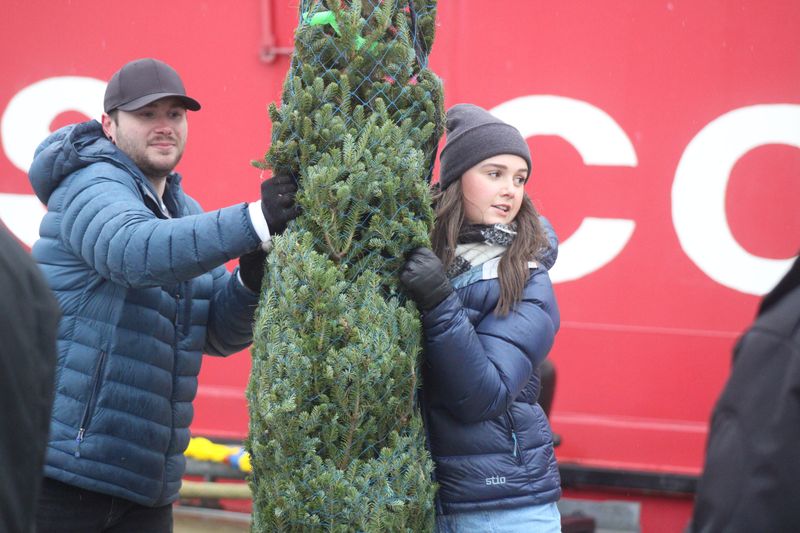
“On the Tuesday before Thanksgiving, three area high schools send students to the docks and they help unload the trees from the trucks, place them on a conveyor belt that brings the trees onto the USCGC Mackinaw, and from there the students help store and secure the trees in the ship,” Cromley said.
Once all the trees are loaded and stored, the students receive tours of the Coast Guard cutter, giving them an opportunity to interact with its crew and see what it’s like to operate an icebreaker vessel on the Great Lakes.
But the volunteer efforts and community engagement doesn’t end there.
“We also ask local children, seniors and families to write Christmas cards,” Cromley said. “We put out an ask for 1,200 Christmas cards, one to go with each tree, so that the families receiving the trees down in Chicago get a Christmas card from families in Cheboygan. We always, and I mean always, get more cards than we ask for.”
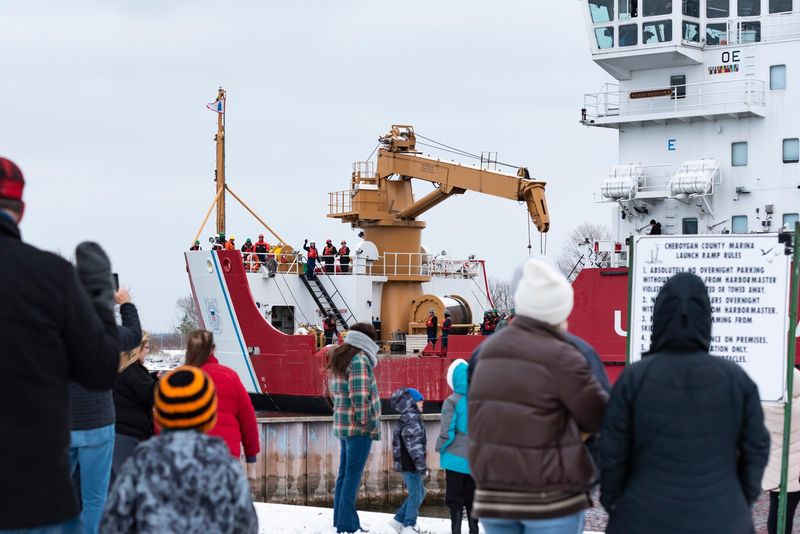
Cheboygan then sends off the Mackinaw with much fanfare, cheering and waving as the icebreaker heads out with a cargo of Christmas trees and cards. This year, the send-off party will begin at 9:30 a.m. at the Cheboygan County Marina on Saturday, Nov. 29, with a 10 a.m. departure time. The date and time is subject to change due to weather or other factors.
“There is a strong sense of local pride in being the home port of the USCGC Mackinaw,” Cromley said. “We have a great local treasure by having a Coast Guard presence here, and the fact that the ship and its crew is involved in a Christmas tradition as special as this, that makes us all really proud to call Cheboygan home.”
Tradition’s impact goes beyond tree delivery
Once the USCGC Mackinaw arrives at Navy Pier in Chicago, the Chicago Christmas Ship Committee, Ada S. McKinley Community Services and a number of other organizations host ship-welcoming events that include educational programing for high school students, choral performances, official memorials for lost sailors, a Chicago Fire Department helicopter flyover and a ship-decorating event, all of which culminates in volunteers boarding the cutter to unload the trees onto trucks that then depart to distribute the trees to needy families throughout Chicago.
“This tradition has an impact well beyond the simple delivery of free Christmas trees,” Kisiel said. “There are about 20 community organizations that we partner with to get the trees out into Chicago neighborhoods and to the families who need them. These organizations tell us that this annual event is their best opportunity to do outreach into the communities they serve, to tell local Chicagoans, ‘Hello there, we’re here in your neighborhood. We’re here if you need us. And by the way, here’s a Christmas tree. The Coast Guard brought it all the way from Cheboygan, Michigan, and we just wanted you to have it. Merry Christmas to you and your family.’”
Ren Brabenec is a Brimley-based freelance writer and journalist with The Sault News. He reports on politics, local issues, environmental stories, and the economy. For questions, comments, or to suggest a story, email hello@renbrabenec.com.
This article originally appeared on Cheboygan Daily Tribune: Legacy of the Rouse Simmons lives on in annual ‘Christmas Tree Ship’
Reporting by Ren Brabenec, Special to the Daily Tribune / Cheboygan Daily Tribune
USA TODAY Network via Reuters Connect