Michigan drivers could soon see an unusual-looking all-electric midsize pickup, covered in camouflage, on the streets of metro Detroit. It is the vehicle that Ford Motor Co. is counting on to carry it into the future.
That was one of many topics Ford’s Chief Financial Officer Sherry House discussed during the UBS Auto and Auto Tech Conference via webcast on June 3.

About the EV pickup, House said the first vehicle off Ford’s newly developed Universal Electric Vehicle platform, an all-electric midsize pickup aimed to start at about $30,000, is ready for launch and prototypes of it are being made in Michigan and tested on roads.
Ford spokesman Dave Tovar clarified that while the prototype are “out in the wild” right now, they are not yet on Michigan roads, but they will be in the next few weeks.
This midsize all-electric pickup is the first product designed by Ford’s “Skunk Works” team at the Dearborn-based automaker’s secretive Electric Vehicle Development Center (EVDC) in Long Beach, California.
“The project is going really well. We’re on plan for our 2027 launch,” House said during the wide-ranging interview at the tech conference for investors. “We are making prototype vehicles in Michigan. We’re testing those already on the road. We’re testing our megacastings, which is a new product. We’re doing a supplier readiness assessment. So all those things that you’d expect us to be doing … preparing for launch is in full force today.”
Megacasting is a production process in which machines inject molten aluminum into giant molds to cast single-piece sections of a car’s frame such as the whole front underbody, according to Automotive Manufacturing Solutions. Tesla has used it for years and it is known to dramatically reduce manufacturing costs.
In addition to Ford’s vision for its new EV, House updated investors on Ford’s pickup production as it works to make up for a 100,000-unit production loss last year due to a supplier hiccup; she revealed a new aspect to Ford Energy’s new contract with EDF power solutions, and she touched upon what Ford wants from a new United States-Mexico-Canada Agreement as negotiations for a tweaked deal begins.
How the new UEV platform gives Ford a cost edge
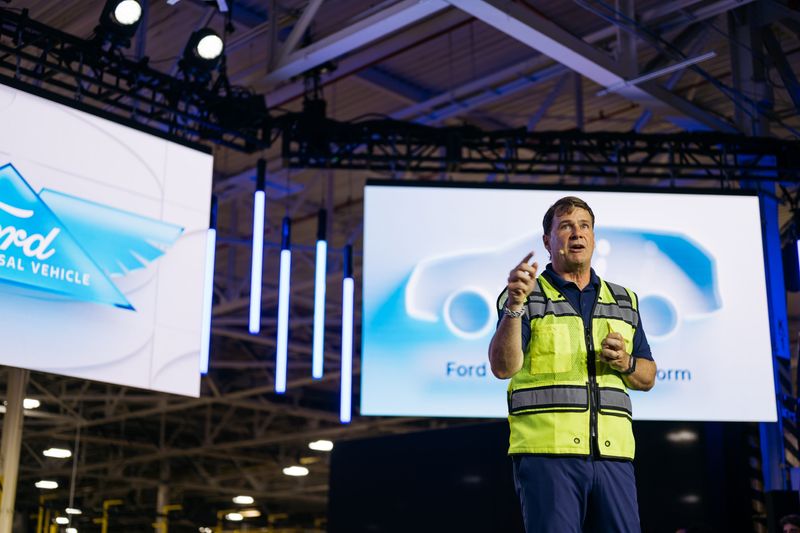
In August 2025, Ford announced that it had had innovated a new electric vehicle manufacturing process and a new EV platform, both of which will allow the automaker to more efficiently bring several lower-cost EVs to market.
Ford CEO Jim Farley has said the first EV to come from these new innovations would be a midsize, four-door electric pickup that starts at $30,000 and is due to launch in 2027. He has promised a family of EVs to follow, all built on that platform, and has hinted at a small SUV and even a sedan as being possible future products.
House told investors that because it is a new platform offering other vehicles, Ford will get economies of scale off of it, allowing the company to price the vehicles affordably but grow profits. Ford has not defined what it views as affordable, other than to say the first vehicle off the platform, the midsize pickup will start at about $30,000.
“It’s going to be very feature-rich. It’s going to be very tech-forward,” House said. “It’s going to be affordable, and we think that it’s affordable to the point that, it’s not just competing against EVs, it’s also competing against gas-powered vehicles as well.”
She said that price point will open up the market and help promote EV adoption.
Ford is currently testing its supplier readiness to support the new vehicles that will be built on the UEV platform at Louisville Assembly Plant in Kentucky once it is ready to start production next year. House said Ford has a standard protocol it takes all of suppliers through that includes production of high quality parts and an approved production process.
“What’s really important about the way we did this product is it started with the design,” House said. “We decided to design the most complex items in-house, and we took a very physics-based approach to the cost, because we looked at what should it cost, and we know because we designed it. So that puts you to very competitive advantage as you’re going out to then source it.”
Ford has also chosen to open up the products to new suppliers rather than use the suppliers it has always had, she said.
“So that process, where we have full design control, we know intimately what it should cost. We also know where you can make adjustments to the design to potentially improve the cost,” House said. “We believe it is part of what is making us so successful.”
The fight to remain America’s top-selling truck
Ford faces a lower than usual F-Series inventory after a fire at Novelis, a key aluminum supplier, last fall disrupted Ford’s production of many vehicles, including its profitable best-seller, the F-Series. Ford uses the lightweight aluminum in the bodies of its trucks to achieve fuel efficiency.
Ford lost about 100,000 units of truck production in 2025, but has said it expects to produce 50,000 units more this year, for 150,000 units total so as to make up for last year’s inventory shortfall.
In early April, Ford leaders said it had a 55-day supply of F-Series at the end of the first quarter. A 60-day supply is considered the industry standard for healthy inventory. Ford said the company’s F-Series inventory is down by about 60,000 pickups from a year ago.
Ford has said it expects an additional $1.5 billion to $2 billion in costs this year associated with having to find alternative supplies of aluminum from other suppliers.
On June 3, House said Novelis is “largely on track” to restart its aluminum production soon.
“In terms of communications with the Novelis facility … we would say it’s largely tracking as planned, and we’re going to be expecting to kind of be in this 10- to- 12-week period where you’re in the process of ramping up. That’s going to consist of validation of the material, making sure that it can get successfully through all the parts of the supply chain, and if there are any hiccups along the way, we have contingency material, as well.”
House said Ford expects aluminum production and supply to be “a little uneven” at first and not see full-pace and full-capacity production from Novelis until into the fourth quarter. The pressure to get Ford’s truck inventory has sparked a truck wars as competitors such as General Motors and Ram have seen Ford’s shortage as a potential opportunity to steal sales.
On June 3, Ford reported its total U.S. sales for May declined 13.6% to 190,828 vehicles sold. Ford pointed to its decision to reduce its sales to commercial rental businesses and its ending production of the Ford Escape and Lincoln Corsair SUVs at Louisville Assembly to make way for the UEV production, as reasons for the steep drop in sales.
But for the month, Ford sold 111,119 total trucks, an 8.4% decline from May 2025 due to inventory shortages. Still, Ford spokesman Said Deep said Ford remains the No. 1 truck seller in the United States.
“With approximately one out of every three full-size truck customers choosing the F-Series this year, the lineup expanded its lead in May as America’s best-selling truck,” Deep said. “Backed by year-to-date sales of 291,194 trucks, the F-Series grew its sales lead to more than 67,000 trucks over the second-place Silverado. This performance was achieved despite tight inventories due to supplier disruptions.”
More about Ford’s new battery venture
On May 18, Ford Energy, a new venture from Ford that is a wholly owned subsidiary of the automaker, said it signed a five-year “framework agreement” with EDF power solutions North America to make battery energy storage systems for EDF.
EDF power solutions North America is an entity of the EDF Group, a French government-owned multinational electric utility company that produces low-carbon electricity. It focuses on using nuclear and renewable energy.
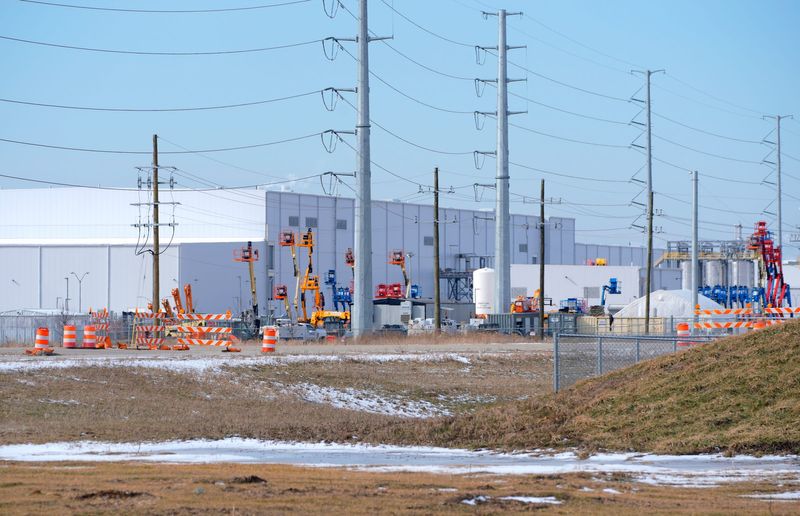
Ford Energy was created to use the full capacity Ford has at new factories in Kentucky and Marshall, Michigan. Those plants were intended to make EV batteries, but with EV demand stagnant, Ford had to find a way to fully use the facilities. The plant in Marshall is making EV batteries now, but will also make smaller energy storage systems for residential use for Ford Energy.
In this new agreement with EDF power solutions, EDF power solutions can procure up to 4 gigawatt-hours of Ford Energy DC Block battery energy storage systems each year, for a total potential volume of up to 20 gigawatt-hours over the term of the agreement. But some experts have said without an assurance that EDF power solutions will buy the storage systems, it could be a negative for Ford Energy because it ties up manufacturing capacity that could go to other customers.
House told investors June 3 that “it is a framework agreement and it has the ability to get up to 4 gigawatt-hours each of five years, but it does, importantly, have a minimum purchase commitment. That’s part of it as well, which some of these agreements don’t always have that clause, but ours does.”
She declined to provide further details of what level of purchase commitment is agreed upon.
What Ford wants from a new USMCA
Late last month, Reuters reported that the Trump administration issued a demand to Mexico to raise the level of regional content in North American-built vehicles to 82% to qualify for preferential trade deal access, with 50% of that value produced in the United States.
The USMCA was negotiated during President Donald Trump’s first term and went into effect in 2020.
The proposed new requirements were laid forth to automakers during two days of bilateral talks to revise the USMCA deal on trade. Canada was excluded from the negotiations in Mexico City, Reuters reported. The revised proposal did not make a provision for counting any parts content from Canada.
But, if accepted, the proposal would be a dramatic move away from the current USMCA, which requires 75% regional content to qualify for preferential tariff treatment. USMCA requires that 40% of the core parts value of North American vehicles be made in high-wage jurisdictions such as the United States or Canada. For pickups, the threshold, which includes engines, transmissions, major body parts and EV batteries, is 45%.
When asked for Ford’s view on a new USMCA treaty, House said it is crucial that Ford gets a strong North America agreement given that 80% of the vehicles Ford sells in the United States are also made here. Such an agreement would also enable North American-based suppliers to thrive.
“So, as we look at the components of the policy that are important to us, we think that we need to have good clarity around labor,” House said. “We need to have really good clarity around content, and there needs to be a structure that enables noncompliance to be handled with tariffs and those tariffs have to be meaningful enough to really encourage the type of behavior that we think the U.S. needs in order to continue to have high-skill, high-wage jobs within America.”
That is the framework that Ford will want discussed with the Trump administration, Canada and Mexico.
UAW President Shawn Fain and other union leaders held a webinar on Thursday, May 21, to discuss changes the union wants in an updated agreement. The UAW indicated it’s interested in a worker-centered trade policy that addresses the shift of factory jobs from the United States to lower-wage Mexico. It also wants to see a policy of build here to sell here, more labor rights and strong standards across borders.
House said Ford is constantly looking at where it makes sense to onshore more of its suppliers and production or “maybe to put more within Canada or Mexico?” She declined to provide specifics other than saying, “We’re always going to be trying to profit-optimize.”
Jamie L. LaReau is the senior autos writer who covers Ford Motor Co. for the Detroit Free Press. Contact Jamie at jlareau@freepress.com. Follow her on Twitter @jlareauan. To sign up for our autos newsletter. Become a subscriber.
This article originally appeared on Detroit Free Press: Keep an eye out: Ford’s EV of the future to be tested on Detroit roads
Reporting by Jamie L. LaReau, Detroit Free Press / Detroit Free Press
USA TODAY Network via Reuters Connect

By Jamie L. LaReau, Detroit Free Press | USA TODAY Network