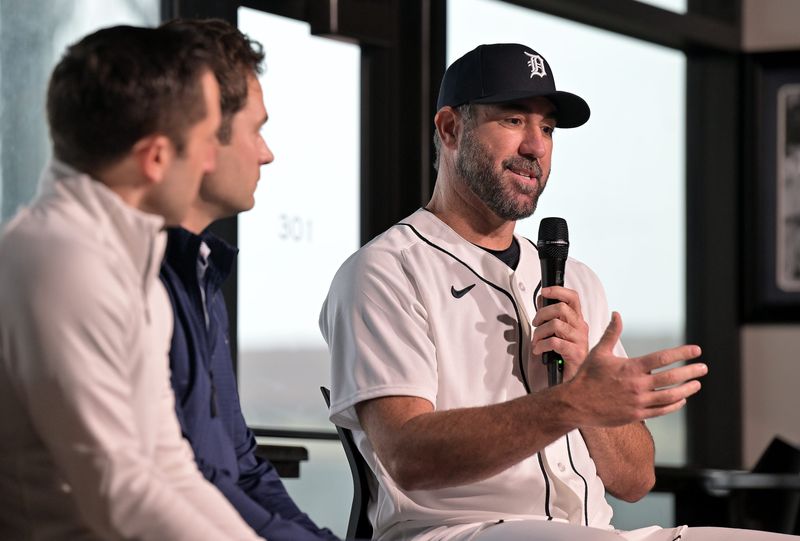
Lakeland, Fla. — It was Justin Verlander’s first day in the home clubhouse at Joker Marchant, which looks very different than when he last saw it in 2017. Still, Tarik Skubal was just messing around when he asked him if he wanted a tour.
“I was joking and he was like, ‘No, seriously, I do,'” Skubal said. “I was like, wait, when was this place built? I’m thinking he’d been here before and I was joking — here’s the trainers, here’s the weight room, that’s the field.

“Then we started walking around the corner, ‘Hey, this is you!”
Yeah, it’s going to be hard for Verlander to escape the nostalgia of this whole situation. Seeing a wall-sized photo of his first, highly decorated go-round with the Tigers is only a tiny glimpse.
“There’s just a lot of emotions running through,” Verlander said Thursday. “I haven’t processed it all yet.”
Tigers president Scott Harris is not a sentimental man when it comes to building Detroit’s roster. And he had no previous history with Verlander. So the decision to sign the soon-to-be, 43-year-old future Hall-of-Famer had less to do with the past and everything to do with the now.
“I’d never met him before, but I know what he means to this city and this organization,” Harris said. “And when we had an opportunity for him, we just want to engage him and help him understand what we’re trying to achieve here and how he fits.
“We know how he fits in the city and organization, we wanted him to know how he fits on this team and how he can help us win.”
It’s a fairytale story, really, one Tigers Nation has dreamt about since Verlander was traded to Houston in 2017. And, as he explained Thursday, a part of Verlander’s heart remained in Detroit.
“It was definitely in the back of my mind,” Verlander said of returning. “I grew up in front of the fans in Detroit. I was 21 years old when I got to Lakeland for the first time. I have so much history here. And last year, when we got knocked out of the playoff run toward the end of the season (with the Giants), I was thinking about where I wanted to be.
“Detroit just kept coming to my mind.”
The last thing he wanted to be was a right-handed mercenary, floating from team to team until he hung up his spikes. He wanted to be on a championship-caliber team. He wanted to be on a team he had a connection to.
The Tigers checked both boxes. The problem was, when he called owner Chris Ilitch and Harris and manager AJ Hinch early in the offseason, the Tigers didn’t have a spot for him. Reese Olson’s season-ending shoulder surgery opened the door.
“That’s not the way you want it to go,” Verlander said. “There is a lot of young talent here. But I am really excited to be back here.”
Harris talked about Verlander having some unfinished business in Detroit, referencing the World Series losses in 2006 and 2012.
“Yeah, that’s what Scott said,” Verlander said with a grin. “I wouldn’t say unfinished. You leave everything on the field. It’s not like it’s unfinished business. It didn’t leave a bad taste in my mouth. I know we did everything possible to try to win one. Playoffs can end up being a little bit of a crap shoot.
“The ball needs to roll your way one time and it can change the course of history.”
That said, to come back and help the Tigers win a ring, well, that’s the ultimate fairytale ending.
“The one thing I’d want to accomplish in Detroit that I had a couple of shots at that I really regret not achieving is a World Series title,” Verlander said. “Mr. I (former owner Mike Ilitch) was such an incredible owner and someone I really admired. In talking to Chris and seeing how the torch got passed down and how he’s going for it like his dad did — I’m really happy to be back here with a World Series-caliber team.”
The support he got from the Detroit fans, which continued even after he left, was not lost on Verlander.
“I’ve definitely felt the Detroit presence,” he said. “I got so many text messages from old friends, from Detroit friends, just as many as when I threw a no-hitter or won the Cy Young or the World Series. It was that much attention. Pretty cool.”
Nostalgia is a funny thing, though. We remember the younger Verlander. The ultra-intense, fireballer who bullied hitters with upper-90 and 100-mph fastballs. The ultra-intense competitor who could be abrasive, even with some teammates, especially on start days.
This isn’t that guy, on either front.
“My daughter really changed me to the core,” he said. “I just want to be more present. It’s something I’ve worked really hard on. I was always like a horse with blinders on, really just trying to pitch. And all the noise was exactly that — noise — and I probably missed a lot of things.
“Along the way, I’ve learned to remove those blinders, take in the bigger picture and enjoy the moments.”
Already, Verlander has made a point to reach out to some of the younger teammates in the clubhouse, showing them that he is approachable.
“My mindset, the one I talked about, wasn’t always conducive to being the best teammate when I was younger,” he said. “I don’t regret it because I think I needed that mentality to be the pitcher I was. But that perspective shift has really changed things.”
Verlander isn’t quite comfortable talking about this being a full circle moment. He will turn 43 this season but, if he has a healthy, successful season, it won’t be his last.
“Since I was 22, I said I wanted to pitch until I’m 45,” he said. “It seemed possible. It was a pretty naive thing to say back then, especially seeing what I’ve gone through and how hard it was to get here. But that stubborn mentality is what helps you achieve the goals.”
He’s gone as far as picking the brains of Tom Brady and Tiger Woods, who were high achievers into their 40s, about how to prolong a career. He’s tweaked and re-tweaked his training regimen and his pitching mechanics. And at the end of last season, everything clicked.
He was throwing his slider and curveball out of the same pocket as his four-seam fastball, now hitting 94 mph instead of 99, and he was back to his dominant ways.
“He puts in the work and he’s definitely unique,” said Hinch, who managed him in Houston. “It’s one of his biggest attributes, just how curious he is about getting better. He’s not afraid to evolve. You need that kind of commitment to get through the difficulties that come with playing at this level at that age.
“I saw what August and September brought last year and it didn’t look like there was any age number attached to his performance.”
If there is a full-circle element to this, at least for Verlander, it’s to be here for the culmination of the rebuild — of both for the city and the organization.
“I was there in 2006, 2008, 2009, 2010 and I remember how bad it was in the city, just the grit,” he said. “The thing that sticks out to me the most was how the fans embraced us, particularly in 2006. To buy a ticket and come to a ballgame was a huge expense for a lot of fans. But it was also a getaway something they could celebrate and cheer for a city that was really struggling.
“That meant a lot to me.”
Now to come back, a full-grown man in all aspects, with a very different perspective, it’s special for him.
“Looking back, I was so young and now my life has changed so much,” he said. “I have two kinds. I’ve been married for a while now. I’m just a different person. So to come back around and have another chance as a different man and to embrace the city I grew up in — it’s a different experience and I’m in a different place.
“I’m just real excited to reexperience Detroit in a new mindset.”
chris.mccosky@detroitnews.com
@cmccosky
This article originally appeared on The Detroit News: ‘A lot of emotions’: Justin Verlander follows his heart to reunion with Tigers
Reporting by Chris McCosky, The Detroit News / The Detroit News
USA TODAY Network via Reuters Connect