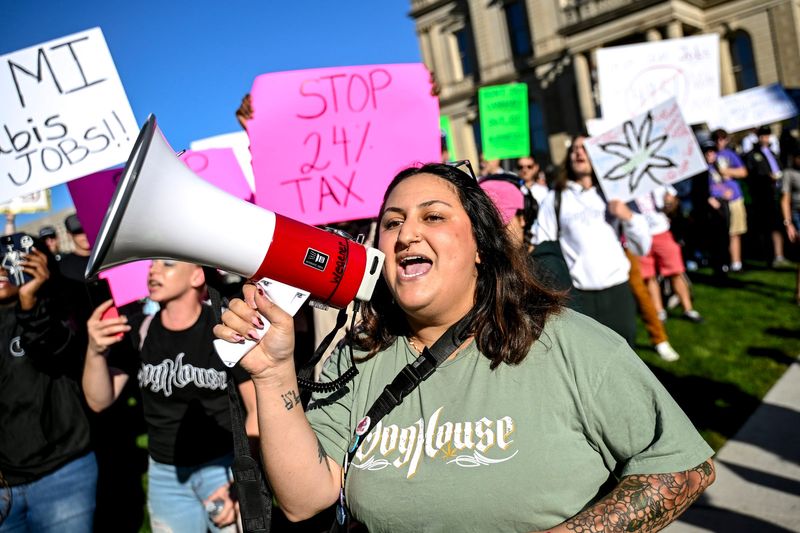
A Michigan judge declined to strike down a new tax on the wholesale price of marijuana, mostly backing the state’s argument that the tax won’t push customers to illicit pot markets and saying lawmakers didn’t violate the constitution when they passed the bills to create the new levy.
In an opinion issued Monday, Dec. 8, Michigan Court of Claims Judge Sima Patel denied a request made by the Michigan Cannabis Industry Association and marijuana cultivator Holistic Research Group to issue a preliminary injunction against a new 24% tax on the wholesale price of pot, set to take effect Jan. 1. Holistic Research Group and the MCIA, which represents over 400 cannabis businesses in Michigan, had sued the state in October, shortly after lawmakers and Gov. Gretchen Whitmer approved the new tax. The revenue from that tax is meant to pay for local road repairs. Legislative analysts forecasted an additional $420 million in annual revenue from the tax.

MCIA attorneys argued lawmakers lacked the super-majority needed to create the tax, as Michigan’s recreational marijuana law, the Michigan Regulation and Taxation of Marihuana Act (MRTMA), was created after voters approved a ballot initiative in 2018. The state’s constitution requires any changes to voter-initiated laws receive three-fourths approval to be amended by the Legislature.
Currently, there is a 10% excise tax on marijuana sales in Michigan. Patel wrote the new tax is allowable without a super-majority vote because “the initiative stated plainly that the 10% retail excise tax was in addition to ‘all other taxes.’ And the phrase ‘all other’ is broad and expansive.”
But Patel said more deliberation is needed to determine if the new wholesale tax violates the spirit of the MRTMA, and ordered attorneys for the state and the MCIA to convene Jan. 13 to schedule further hearings in the case.
The new wholesale tax is likely to provide a major shakeup to Michigan’s marijuana landscape. Retailers were already facing uncertainty, thanks in part to low retail prices for marijuana and market oversaturation. Cannabis industry stakeholders have argued they don’t have the profit margins to absorb a new wholesale tax, and at 24%, Michigan is poised to have one of the highest tax rates on pot in the country. MCIA Executive Director Robin Schneider previously told the Detroit Free Press the wholesale tax would lead to job cuts in the industry.
Industry advocates also argued they’d have to hike prices on their products, which could drive customers in Michigan to the illicit market. Patel didn’t appear receptive to the argument, siding with the state’s assertion that the claim was speculative.
Still, some government officials recognize the potential effect of the new tax. Bills have been introduced in the Michigan Legislature since October to create license caps for new marijuana businesses in communities, something cannabis business advocates say would help fight the market oversaturation the state currently faces. Other proposed changes include placing certain types of hemp, that contains certain amounts of THC and can produce a high, under the same regulatory scrutiny as cannabis.
Revenue from the new wholesale tax is part of a state plan to pay for local road repairs. Whitmer has made road rehabilitation in Michigan a key aspect of her tenure, and House Speaker Matt Hall, R-Richland Township, had argued during budget negotiations this year that funding was needed to address local roads.
Ron Leix, a spokesperson for the Michigan Department of Treasury, said the new wholesale tax will take effect Jan. 1 as planned, after Patel denied a motion for a preliminary injunction.
An MCIA spokesperson said the group plans to appeal Patel’s ruling.
“We don’t believe the Court of Claims made the right call. While we are deeply frustrated by this ruling, I can tell you this: The fight is far from over. We remain confident in the strength of our case that this move by the Legislature violated the will of the voters who approved the 2018 citizen ballot initiative,” Rose Tantraphol, MCIA spokesperson, said in an email.
Patel, who is a Michigan Court of Appeals judge but also handles cases in the Court of Claims, was appointed to her Court of Appeals post in 2022 by Whitmer. The Court of Claims has jurisdiction in lawsuits brought against state agencies and state law.
This story was updated to add new information. You can reach Arpan at alobo@freepress.com.
This article originally appeared on Detroit Free Press: Judge appears skeptical of lawsuit against Michigan’s new weed tax
Reporting by Arpan Lobo, Detroit Free Press / Detroit Free Press
USA TODAY Network via Reuters Connect