Their paths to Ann Arbor could hardly be more different.
For one, it was Spain to California to Michigan.

Another left Puerto Rico for Alabama, then zoomed north.
And then there’s the Midwesterner, heading south in Illinois, from Riverdale to Champaign, before arriving in the Great Lakes State.
And yet, despite those disparate distances covered, they wound up in one place, with one goal, with one team: Michigan basketball.
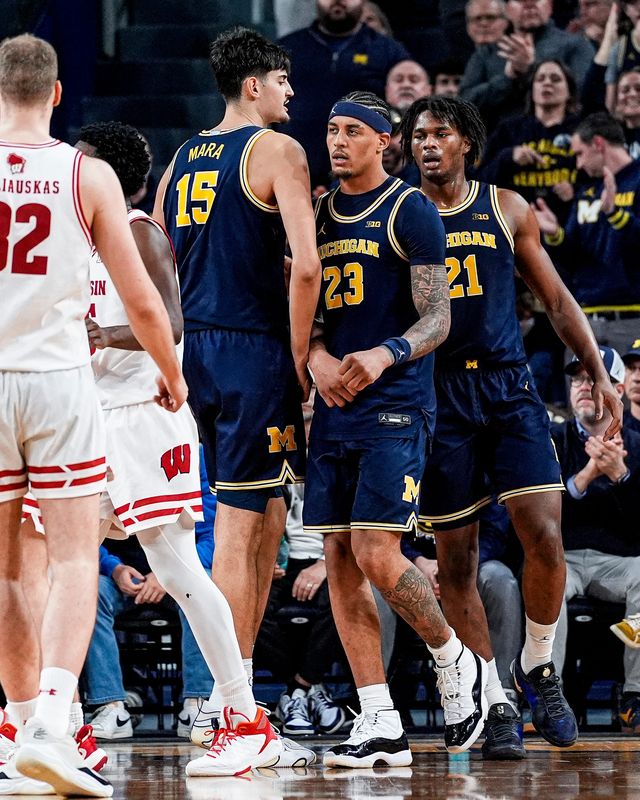
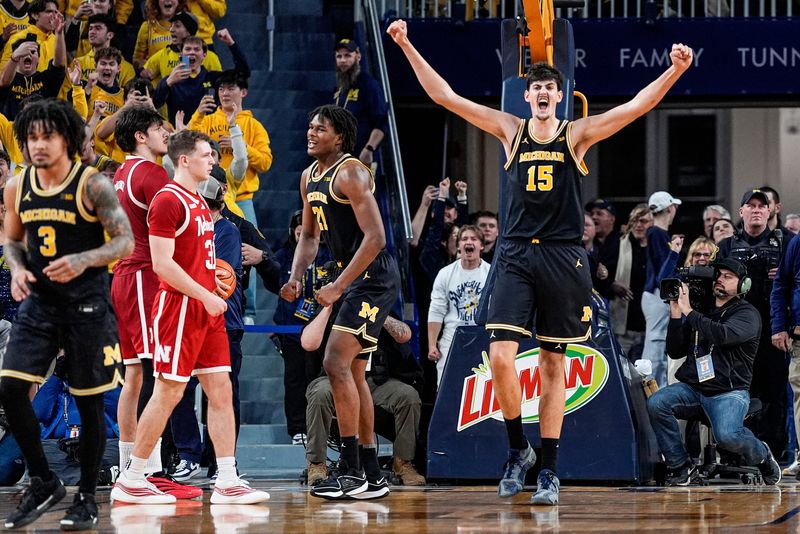
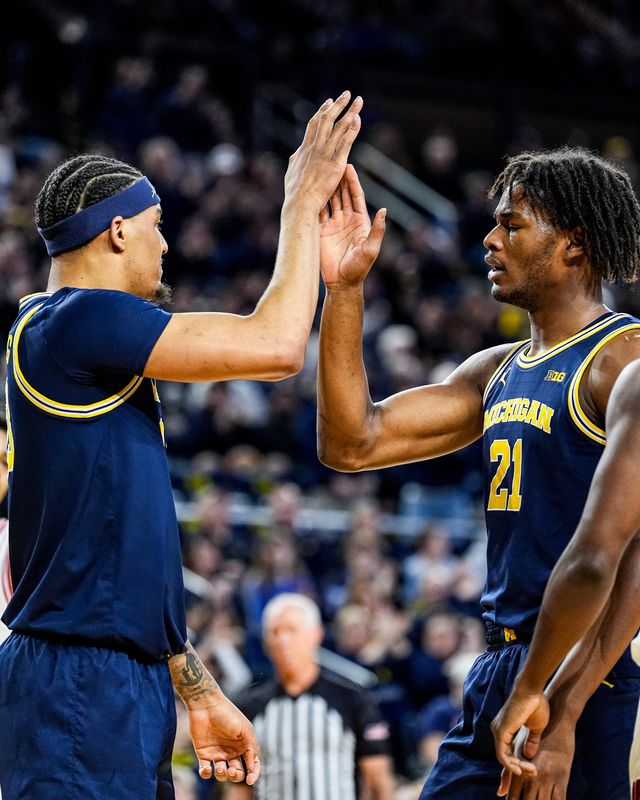
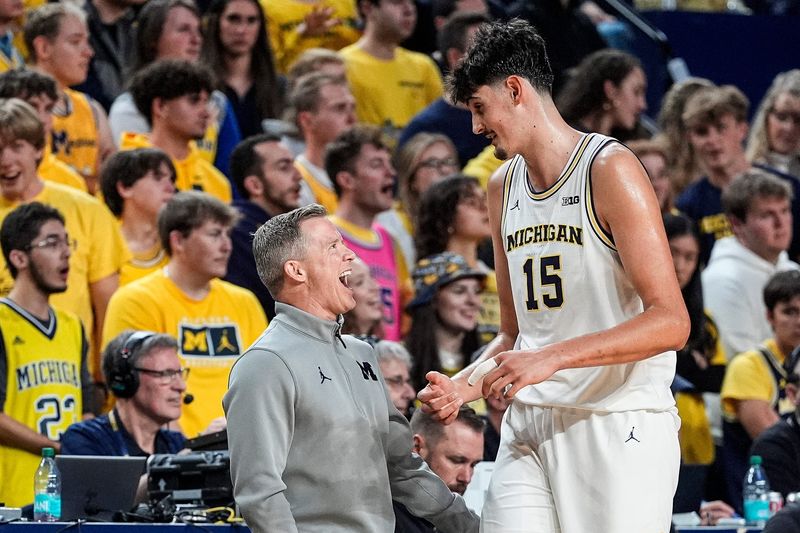
Aday Mara, Yaxel Lendeborg and Morez Johnson Jr. – the “Big Three” for coach Dusty May – are all on their second stop in Division I basketball, each poised to spend next season in the NBA as first-round picks. But first, each is looking to make history with the Wolverines.
U-M (24-1, 14-1 Big Ten) is off to its best-ever start, and now prepares for a regular-season finish that features four of the nation’s top 12 teams in 20 days.
But before looking ahead – to No. 12 Purdue on Tuesday (6:30 p.m., Peacock), No. 6 Duke on Saturday, No. 7 Illinois on Feb. 28 and, finally, No. 10 Michigan State on March 8 – it’s worth a moment to look back at how they all arrived in Ann Arbor, and how they learned to thrive together.
“I think they trusted us and the people that advised them said they could trust us,” May told the Free Press in January.
In May’s first year, the Wolverines had made a surprising surge from the bottom of the Big Ten to a Sweet 16 appearance, thanks to a pair of 7-foot transfers, Vlad Goldin (from FAU) and Danny Wolf (from Yale). Could they go even farther with three bigs?
“I think the Danny and Vlad experiment gave us a little bit of credibility that we will figure it out when everyone else was saying that we couldn’t,” May said. “But as far as having to sell them on it? No, we just presented what our vision was and hoped they’d buy into it.”
Coming together
That they did.
Johnson was first, committing to the Wolverines on April 1, 2025 after one season at Illinois. Less than two weeks later, Mara jumped from UCLA after two seasons. Lendeborg took a little longer to decide his destination after two seasons at Alabama-Birmingham; the No. 1 prospect in the transfer portal debated between Ann Arbor and the NBA draft.
That was fine with May and the Wolverines; U-M’s staff met with Lendeborg sporadically (including at the NBA scouting combine) and arranged visits for him to see the facilities, giving him a vision of how he would fit with the other bigs.
Lendeborg liked U-M’s approach – no forced decisions or hard deadlines. And so, nearly 50 days after Johnson and Mara jumped, Lendeborg withdrew from the 2025 NBA Draft and committed to Michigan.
May celebrated with staff, then quickly made a phone call.
“I didn’t know what to expect at first – when I first heard … I was just in shock and Dusty called me,” Johnson said. “He was telling me how it’s going to work, I’m like, ‘OK, OK.’ I just had trust in it, believed what he was saying and hoped he would keep his word.
“That’s what he did.”
Going to work
Johnson arrived in Ann Arbor about a week after committing. Soon after that, he was a fixture in the gym, with a work ethic U-M general manager Kyle Church described as “maniacal” a mere month later.
But Johnson didn’t stay in Ann Arbor for long. By the time Lendeborg and Mara arrived, Johnson was in Switzerland with the USA U-19 team that won gold. He returned later in the summer, but by then, he and Mara were dealing with lingering injuries – seeing all three on the court was a rarity.
Mara, meanwhile, was simply happy Johnson was in the fold.
“I actually thought you were going to UCLA,” Mara told Johnson months later, at a sitdown with the Free Press.
Johnson made a face and simply said, “Nah.”
But by fall, all three were running practices together and figuring out how to play in their new roles. Lendeborg was used to being the focal point of an offense in the paint. Johnson had been a rim-runner for the Illini. Mara, meanwhile, was learning to share space down low with others for the first time.
Of the three, Lendeborg had the most adapting to do.
“At first it was kind of an adjustment, because I know I really had to become a shooter in order to make sure we can all stay on the floor together,” he said. “I had high hopes for how it was gonna go, and it’s been going better than I thought.”
At first, though? U-M lost its first exhibition game to Cincinnati, despite 31 points and 12 rebounds from Lendeborg. The regular season barely started better: Unbeaten, but with a clunky offense featuring less than a point per possession with the trio on the court.
Then, it all clicked in the desert.
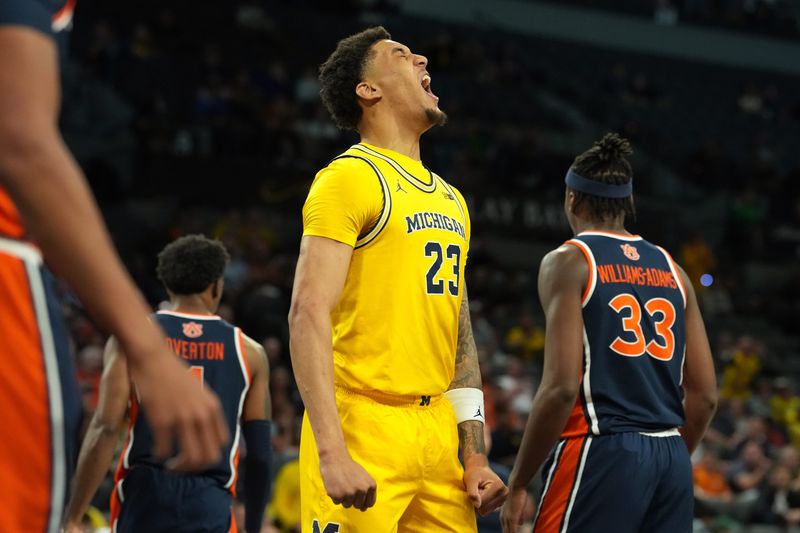
“In Vegas, for sure,” Lendeborg said. “I feel like that’s when my 3-point shot started to come along and I started feeling way more confident in myself. That really helped the spacing a lot more because I didn’t have to rely on being in the paint [to score].”
In U-M’s opener in the Players Era Festival in Las Vegas during Thanksgiving week, the three combined for 35 points and 20 boards against San Diego State. The next night, against Auburn, it was 37 points and 18 boards. They closed out the tourney with a 40-point route of No. 7 Gonzaga with 44 points and 22 boards, despite only Lendeborg playing more than 23 minutes.
‘He could be anywhere … else in the country’
Three frontcourt stars, all of whom arrived as developed players – it didn’t take long for accusations of “mercenaries” to land on the Wolverine trio.
Not from May, however. He reiterated in February the sacrifice needed to lift the Wolverines to their lofty perch in the Big Ten. It started with Lendeborg, who entered Saturday averaging 14.3 points and 7.7 boards a game – respectable numbers, but not what might have been expected from a forward projected as a late first-round NBA selection last summer, and definitely not from a potential lottery pick this summer.
“[Yaxel] set the tone,” Johnson said in early January. “Like, if he’s willing to sacrifice things for the team, everyone should be able to sacrifice things for the team. Lord knows he could be anywhere, somewhere else in the country, just getting shots up, trying to get his numbers.”
Lendeborg, who spent his first three seasons in juco at Arizona Western, has been willing to give up touches to make sure his teammates are involved.
“He doesn’t act like a mercenary every day,” May said in February. “He’s completely engrossed and embedded in our program, our culture and winning for others, He’s unique. He’s special. … We wouldn’t be where we are if it wasn’t for his unselfishness and his humility as a guy that was ranked as the No. 1 [player in the portal].”
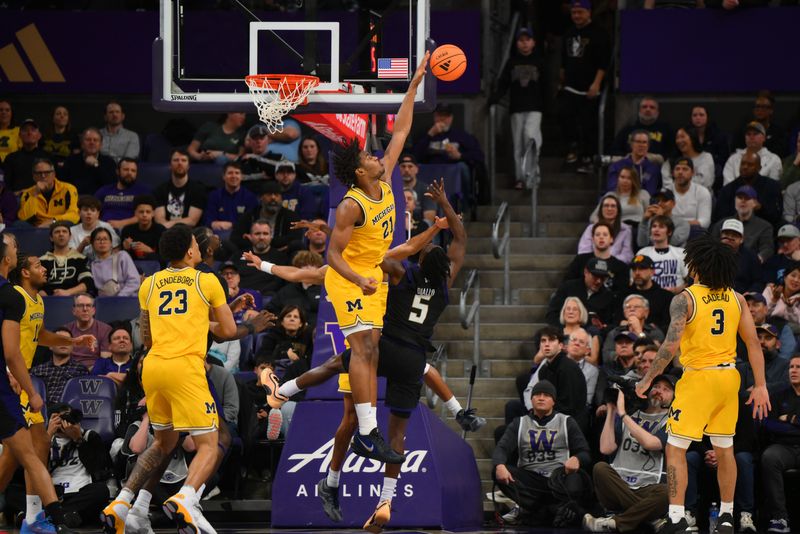
Together the trio has formed what is widely regarded as the best frontcourt in the nation. Mara is top-10 in the nation in block rate, while Lendeborg (25) and Johnson (27) are both among the nation’s best in offensive rating per KenPom. They all average 10-15 points with at least seven rebounds and more than one block per game.
Johnson said the three have felt like they’ve had an advantage whenever they’ve stepped on the court. Mara concurred. Lendeborg, went a step further.
“I already said this like three times, but I don’t think there’s a frontcourt that’s better than ours,” he said. “I’ll go to war with these guys every day about it.”
‘A soft teddy bear’
As they’ve meshed on the court, they’ve melded off it, as well.
Mara is the one who cooks “on and off the court,” Johnson said in January, while Mara said Lendeborg’s most surprising trait is his humility: “Maybe [outsiders would] think that he’s another way, but he’s super humble,” Mara said.
Johnson, however – according to Lendeborg, at least – is the one whose demeanor changes most when he’s not playing.
“Morez is a super-tough guy on the court man, but off the court, he’s really just a soft teddy bear,” Lendeborg said as all three laughed. “When you talk to him a little bit, he’s really just a sweetie.”
When asked about the others’ best trait, the answers were unanimous. For Johnson, it’s his elite rebounding instincts. For Mara, incredible length and shot-blocking skills. Lendeborg? He’s can “do it all,” Mara said.
One of those skills is passing, a skill Mara excels at considering his 7-foot-3 height.
“[Their passing] opens up everything,” Johnson said. “Having players who will pass, you know, that helps because you can’t really go double Aday or Yax or me, because we all capable passers.”
Johnson likes to consider himself a passer, too, even if the others disagree.
As they chatted in mid-January, Mara grinned as a wide-eyed Lendeborg asked Johnson, “How many assists you got this year?”
Johnson said 25 as Lendeborg whipped out his phone to pull up the numbers.
During the web search, Johnson backtracked slightly: “It’s got to be at least 20,” he said.
The answer: 18.
“They haven’t added last game yet,” Johnson said.
“Yes, they have,” Lendeborg said with a chuckle, showing him the phone.
‘One eye pointed toward their future’
March Madness remains more than a month away, but everything is lining up for the Wolverines, who entered Saturday with a two-game edge in the Big Ten, a likely No. 1 ranking on Monday and a projected 1-seed in the NCAA Tournament come next month.
Much of that success has been fueled by the frontcourt, which has spent the past four months proving the naysayers wrong.
“When one of them committed and then the next one committed, they were both told by everyone that they couldn’t work,” May said. “‘Why would you do that? You’re not going to play.’ … When we got all three of them, then it became overload. … All the original schools recruiting them all circled back to that ‘You can’t play together.'”
As it turns out, they can.
Johnson entered Saturday shooting 69.4% on 2-pointers, a mark that would be No. 2 in program history. Lendeborg is a member of most All-Big Ten first-team projections. Mara is averaging career highs in points, rebounds, blocks and minutes.
The Wolverines’ historic success hasn’t prevented anybody from looking forward, however.
“In a perfect world, these three guys are playing in the Association as first-round picks next year,” May said. “They’re incredibly important to us, too and we have one eye pointed towards their future and their developments. Even when we’re working extra on things they’re not doing now in games, it’s to help them down the line.”
Those days will come soon enough.
In the meantime, the trio has some business to finish in their shared hometown.
Tony Garcia is the Wolverines beat writer for the Detroit Free Press. Email him at apgarcia@freepress.com and follow him on X at @RealTonyGarcia.
This article originally appeared on Detroit Free Press: How Michigan basketball built nation’s biggest and best frontcourt
Reporting by Tony Garcia, Detroit Free Press / Detroit Free Press
USA TODAY Network via Reuters Connect