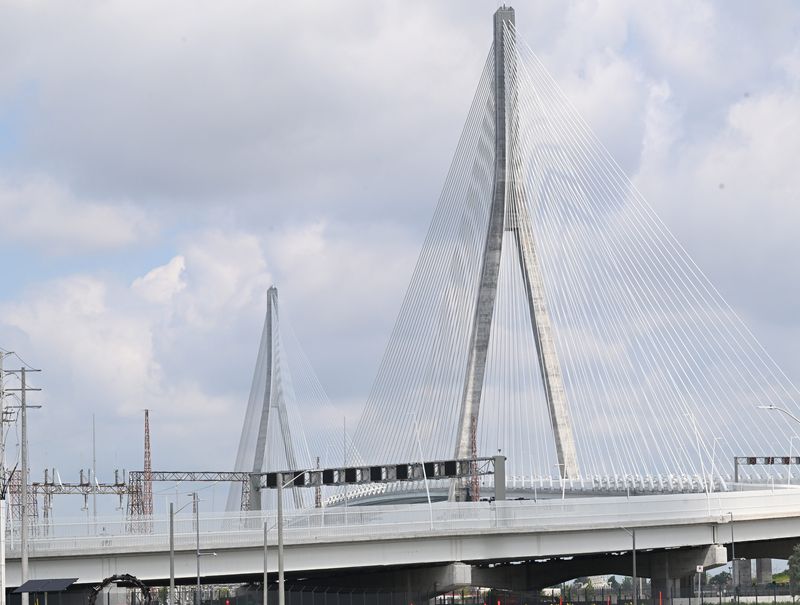
U.S. Ambassador to Canada Pete Hoekstra is calling claims Canada paid for the Gordie Howe Bridge’s construction “a big myth.”
The former Michigan congressman appeared last week on “The Food Professor” podcast to discuss trade between the U.S. and Canada and food security.

The topic of the Gordie Howe Bridge came up. Hoekstra asked the hosts, Sylvain Charlebois and Michael LeBlanc, if they could tell him who paid for the new crossing.
Charlebois is a professor and researcher of food distribution and policy at Dalhousie University in Halifax, Nova Scotia. LeBlanc is founder and president of M.E. LeBlanc & Company Inc., a retail consulting firm based in Toronto. Their podcast examines issues in the food, food service, grocery, and restaurant industries.
Charlebois answered Canada.
“That’s the big myth that is out there, the funding of the bridge,” Hoekstra said. “I think it’s important that people realize this.”
He explained that the Canadian government loaned the authority behind the bridge $4.5 billion to $5 billion. “Canada is serving as the bank for the bridge,” the ambassador said. “The expectation is that over the years, as the bridge generates revenue, the bridge will be paid back. So the bridge will actually be paid for by the folks who are using the bridge. It will not be paid for by the Canadian government.”
“Canada put the money up front, but at the end of the day, the expectation is that there will be a use tax that will pay for the bridge,” he said.
Last month, the Windsor-Detroit Bridge Authority was making plans to formally open the bridge after eight years of construction. But the plans were canceled on June 11, one day before the planned ribbon-cutting ceremony on the Ontario side of the span.
Hoekstra also addressed the delayed opening of the bridge. He said the project was “significantly over budget” and was completed “significantly later than originally forecast.”
As a result, the bridge’s business model has changed, according to the former lawmaker. He said both the Canadian and U.S. governments decided to iron out issues that arose from the change before the bridge opens, and that’s what caused the opening to be postponed.
“We’re working through that process right now,” he said. “The expectation is the bridge will open, we’re just not quite sure when.”
Bridge background
Hoekstra and Commerce Secretary Howard Lutnick, both top advisers to U.S. President Donald Trump, privately pushed back last month on plans to open the long-awaited Gordie Howe International Bridge, according to three sources.
During the podcast, the ambassador pointed out that the traffic that will travel over the new span won’t be new, and as a result, the revenue generated from its use won’t be new.
“You’re moving revenue from either the (Detroit-Windsor Tunnel) or the (Ambassador Bridge),” Hoekstra said.
Trump had threatened to block the bridge’s opening in February, demanding concessions from Canada in trade talks or a share of future toll revenue.
Hours before Trump’s threat, Lutnick met with Grosse Pointe businessman Matthew Moroun, owner of the Ambassador Bridge, Detroit’s only bridge to Windsor.
Former Gov. Rick Snyder, who played a key role in forging a 2012 agreement with Canada to build the bridge, said last month it will mean growth for the region and state.
“More jobs, more prosperity on both sides of the river,” he said. “It’ll make it less expensive, easier to do business between the two countries. And that results in jobs and a better quality of life for everybody.”
cramirez@detroitnews.com
@CharlesERamirez
This article originally appeared on The Detroit News: Hoekstra says it’s ‘a big myth’ Canada paid for Gordie Howe Bridge
Reporting by Charles E. Ramirez, The Detroit News / The Detroit News
USA TODAY Network via Reuters Connect
By Charles E. Ramirez, The Detroit News | USA TODAY Network