This story has been updated with new information.
I wouldn’t want to live across the street from this data center, no matter how much you paid me.

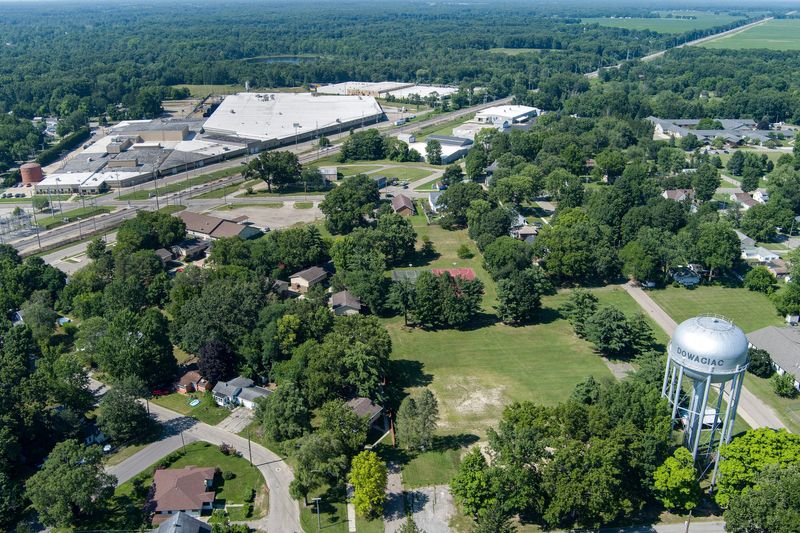
It’s in Dowagiac, and sits in an industrial park in an otherwise woodsy corner of town, off a railroad track, with a small neighborhood across the street. On a drive home from Chicago, I took a detour to find this noise machine that has been the subject of news reports and a federal lawsuit. I’ve written about why Michigan should embrace data centers, and I wanted to see this one firsthand.
I drove north from Indiana’s toll road through lush green farmland, was smacked in the nose with the heavy smell of fertilizer (I wouldn’t want to live across from that farm with that smell, either) and stopped for gas at a station nestled next to an Indian casino. I made my way through town and passed auto dealers, grocery stores, and fast-food joints. Dowagiac is a small southwest Michigan town, just a few miles from Lake Michigan, that just so happens to be home to a 28-megawatt, 617,000-square-foot facility that powers artificial intelligence.
And it’s creating quite a ruckus. Residents filed a federal class action lawsuit against Alliance Cloud Services, LLC, the company that owns the data center, for “unreasonable and excessive noise” that is alleged to affect their enjoyment of their homes, health and property values.
“I can no longer sit in my backyard and enjoy the peace and quiet, I can’t have my windows open. I can hear the noise over my TV. No one will [buy] my house,” said Joyce Felthouse, one of the plaintiffs, according to court documents.
This story comes amid widespread, bipartisan opposition to data centers. Opponents fear that data centers are taking over farmland, guzzling too much water, and straining the energy grid. (The Goldwater Institute, where I work, has debunked these misconceptions.) On the other hand, the financial benefits of data centers are extraordinary and could be a saving grace for cash-strapped localities. And that’s creating a conundrum for local governments.
Data centers are big business, and they are a golden goose for communities. A data center in Mason, was projected to bring $1 billion in investment, high-paying jobs, and would generate $7.6 million in tax revenue per year, nearly tripling the city’s revenue. New estimates put that number at $8.4 to $12.6 million. That’s a massive amount of money that could be put toward schools, roads, police, fire, and more — or it could be used to reduce residents’ tax burden, lowering the cost of living. That kind of cash infusion doesn’t happen every day — or ever — and would be transformational for small Michigan towns.
Loudon County, Va., which is home to some 200 data centers, illustrates how a community can benefit financially from the data center boom. The county reports that their data centers generate almost half of the county’s property tax revenues. Without that revenue, a typical homeowner would pay $5,800 more in property taxes per year. On top of that, the data centers in Loudon County provide 12,000 jobs and create an ecosystem that attracts even more development.
But the data centers in Loudon County generate noise complaints, too, and the county is wrangling with how to mitigate it.
Is the sound of silence worth the cost of passing up on data center investment?
I followed my GPS to the Dowagiac data center’s address and wound up on the other side of town and arrived at my location. I couldn’t hear it. I couldn’t see it. Where was this behemoth of a futuristic industrial giant? If it was so loud, I sure couldn’t tell.
I ate a handful of pretzels, took a swig of pop, and searched for the address of a resident who complained about the data center to local TV. I drove around the corner, rolled my windows down, and was listening for the data center as I drove down a quiet residential street.
I heard it before I saw it. And there it was. I was imagining the Death Star. What I found was much different.
The droning hum emanated from a non-descript building that was tucked behind a fenced-in lot with a gated entryway, cameras, and a “No Trespassing” sign. It’s like a small factory housing a white noise machine super-charged for the whole neighborhood. The sound is loud, no doubt, and it radiates toward a well-kept home proudly displaying an American flag, right across the street. If you wanted to torture an annoying neighbor, this would be a great way to do it.
I drove a block or so away and could barely hear it, though the noise was still there. My car engine was louder than the hum, and a plane that flew above was much, much louder. A few blocks further, and I couldn’t hear it at all. I drove back to the data center entrance, and there was the noise again, unabated. And that’s really the problem for these folks. The noise just doesn’t stop, and it’s very audible for the immediate neighbors.
You can love economic development, indulge in AI on your smartphone, and be a total tech nerd, but I can assure you, this noise wouldn’t be for you. It’s a nuisance, no doubt. But there are ways to deal with that.
A fundamental principle in property rights is that if you own something, property included, you can use it however you want unless you harm others. That’s where local governments come in. They have “police power” which allows them to regulate for public health and safety; in other words, they can put restrictions on your use of land. But that power has limits.
Under Michigan law, cities cannot ban data centers outright, but they can use ordinances to decide where data centers go and to address nuisances like noise. That’s what Dowagiac’s leaders should do[SA1] . Meanwhile, the data center should be a good neighbor and take action to mitigate the noise as well.
Noise and zoning ordinances, in fact, can incentivize companies to learn how to operate data centers more quietly as well. We’ve already seen that technological advances have quickly led to data centers’ ability to use recycled water and otherwise function more efficiently.
That’s cold comfort for the families affected by the Dowagiac data center, who no doubt love their homes and are living in a noisy hell. They want relief now, and that’s why they’re headed to court.
Dowagiac’s experience is instructive for Michigan communities that want to welcome data centers and the benefits they provide — including the massive infusion of revenue — but also want to guard against any potential drawbacks.
Like many things in politics, there’s a reasonable middle path. The reality is, artificial intelligence isn’t stopping, we’re not turning back the clock on technology and data centers are going to be built somewhere. Another reality is that Michigan is struggling economically and needs this kind of investment. It’s up to local governments to figure out how to enable smart development so that residents’ quality of life is preserved without stopping the clock on the future.
No, I wouldn’t want to live across the street from a data center that’s cranking out noise 24/7. But I also don’t want to live in a state that is permanently closed for business.
Mike Brownfield is vice president of communications and strategy at the Goldwater Institute and previously served in the Michigan governor’s office.
This article originally appeared on The Holland Sentinel: Here’s what Dowagiac’s controversial data center sounds like | Opinion
Reporting by Mike Brownfield, Holland Sentinel / The Holland Sentinel
USA TODAY Network via Reuters Connect
By Mike Brownfield, Holland Sentinel | USA TODAY Network