State lawmakers questioned the founder of Rx Kids during a hearing June 2, as the cash aid program for moms and babies rapidly expands across Michigan this summer.
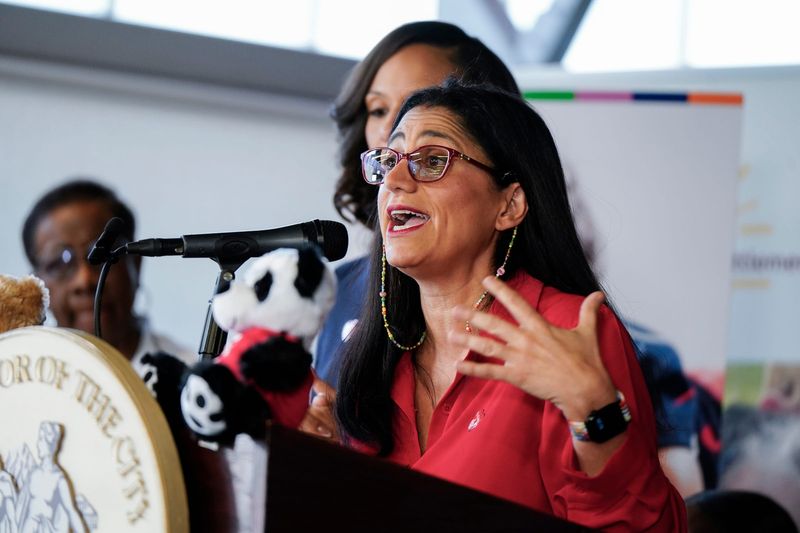
Pediatrician Dr. Mona Hanna, director of Rx Kids, spoke before a hearing of the House Oversight Committee. Though the program has received bipartisan support, Republican lawmakers raised questions about the long-term goals and the sustainability of Rx Kids, if participants have had abortions while enrolled, how families are spending the aid and if taxpayer dollars are going to undocumented immigrants.

“Our role is to look at this from an objective perspective. It’s not a debate about do we love babies and moms because everybody sitting up here does. It’s the reality of the management. … And what we’re actually trying to accomplish beyond just helping moms and babies,” said state Rep. Jay DeBoyer, R-Clay, chair of the oversight committee.
Rx Kids — pitched as a prescription to help alleviate financial burdens for families during an important part of an infant’s development — offers $1,500 in cash assistance mid-pregnancy and then monthly $500 payments for six or 12 months after birth, depending on the location. The program is funded with a combination of state, local, private and philanthropic dollars. It’s led by the Michigan State University College of Human Medicine, where Hanna is an associate dean of public health, and administered by GiveDirectly, a nonprofit that specializes in cash delivery programs intended to alleviate poverty. The University of Michigan is a research partner.
“I’m just advocating for supporting families during this most vulnerable time, where we have significant evidence that this is working. It’s stabilizing families. It is saving money and it’s putting money back into local communities,” Hanna said.
The hearing took place shortly after the Lancet Public Health journal published a study looking at about 4,500 births in Flint from 2021 to 2025, before and after Rx Kids launched, and comparing outcomes to similar cities without the program. The report found a 18% reduction in preterm births and a 27% decline in low birth weight in Flint. Researchers also identified a 29% decrease in NICU admissions.
The study adds to a growing body of research on cash aid programs across the country, including one called Baby’s First Years where researchers did not find differences in several child development outcomes between low-income moms who received $333 a month and those who got $20 a month for the first years of their children’s lives. Researchers of that study mentioned multiple explanations for this, such as the size of the cash aid and moms getting payments during the COVID-19 pandemic.
Hanna addressed the findings of that study on Tuesday.
Rx Kids is “very different” from Baby’s First Years, she said. The study took place during the pandemic, when there was an infusion of cash supports. Families received payments after birth (not during pregnancy), were given less money than Rx Kids and it tested a small sample size of 400 people, compared with about 12,000 participants for Rx Kids.
Mothers who are part of Rx Kids recently told the Free Press that they used the cash aid on basics, from strollers to diapers, that they were able to be more present for their children, that it offered them time to prepare to go back to work and catch up on bills.
Here are four takeaways from the the House Oversight Committee hearing discussing Rx Kids:
Do Rx Kids funds go to undocumented immigrants?
No taxpayer dollars from any level of government — including the state and municipalities — supports undocumented immigrants, Hanna said. In cases where an Rx Kids-enrolled mom is undocumented, the cash aid comes from philanthropic contributions.
“Municipalities do provide support for Rx Kids, but we’re not using municipal money for folks with no legal status. We’re only using philanthropic dollars,” Hanna said.
Does Rx Kids track abortions or prevent them?
Rep. Josh Schriver, R-Oxford, asked whether Rx Kids prevents pregnant mothers from taking the cash aid and then getting an abortion at 25 weeks. Hanna said there’s nothing in the framework that does that but it’s “highly unlikely” to have an abortion then. The program does not track abortions. Moms must be at least 16 weeks pregnant to apply to get the $1,500 lump sum, and then they can get $500 for six or 12 months after birth. If a mom or guardian is applying after birth, the baby must be under 6 months old. Applicants must show proof of pregnancy or guardianship.
“In Flint, after the program started, we actually saw more babies being born. The No. 1 reason that people have an abortion is because of finances because it’s expensive to have a baby,” she said.
Where does Rx Kids money go?
So far, Rx Kids has raised more than $86 million from private and philanthropic donors. In total, the program has about $291 million in state funds, including the federal Temporary Assistance for Needy Families (TANF) block grant and the Healthy Michigan Fund.
Hanna said 85% of state dollars goes directly to families and 15% goes to the administration of the program, including eligibility verification, customer service, cash delivery, fraud prevention, oversight and communications and marketing. It’s the same breakdown for non-state dollars.
Moms on Medicaid — which has immigration and citizenship requirements — receive a combination of federally allocated (TANF) and state (Healthy Michigan) dollars, as well as private funds. For those who don’t get Medicaid, but have legal status, Rx Kids uses Healthy Michigan and private money. All other moms and babies are fully funded by philanthropy.
“No state funds go to undocumented immigrants,” she said.
Does Rx Kids monitor spending?
State Rep. Angela Rigas, R-Caledonia, asked how Rx Kids differs from a host of other programs, including the Supplemental Nutrition Assistance Program (SNAP), Head Start and State Emergency Relief, and whether administrators monitor how funds are spent. She wanted to know whether parents can spend taxpayer funds on alcohol, marijuana and TVs. That’s not what the data shows, Hanna said. Rx Kids gives families flexibility, she said. Rx Kids does not monitor spending — that would make it much more expensive to administer.
“This is a program built on trusting women, trusting mothers, trusting families to best meet their needs,” Hanna said.
State Rep. Matthew Bierlein, R-Vassar, asked whether Rx Kids requires prenatal care with cash payments. Families must show medical documentation proving pregnancy, such as an ultrasound or after-visit summary from a doctor. Moms in Flint — where the program started about two years ago — are going to prenatal care earlier and more often, Hanna said, referencing research published last year.
“We are pushing people to prenatal care,” she said.
State Rep. Denise Mentzer, D-Mount Clemens, said the program ensures that more babies are born healthy.
“This program is just kind of a miracle and in the city of Mount Clemens where I am from, it has made a huge difference,” she said.
Reach reporter Nushrat Rahman at nrahman@freepress.com.
This article originally appeared on Detroit Free Press: GOP lawmakers question Rx Kids as study shows healthier births in Flint
Reporting by Nushrat Rahman, Detroit Free Press / Detroit Free Press
USA TODAY Network via Reuters Connect
By Nushrat Rahman, Detroit Free Press | USA TODAY Network