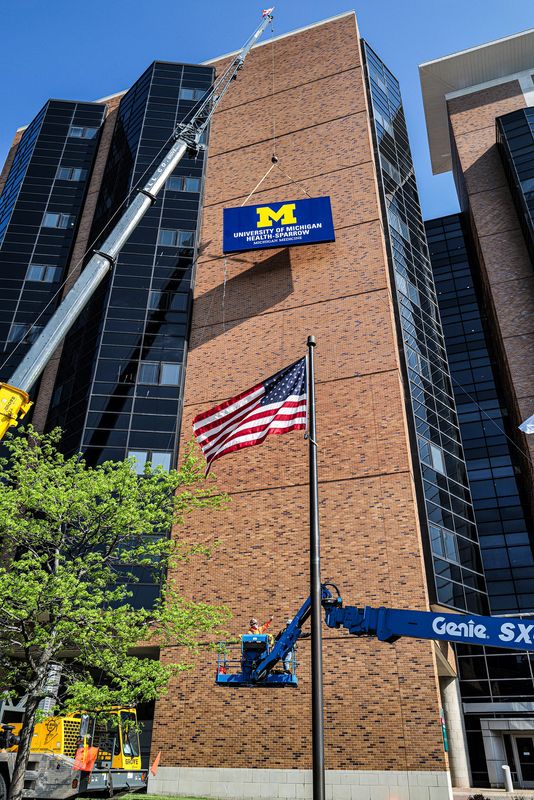
LANSING — The former Sparrow Health System was bleeding cash, including a $158 million loss in 2022, when it got swept up by the the University of Michigan Health network.
By June 2025, less than three years after the merger was announced, the newly branded UM Health-Sparrow was out of the red and registered a systemwide operating margin of $40 million. A study shows employees are both happier and less likely to leave, and there are new developments for its medical campuses on the way.

The financial turnaround is critically important to the region, which is dominated by two health systems. UM Health-Sparrow has the downtown Lansing hospital as well as four regional hospitals in Carson City, Charlotte, Ionia and St. Johns. McLaren Health System also has a new hospital, the Izzo Family Medical Center, McLaren Grand Ledge and Mid-Michigan Physician medical campuses throughout the community.
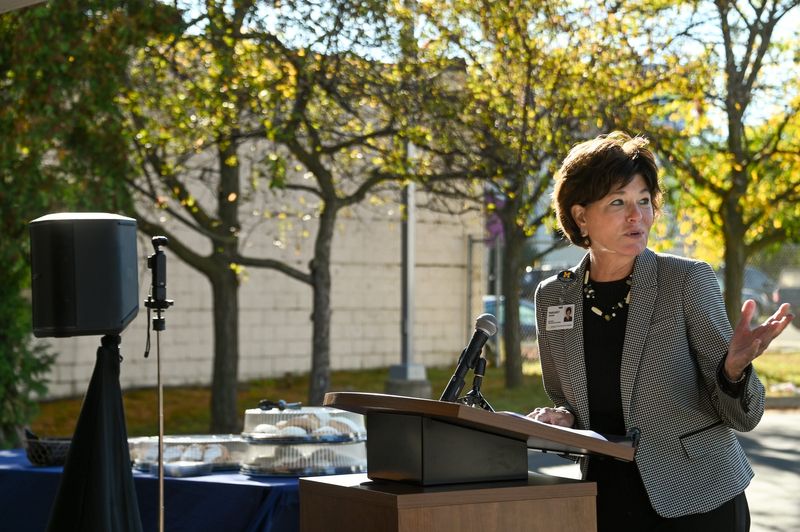
Margaret Dimond, well versed in hospital administration from previous healthcare leadership roles in Michigan and elsewhere, took the reins of Sparrow’s flagship hospital as the merger was commencing and continues to oversee the former Sparrow sites, along with UM Health-West in the Grand Rapids area, as president of the University of Michigan Health regional system.
She co-authored an article published last month in the “The New England Journal of Medicine” that said UM Health-Sparrow’s turnaround happened by creating a coordinated, integrated statewide system of care that allowed the former Sparrow Health System to partner and coordinate with UM Health’s academic medical center in Ann Arbor and UM Health-West, plus provide care closer to home for patients across the state.
“(Eighteen) months after supply chain integration, we achieved more than $23 million in savings from new sourcing strategies and aligned system vendor contracts, without significant reductions in force,” the report said.
Getting better deals as part of a bigger system and focusing on expense management also resulted in better aligning staffing with clinical volume, reducing the use of agency nurses, and achieving supply chain cost savings through aligned vendor contracts, the report said.
Dimond said the UM Health affiliation made a world of difference and should mean both additional and better services in years to come.
“Very few hospital systems that have multiple-year losses, almost to $200 million, come back on their own,” Dimond said. “I think that the U-M affiliation agreement provided things like capital infusion and buying new machines. When you’re losing $160 million, you can’t buy equipment, you can’t grow, you can’t refurbish buildings. You’re just hanging on to do the basic healthcare piece.
“Sparrow was in the ashes, right? McLaren is great, but it’s smaller, even though they built (a new hospital). They’re a Level III ER. We’re a Trauma Level 1. This affiliation with the University of Michigan not only saved the Sparrow health system, but we benefit from their excellence. That excellence stays in the community.”
Dimond, originally from the Detroit area, was serving as chief administrative officer of the Naples Comprehensive Health Physician Group in Florida when Sparrow Health System officials announced in February 2023 that she would be returning to Michigan to lead Sparrow during a transitional time.
“The opportunity to bring a system that was failing financially into a system that is Top 20 in the country and really provide care closer to home on those higher level specialties that patients prior to the merger were traveling for, that’s just one of many reasons that compelled me to say I’d love to end my career doing something like this,” she said.
No longer an island on its own
The turnaround happened amidst 2024’s picketing nurses and threats of a strike during contract negotiations. At around the same time, the health system announced the demise of the former Physicians Health Plan insurance program with no clear replacement plan. Sparrow Health System had owned the plan but shuttered it, according to Mary Masson, senior director of public relations for UM Health, because of an increasingly competitive health insurance landscape and changes to Medicare Advantage plans.
“I’m told that UM Health-Sparrow did not feel the financial impact or savings from the closure of PHP (which presumably means it was felt by Michigan Medicine in Ann Arbor),” John Foren, spokesman for UM Health-Sparrow, said in an email.
Michigan Medicine is owned by the University of Michigan and made the original announcement that it was acquiring the Sparrow Health System so that Sparrow could partner with UM Health.
There were critics of the merger and some of the decisions that followed. UM Health officials ordered the demolition of the old Eastern High School building along Pennsylvania Avenue to make way for a behavioral health hospital on the property. A group protested frequently leading up to and during the demolition. A groundbreaking for the new hospital is scheduled for August with completion expected in 2028.
“The 64-bed, $83 million state-of-the-art facility will serve adult, geriatric and — in a first for the area — child and adolescent patients,” said a release on the UM regents’ February vote of approval. “The facility is being designed to highlight the natural environment and ample acreage, with indoor and outdoor gardens, light-filled spaces and modern security and safety enhancements for patients and team members.”
Dimond said mental health patients were calling her to say Eastern would look like an asylum if a mere gutting and renovation for the project happened, which “is not a good thing for patients.”
The new facility will have a lot of light and glass, along with a memorial park that Foren said is expected to include stone arches from outside the old high school, a pallet of bricks from the former site that will support the arches, an Eastern High School name plate, the 1927 cornerstone and inscribed bricks that were in the back of the old school.
“We were creating blight because we didn’t do anything for so long with that high school,” said Dimond, referring to the Edward W. Sparrow Hospital Association’s 2016 purchase of Eastern High School. “Even though we had it boarded up. If you walked through before we demolished it, you would see drugs going through there. We would find empty syringes. We had the homeless breaking in. We needed to do something.”
“Again, could we have done that on our own, when we were in financial peril, and we couldn’t retain the brightest and the best, subspecialties that we needed to perform higher level surgeries and life saving treatments? I don’t know where Sparrow would have gone without the affiliation.”
A list of wins for the rebranded Sparrow hospitals includes, in 2024, MSU Health Care and UM Health partnering in a new neurology unit to expand neurosurgery and neurology services in mid-Michigan.
The Neuro Care Network is made up of practitioners from both organizations, with services provided at both UM Health-Sparrow in Lansing and MSU Health Care in East Lansing. The partnership allows better access to spine and stroke care and other specialty services.
A groundbreaking for a $60 million ambulatory surgery center, near Michigan and Pennsylvania avenues, west of the hospital, happened June 22, with completion expected in early 2028. The outpatient facility on the north side of Michigan will feature six operating rooms at the start.
A new $28 million, 31,000-square-foot ambulatory clinic center adjacent to the University of Michigan Health-Sparrow Ionia also is being planned, and work continues on a new health care center near Grand Ledge that could open early next year.
There’s also a focus on high levels of care closest to home. Historically, patients from UM Health-Sparrow’s community hospitals requiring more complex care were transferred to the Lansing hospital. Now, they might go to UM Health-West’s hospital near Grand Rapids.
“We’re pushing physicians and service lines out to those smaller hospitals,” Dimond said. “If you look at the literature, people in rural areas, they don’t want to come to the big city. They don’t like driving on highways. They will defer care, if they have to, because they don’t want to travel. For instance, we’ve added diagnostic capabilities — like MRI availability and cat scan availability in our smaller community hospitals.”
About 20,850 surgeries took place at UM Health-Sparrow Lansing and about 8,300 in the four smaller hospitals in 2025. There were approximately 20,200 surgeries at the Lansing site the year before, Foren said.
“I can tell you that we measure patient satisfaction,” Dimond said. “Our likelihood to recommend the hospital – that’s the strongest indication of what patient satisfaction looks like, and we dipped down in ’21 and ’22. If you remember, there was a layoff of over 500 staff in 2022. We’ve gone up at least 8 percentile pieces in the last three years.”
‘Center of the universe’
Jeff Breslin is the president of the local Professional Employees Council of Sparrow Hospital-Michigan Nurses Association, representing about 2,200 healthcare professionals, including nurses, at the Lansing hospital and other local sites. The union bargains separately from Ann Arbor employees.
Considering UM Health-Sparrow Lansing one of the better places to work, the registered nurse saw both pros and cons in the merger, he said.
“UM has got a really good name country wide, in fact in some circles worldwide. Having an entity that is as much bigger as UM is, compared to what Sparrow was — it added a whole new ballgame as far as financial support,” Breslin said about the positive.
Loss of local control is a negative, he added. “Ann Arbor is the center of the universe. We’re a satellite,” he said of the shift in control. “We still make a lot of decisions, but it all has to be approved or driven by Ann Arbor.
“There’s been a bit of a push toward the union to almost isolate us at the Lansing-Michigan Avenue campus.”
Breslin questioned the lack of a “clear replacement plan” for Physicians Health Plan in 2024. It was renamed the U-M Health Plan before it expired at the end of 2025.
“Our negotiations bled over into the beginning of 2025, and it worked out well because, if we would have finished in ‘24, we would have, of course, negotiated healthcare,” he said. “Then they would have come to us, saying, by the way, what you just negotiated has gone away, and we’re going to replace it with something else.
“Since the negotiations did drag on, they did give us notice that PHP was not going to be there anymore and we were able to negotiate the effects of that along with the rest of the contract.”
He said union members have gone from having a choice of two PHP options and one Blue Cross option to three different Blue Cross plans.
“The hospital, in and of itself, is a business,” Breslin added. “As a business, they’re looking to make money and we want them to. We need to make sure that they don’t stray too far from clinical as well. There’s the financial side and the clinical side, and you need to fall somewhere in the middle.
“If you get too close to either extreme, then the hospital is not going to function and be viable.”
Beating the odds
A State Journal investigation in 2025 showed numerous studies have found no definitive evidence that hospital mergers improve patient care. Study after study has found, however, that they increase patient costs. And the mergers aid tax-exempt systems — like UM Health-Sparrow and McLaren Health Care — in accruing billions in cash and assets that can be used to expand further.
Dimond, in the New England Journal article she wrote with Scott Flanders, chief clinical strategy officer for Michigan Medicine, and David Miller, CEO of Michigan Medicine and executive vice president for medical affairs for UM, noted that hospital consolidations are accelerating nationally through acquisitions and findings on benefits for providers, patients, and communities are mixed.
Yet their conclusions for UM Health-Sparrow included employee satisfaction inching up from 3.5 on a 1 to 5 scale in 2022 to 3.9 in 2024. Annual turnover of registered nurses dropped from 17.4% in 2022 to 7.7% in 2024.
“I think it’s a lot of things. Stability in the future, a lot of work that we did around cultural integration, as we moved toward integration, aligning around mission, vision, values, all the work that was done to improve that work environment were contributing factors,” Flanders said. “University of Michigan Health is thinking a lot about the patients and the citizens of the broader Lansing community and our goal is really to strengthen those respective communities, optimize care at the local level and advance health of Michiganders. I hope they see that the program’s new capabilities, investments we’re making in and around Lansing with UMH-Sparrow are living into that vision.”
UM Health-Sparrow Lansing announced May 28 plans to outsource environmental services, such as housekeeping and biohazard removal, to Xanitos in Pennsylvania and food and nutrition services to TouchPoint Support Services in Georgia, potentially affecting nearly 400 UM Health-Sparrow employees in the Lansing area.
“We expect an update soon,” Foren, the UM Health-Sparrow spokesman, said. “We are focused on working with our team members on the transition and would caution that we have not yet signed a contract with any outside party.”
Foren said the move was “to prepare for the financial headwinds we anticipate over the next several years due to Medicare and Medicaid reimbursement challenges, while sharpening the focus on our core mission of advancing health to better serve Mid-Michigan and our communities.”
Because of those same challenges, where reimbursements may be smaller and tougher to come by, Dimond is predicting the operating margin to stabilize in years to come.
“Realistically, if we can hold where we’ve been at a 2% margin, I would feel comfortable with that,” she said. “Really, it’s a nonprofit, right? So that margin gives us capital to reinvest in equipment, in building.”
Contact editor Susan Vela at svela@lsj.com or 248-873-7044. Follow her on Twitter @susanvela.
This article originally appeared on Lansing State Journal: Former Sparrow hospitals see improved finances 3 years after UM merger
Reporting by Susan Vela, Lansing State Journal / Lansing State Journal
USA TODAY Network via Reuters Connect





By Susan Vela, Lansing State Journal | USA TODAY Network