Ford Motor Co. has secured a U.S. Defense Department contract for three prototype trucks based on F-Series Super Dutys in its largest vehicle defense opportunity in decades, the Dearborn automaker confirmed on Monday.
Ford has joined the competition alongside General Motors Co. to build future U.S. Army heavy-duty infantry squad vehicles (ISV-H) aimed at providing on-the-road power as well as transportation to troops and equipment. Both automakers and Utah-based off-road vehicle manufacturer BC Customs LLC were awarded deals for prototypes to test, the U.S. Army said. The contract would be Ford’s biggest military contract since the Cold War.

“We are excited to start work on this Army contract,” spokesperson Dave Tovar said in a statement, “and look forward to delivering several incredibly capable vehicle protypes that demonstrate the value Ford can provide to the Army and soldiers.”
The Pentagon has been in talks with automakers to use their manufacturing knowledge for updating and replenishing U.S. military equipment following wars in the Middle East and Russia’s invasion of Ukraine. The Army has said it’s looking for a vehicle that can move soldiers over rough terrain as well as operate a mobile charger for drones, command-and-control systems and other equipment.
First deliveries are scheduled to happen by March 30, 2027, according to the Army. The prototypes will undergo operational assessments and limited developmental testing with the Army Test and Evaluation Command. The competitive prototyping effort seeks to enhance “lethality and operational flexibility on the modern battlefield,” according to a statement from the Army.
The Wall Street Journal first reported Ford’s awarding of the contract.
Ford has emphasized the bidirectional charging capabilities of its light-duty F-150 Hybrid and the now-discontinued all-electric F-150 Lightning pickup. The trucks are able to power homes in the event of a power outage, tools on a work site and other equipment. Currently available Super Dutys, however, don’t have that kind of capability.
“Our Built Ford Tough Super Duty trucks are engineered for extreme durability and for the most challenging use cases making it an ideal platform for military use,” Tovar said. “Our Ford Pro platform, technologies, and capabilities offer global service and parts support and industry-leading uptime.”
He added that off-the-shelf products from the Ford Pro commercial vehicle division can offer capacity and scale while being cost-effective for governments as well as other commercial customers.
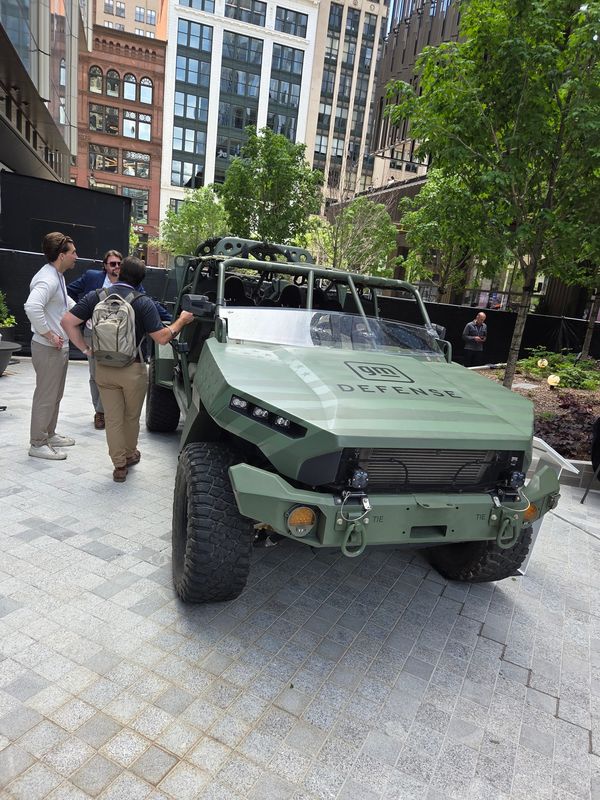
GM for years has been developing the ISV-Heavy trucks. The military has purchased three prototypes of that vehicle for field testing too. It’s built off the heavy-duty Chevrolet Silverado truck equipped with a diesel electric powertrain similar to a hybrid that allows the vehicle to travel silently and also recharge equipment.
The Detroit News left a request for comment with a GM representative, who did not immediately respond.
Ford CEO Jim Farley has said Ford was having conversations with the U.S. government and defense officials in Europe about military programs from which it could build off its core business into areas that are less cyclical and technology-driven. In June, representatives from the company in Paris promoted its fleet of tactical and utility vehicles at Eurosatory 2026, the world’s largest international exhibition for the land, air-land defense and security industry.
Governments already use Ford vehicles for security, Ford Rangers for military transport and Police Interceptor Explorers for law enforcement fleets.
GM CEO Mary Barra last week emphasized the profit potential from the defense sector, forecasting double-digit margins in the next several years as GM Defense LLC predicts $700 million in revenue in 2026.
She also expects a $1 billion contract with the U.S. Army for 10,000 light utility vehicles based on the Chevrolet Colorado pickup trucks. Last month, GM also announced a partnership with Lockheed Martin Corp. to use GM’s expertise in supply chain, early stage digital design and commercial-scale production to ramp up Lockheed manufacturing as it invests $9 billion in 20 facilities to keep up with demand.
Automakers like Ford and GM made Detroit into what became known as the Arsenal of Democracy for building militarized vehicles, bomber planes and other weapons during World War II. Ford supplied off-road tactical vehicles during the Vietnam and Korean wars, but it largely exited the defense business in 1990 when it sold its Ford Aerospace subsidiary, which is now a part of Lockheed, that supplied missiles, drones and other equipment for military and space application.
bnoble@detroitnews.com
@BreanaCNoble
This article originally appeared on The Detroit News: Ford joins competition with GM for Army tactical trucks
Reporting by Breana Noble, The Detroit News / The Detroit News
USA TODAY Network via Reuters Connect
By Breana Noble, The Detroit News | USA TODAY Network