Ford Motor Co. CEO Jim Farley has long worried about the impact Chinese cars could have on U.S. automakers’ market share if the Chinese ever got a foothold in this market, so to thwart that threat he discussed with the Trump Administration a way to protect domestic carmakers, while allowing for Chinese carmakers to enter the country, a source familiar with the situation told the Detroit Free Press.
The source asked to not be named because they are not permitted to share the information publicly. But Chinese automakers have long eyed the U.S. market because China is saturated, so the companies must export to grow profits.

The only thing keeping them off shore is a 100% tariff, put in place by former President Joe Biden and left intact by President Donald Trump, on all imported Chinese cars.
Most experts agree that it is only a matter of time before Chinese automakers find a way to sell their low-priced, high-tech electric vehicles in the states, especially given that Canada will soon be allowing some Chinese EVs to be sold there. They have been sold in Mexico for a few years now and by early 2026, Chinese EVs already comprise 20% of total new vehicle sales south of the border.
Farley discussed the idea with the Trump administration that the Chinese automakers be allowed the chance to build their cars in the United States as part of joint ventures with U.S. car companies where the U.S. automaker would hold a controlling stake and both partners would share profits and technology, the person familiar with the situation said.
Trump administration’s response
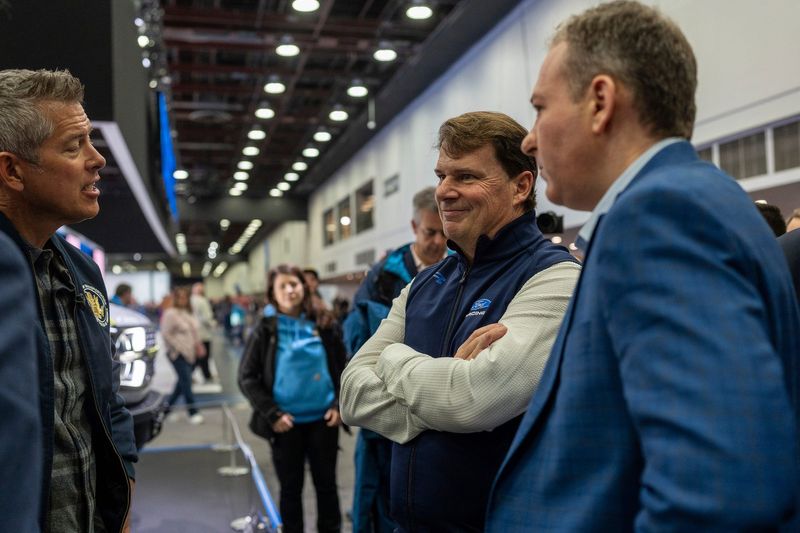
The news was first reported by Bloomberg. Farley discussed his idea with U.S. Trade Representative Jamieson Greer, Transportation Secretary Sean Duffy and EPA Administrator Lee Zeldin when they visited the Detroit Auto Show, the person confirmed to the Detroit Free Press.
It all happened just days after Trump indicated during a Jan. 13 speech at the Detroit Economic Club that he’d be open to allowing Chinese automakers into the U.S. if they built plants and hired American workers.
Ford spokesman Dave Tovar confirmed to the Detroit Free Press that Farley gave the cabinet secretaries a tour of the Ford stand at the Detroit Auto Show, but he declined to reveal any specifics around what was discussed.
According to Bloomberg, Farley was not pushing the joint venture option, but it was discussed as a way to protect U.S. interests if Chinese companies do enter the U.S. But the idea reportedly “got a cold reception from the Trump officials, who felt it would face opposition in Washington,” Bloomberg reported citing people familiar with the situation.
Representatives for the EPA, the U.S. Trade Representative and the Transportation department had no immediate comment to Bloomberg.
When asked to comment on Farley’s conversation last month with Trump administration officials about potential joint ventures, Tovar said: “As the leading American auto producer, we have been consistent about the need to protect our home market from a flood of subsidized vehicles built in China. We have also been clear about the privacy and national security issues associated with Chinese vehicles in the U.S. and we will continue to reiterate this in our discussions with policymakers.”
The threat the Chinese pose
Farley has been consistent in his public comments about the speed of the Chinese technological advancements to bring low-cost, high-quality cars to market.
In fact, the Dearborn-based automaker has been studying China’s car companies for years now and in recent years Ford’s leaders have intensified their examination of its Chinese rivals viewing Chinese automakers as the top competition to learn from — and beat.
In 2023, Farley started taking his leadership team to Shanghai and other big markets in China a couple times a year starting about two years ago. There, the team drives China-made vehicles, talks to experts in China, studies their technology and customer service all with the purpose of learning to ensure Ford has the right partnerships and strategy to succeed, Ford spokesman Mark Truby told the Detroit Free Press for a story last summer.
Farley drives a Xiaomi SU7, which he described last fall in an interview as “high quality, great digital experience.” He said he drives the Chinese car because “they’re the competition and to beat them, you have to know them.”
Last fall, as the Detroit Free Press reported, Farley gave a new warning about the Chinese competitors, characterizing their cars as an “existential threat” to U.S. automakers.
“They have enough capacity in China with existing factories to serve the entire North America market; put us all out of business,” Farley said.
Many in Trump’s administration have expressed worries that there could be negative economic impacts and national security issues if the Chinese were to start building cars here. Still, the reality is that one day the Chinese automakers will come on shore.
On Jan. 5, a spokesperson for China’s Geely Group, which owns Volvo and Polestar, said in a story by Autoline Network: “The big question for us is when and where will we go to the USA. I think we’ll have an announcement on that in the next 24 to 36 months.”
In the meantime, Ford has been seeking ways to protect itself with an eye on partnering with its competitors.
Earlier this month, the Detroit Free Press reported that Ford and China’s Geely are in early talks to potentially share Ford’s excess production space in Europe. The discussions center on the possibility of Geely using some of Ford’s excess factory space in Valencia, Spain, to produce vehicles for Europe.
(This story has been updated to add new information about the joint venture discussion.)
Jamie L. LaReau is the senior autos writer for USA Today Co. who covers Ford Motor Co. for the Detroit Free Press. Contact Jamie at jlareau@freepress.com. Follow her on Twitter @jlareauan. To sign up for our autos newsletter. Become a subscriber.
This article originally appeared on Detroit Free Press: Ford CEO Farley, Trump administration discuss Chinese car making idea
Reporting by Jamie L. LaReau, Detroit Free Press / Detroit Free Press
USA TODAY Network via Reuters Connect