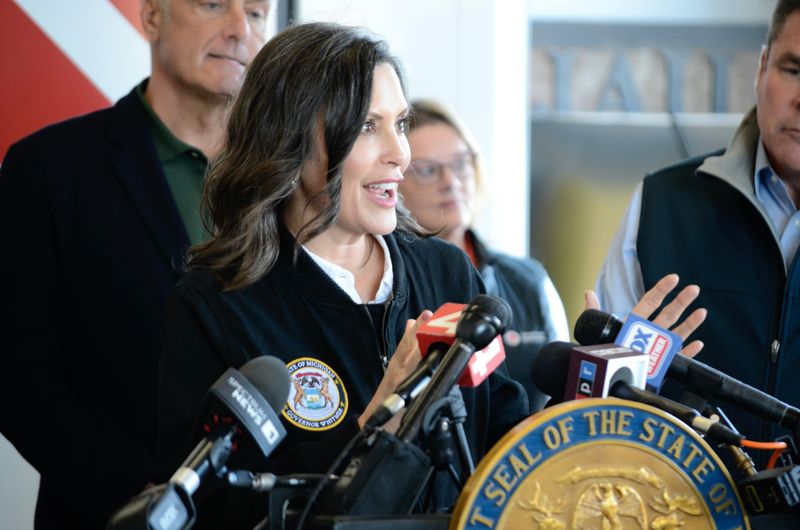
Gov. Gretchen Whitmer on Friday, April 17, declared a state of emergency in Eaton County and four others — increasing the number of counties in Michigan under state declarations to 38 because of flooding and storm damage.
In addition to Eaton County, the latest declaration includes Jackson, Kalamazoo, Mecosta, and Muskegon counties, and the cities of Ann Arbor and Kalamazoo.

“(Friday), I’m adding seven additional counties and cities to our state of emergency declaration. This declaration will help these areas with recovery efforts as they work to clean up after severe weather damaged homes, roads, and businesses,” Whitmer said. “My administration will continue to work with local emergency managers over the weekend and monitor water levels across the state. The forecast for next week is looking better, which should provide some breathing room for first responders, but we aren’t out of the woods yet.”
In addition to the statewide declarations, numerous Michigan counties also have issued location declarations because of flooding or storm damage. Eaton County added a local declaration on April 17, county officials said, due to the impact of heavy rain and storms on local infrastructure.
“More and more, local governments across the State are struggling with infrastructure expenses facing communities. We are requesting the State to assist us in our response,” Eaton County Board of Commissioners Chair Jim Mott said in a release.
Severe storms Tuesday, April 14, into Wednesday, April 15, spawned eight tornadoes and high winds caused widespread damage across southern and mid-Michigan. In addition, impassible roads have made rescue and evacuation operations difficult in many northern regions, and multiple rivers throughout the state have continued to experience rising water levels, threatening the condition of various dams.
In response to the danger of the Cheboygan Dam being overtopped and failing, Whitmer initially declared a state of emergency on April 10 for Cheboygan County. Later, the state of emergency was expanded to include Alcona, Allegan, Alpena, Antrim, Arenac, Barry, Benzie, Charlevoix, Clare, Crawford, Emmet, Grand Traverse, Gratiot, Iosco, Kalkaska, Lake, Leelanau, Manistee, Menominee, Missaukee, Montcalm, Montmorency, Newaygo, Oceana, Ogemaw, Osceola, Oscoda, Presque Isle, Roscommon, Saginaw, Shiawassee, and Wexford counties.
On Tuesday, April 14, Governor Whitmer activated the State Emergency Operations Center (SEOC) statewide to monitor weather-related events. That same evening, the governor declared an energy emergency statewide due to a disruption of gasoline supply at the U.S. Energy Cheboygan terminal on the Cheboygan River.
By declaring a state of emergency, Whitmer has authorized the use of all available state resources to assist local response and recovery operations in the affected counties.
The Michigan State Police Emergency Management and Homeland Security Division (MSP/EMHSD) is coordinating the state’s emergency response through the SEOC. MSP troopers are on the ground assisting local emergency response efforts.
The declaration also allows eligible communities to seek financial assistance under Section 19 of Michigan’s Emergency Management Act, Public Act 390 of 1976, as amended. The funding helps local governments cover emergency response costs and repair public infrastructure damaged by the storms.
Residents are urged to sign up for local alerts through MIREADY, and to sign up to receive MSP and SEOC news releases and follow Facebook for updates.
Here’s where the state of emergency applies and what is means:
How is a state of emergency declared?
In the aftermath of a natural or human-made disaster, the scope of the response starts with local authorities, including police, fire or emergency medical services, according to the MSP’s Disaster Declaration Process webpage.
After their initial assessment, other local departments may step in, including the local Emergency Management Coordinator. The EMC may recommend local state of emergency.
If the disaster is too large for local authorities to handle, a state of emergency or state of disaster is requested from the governor.
Before the state steps in to help, it’s typical for the local emergency management programs to ensure that the local efforts were utilized to the maximum extent.
“State disaster assistance is used to supplement local efforts and resources, and to help relieve extraordinary burden,” according to the Disaster Declaration Process website. “It is not to be used for simple budgetary relief or to relieve hardship.”
An official document is signed by the governor to create the state of emergency.
Why is the state of emergency important?
A state of emergency declaration means all state resources may be used to assist local authorities and first responders in the flooding response.
The declaration allows eligible communities to seek financial assistance under Section 19 of Michigan’s Emergency Management Act. The funding helps local governments cover emergency response costs and repair public infrastructure damaged by the storms.
A state of emergency is possible under the Michigan Emergency Management Act.
What is the State Emergency Operations Center?
The SEOC is where state, local and federal agencies coordinate a response to a disaster. The facility is located in Lansing, and is used to streamline all state resources.
The SEOC was activated at 10 a.m. Friday, April 10, to support response efforts to rising water levels at the Cheboygan Dam and Lock Complex on the Cheboygan River. Whitmer extended the activation on Tuesday.
Contact Sarah Moore @ smoore@lsj.com
This article originally appeared on Detroit Free Press: Eaton County state of emergency declared to speed storm assistance
Reporting by Jenna Prestininzi, Sarah Moore and Dan Basso, USA TODAY NETWORK / Detroit Free Press
USA TODAY Network via Reuters Connect