As Michigan residents continue to deal with hazardous air quality Friday, July 17, experts say masking up when heading out can protect you from the health risks of wildfire smoke, and many people may have the masks they need in their closets.
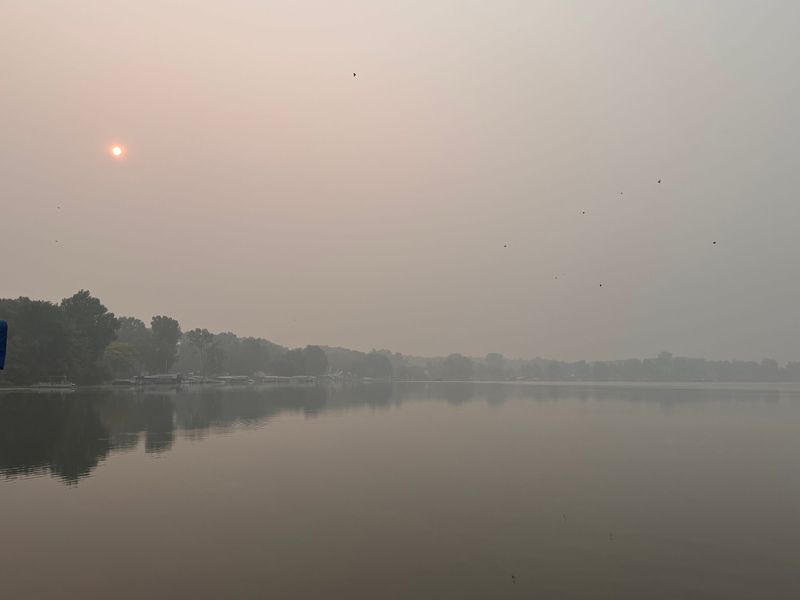
The Michigan Department of Environment, Great Lakes, and Energy has extended a statewide air quality alert into July 18 because of elevated levels of fine particulates from wildfire smoke billowing from blazes in Ontario, Canada, and northern Minnesota.

If you have to be outside, wearing an N95 or P100 mask, along with avoiding strenuous activities and limiting time outdoors can offer crucial protection against inhaling unhealthy air, according to the Michigan Department of Health and Human Services.
The recommended masks are the same ones officials recommended people wear to reduce the risk of contracting COVID-19.
Some areas of Michigan continue to see air quality readings that approach 1,000 on the index Friday, July 17 — deep into the “hazardous” zone for everyone.
Shop for N95 masks at Walmart
Readings from 0-50, or green on the index, means air is generally good quality. Readings above 301, or maroon on the index, are hazardous for anyone to breathe.
Here’s what to know about masking up amid poor air quality.
How bad is Michigan’s air quality today?
The Air Quality Index includes ratings from zero (the best) to 301 and above, which is considered hazardous for everyone.
Some areas of Michigan continue to see air quality readings that approach 1,000 on the index on Friday, July 17 — well into the “hazardous” zone for everyone.
Readings Friday morning in Detroit were in the 300 to 500 range. In the Lansing area, the peak was 478, while in west Michigan, readings were in the 200 to 900 range. Across northern Michigan and the Upper Peninsula, readings were in the 100 to 500 range.
Should you mask up amid poor air quality?
Yes, the Michigan Department of Health and Human Services recommends wearing an N95 mask or P100 respirator marked with NIOSH when outdoors amid poor air quality.
According to the Weather Channel, the biggest health threat from wildfire smoke is PM2.5, tiny particles small enough to travel deep into your lungs. A properly fitted N95 respirator, or KN95 and FFP2 masks offer protection.
What are the symptoms of smoke inhalation?
Smoke inhalation from wildfires, house fires and vehicle fires can damage your airways and lungs, the Cleveland Clinic says, because chemicals in the smoke can keep your body from getting enough oxygen. Even smaller amounts of smoke, like from wildfires that are far away, can irritate your airways and eyes.
You may be suffering the effects of smoke inhalation if you experience these symptoms:
Get to fresh air as quickly as possible and seek medical attention, the Cleveland Clinic says.
People with asthma, chronic kidney disease, COPD, diabetes, heart disease, who are pregnant, and children are at higher risk of smoke effects.
What is an N95 mask?
N95 respirators are typically used as health care personal protective equipment, filtering out over 95% of particles as small as 0.3 microns when properly fitted to the user’s face, according to SmartAir.
The EPA recommends choosing a “particulate respirator” that has been tested and approved by the NationalInstitute of Occupational Safety and Health (NIOSH). It will have the words “NIOSH” and either “N95” or “P100” printed on it.
See Michigan’s current air quality
The map below displays the current air quality at monitoring sites in the U.S., Canada and Mexico. Air monitoring sites are color-coded based on the pollutant (ozone or particulate matter) with the highest value. Particles that are less than 10 micrometers and 2.5 micrometers in diameter are called PM10 and PM2.5, respectively.
An AQI of 50 or below means the current air quality is good. The shaded areas of the map show the approximate boundaries where air quality is available and listed as anything other than good. The information is updated hourly.
Lansing State Journal reporter Sarah Moore contributed.
Contact Jenna Prestininzi: jprestininzi@freepress.com.
This article originally appeared on Detroit Free Press: Do ‘COVID masks’ work for wildfire smoke? What to know about masks
Reporting by Jenna Prestininzi, USA TODAY NETWORK / Detroit Free Press
USA TODAY Network via Reuters Connect
By Jenna Prestininzi, USA TODAY NETWORK | USA TODAY Network