Detroit Metro Airport added more temporary barriers outside terminal entrances this weekend after a vehicle drove through doors for the second time this year.
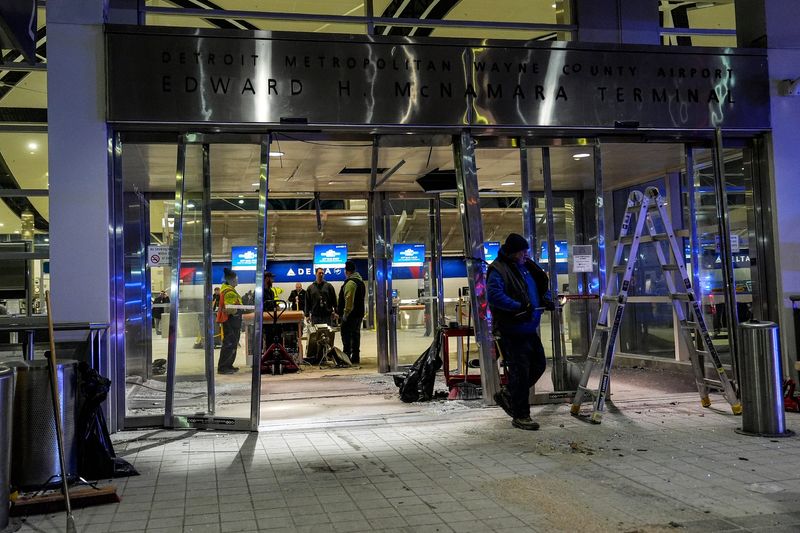
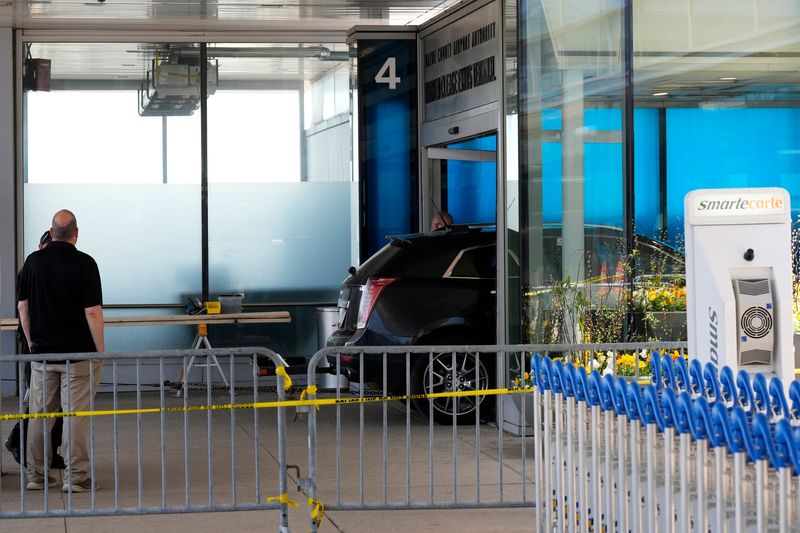
A black Cadillac crashed through an entrance to the Evans Terminal on Friday, May 29, while in January a Mercedes sedan plowed through a door at the McNamara Terminal. No one was seriously injured in either incident, and both drivers were arrested.

However, before each crash various barriers were in place that — in theory — are supposed to protect travelers.
Experts told the Detroit Free Press it’s clear the airport needs to reassess how it’s protecting these doors.
“DTW has 100% been reactive,” said Robert Miller, a bollard and fencing expert with more than 40 years of experience.
“They’re throwing Band-Aids on things and not making the right decisions.”
In January, the car simply rammed through vertical barriers known as bollards that were installed outside the door. In the latest incident, the vehicle drove around other larger barriers that lined the terminal road.
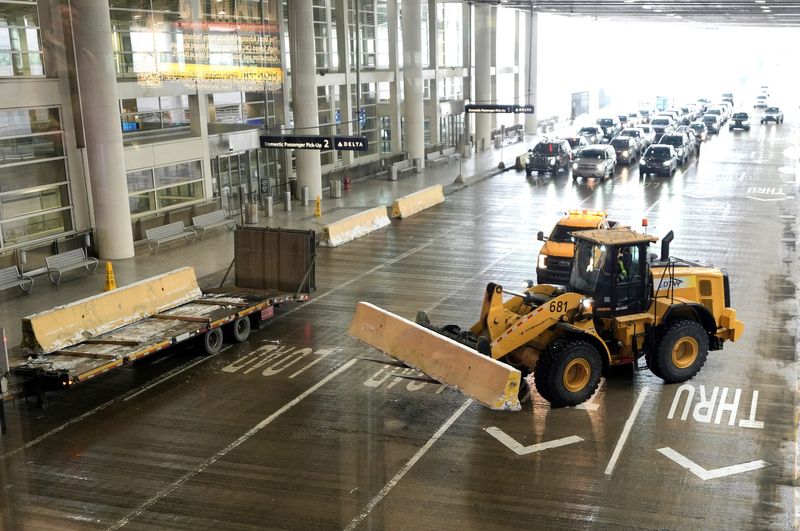
Free Press journalists observed airport workers putting in new barriers outside terminal entrance doors Saturday, May 30. The obstructions were outside most entrances and exits at both terminals by 1 p.m.
The barriers run perpendicular to the terminal road, in theory creating a way to prevent a car from entering the terminal as the driver of the Cadillac did this week.
“We are always looking for ways to improve security around the airport campus, but we cannot predict every scenario that may occur. As a result of this incident, we will improve the plans we’re developing for permanent bollards and barriers,” said airport spokeswoman Erica Donerson in a statement on Saturday.
‘That defeats the purpose’
After each event, airport officials offered explanations that raised questions.
In January, officials suggested the current airport infrastructure made it difficult to install bollards or other barriers that could stop a car. This time, Tadarial Sturdivant, senior vice president of emergency and support services and operations for the Wayne County Airport Authority, initially said the black Cadillac SUV that shattered a door in the Evans Terminal on Friday was able to squeeze between a space in barriers required by the federal Americans with Disabilities Act.
Neither answer makes much sense, said Miller, who is president and owner of Detroit-area Imperial Professional Consulting Services. Josh Copen, who also runs a bollard and barrier business in metro Detroit, added that if a car can fit through the space between barriers, something is wrong.
Copen and Miller agreed the ADA requires at least 36 inches between barriers, to ensure someone in a wheelchair could pass through. At an airport, both agreed the space should be a little larger, to allow for people with luggage or a gurney, but anything larger is a problem.
“We will not do anything over 5 feet [of space between bollards] because that defeats the purpose,” said Copen, president of Trident Industrial Systems.
Later Friday, an airport authority corrected Sturdivant’s statement, saying “the vehicle was driven over the curb, in a gap between the barriers protecting the doorways.” Donerson acknowledged on Saturday a car could not fit through the spaces in barriers required by the ADA. She stressed the airport continues to work on a long-term solution for protecting entryways, one that will take into account both recent crashes.
“The measures put in place after January’s incident were designed to address the circumstances involved in that event. What occurred on Friday was very different. We didn’t anticipate someone jumping the curb, making a U-turn and driving into the door at a slow speed,” Donerson said.
“Of course, the safety and security of our customers, employees and stakeholders is our No. 1 priority.”
‘They did a really poor job’
Vehicles crash into buildings all the time. The Storefront Safety Council, a national organization that works with government and industry to prevent such crashes, said data indicates vehicles blow into structures more than 100 times a day in the United States.
As such, there were already various kinds of barriers installed at the airport before this year, including bollards in front of entrances.
In January, a driver drove fast enough that the bollards did not stop the vehicle. After this event, airport officials placed 9,000-pound “Jersey barriers” along the sidewalks next to the terminal entrance.
At the time of the latest crash, three of these movable, waist-high concrete walls commonly used on freeways to separate construction workers from passing traffic were guarding the curb directly in front of door No. 4 at the Evans Terminal.
But just north of the door, a stretch of curb that appeared to be about 20 feet or more was exposed with no barriers guarding it. Sturdivant said after making a U-turn, the vehicle approached the door from that direction.
Once the Cadillac hopped the curb onto the sidewalk, the driver still had to navigate around large pillars that support the roof and the bollards that protrude from the ground. He did and proceeded into the terminal itself with his vehicle.
No one sustained severe injuries, and the driver reportedly discussed motivations related to actor Tom Cruise, hinting at a mental health episode. Airport officials did not name him, but said they plan to refer the case to the Wayne County Prosecutor’s Office.
The Jersey barriers and bollards at the airport might look imposing, but Miller said there are generally more effective options for stopping a car at an airport.
First, the bollards installed outside a door in this case need to be of a certain caliber that they could immediately stop almost any vehicle. Miller said typically, airports would use something rated to stop a medium-size vehicle traveling up to 50 mph.
That means, if properly installed, a delivery truck or any other vehicle weighing less than 15,000 pounds traveling up to 50 mph would not make it 3 feet past a bollard.
It’s a high standard, but one that is necessary for this kind of facility, he noted. Most airports, from Los Angeles International Airport to Denver International Airport, use this kind of bollard, Miller said.
In January, the car went through the bollard despite traveling slow enough that its airbags did not deploy when it crashed, Sturdivant said at the time.
“I would have thought our bollards would have stopped a vehicle. But it’s evident that they don’t. So having that information, we are now taking the necessary steps to ensure that whatever goes up will stop vehicles,” he said during a February news conference.
In an interview with the Free Press after the January crash, Airport Authority CEO Chad Newton pointed to the installation of the Jersey barriers specifically because, “there’s nothing to say that this can’t happen again.”
“I think that the travelers, they should feel confident that the airport is safe and is getting safer every single day,” Newton said in February. “As a result of what happened, we’ve taken appropriate steps to ensure that this incident can’t happen again.”
Newton also suggested better bollards could not be installed at some terminal entrances due to infrastructure restraints. Specifically, at raised terminals that are essentially bridges, he said, “It’s not a place where we can dig 4 feet down and cement a bollard in like you can if it were on ground level.”
Miller said every airport is different, and completely agreed each facility presents its own safety challenges. But he said new technology that requires as little as 9 inches of digging could accommodate these Detroit terminal entrances.
Miller noted that during big sporting events in Detroit, officials tend to use something called a Meridian barrier. They’re smaller and mobile, but they are specifically designed to prevent vehicular attacks.
It’s not the only option. Miller said an extensive, long-term bollard project would cost millions of dollars. Yet while Miller is reticent to criticize airport officials, he thinks in this case, “they did a really poor job.”
“Basically, the management sat in a room and said, ‘What can we do right now to fix this?’ And somebody said let’s throw some Jersey barriers up there,” Miller said.
“They literally just took some old Jersey barriers, threw them out there and said, ‘OK, we’ll figure this out later.’ And I think later came and they had another incursion.”
Staff writer John Wisely contributed to this report. Reach Dave Boucher at dboucher@freepress.com
This article originally appeared on Detroit Free Press: Detroit Metro adds barriers after 2nd car crash into terminal in 2026
Reporting by Dave Boucher, Detroit Free Press / Detroit Free Press
USA TODAY Network via Reuters Connect