This is the fifth installment in a Free Press series exploring low voter turnout in Detroit. Read the first four:
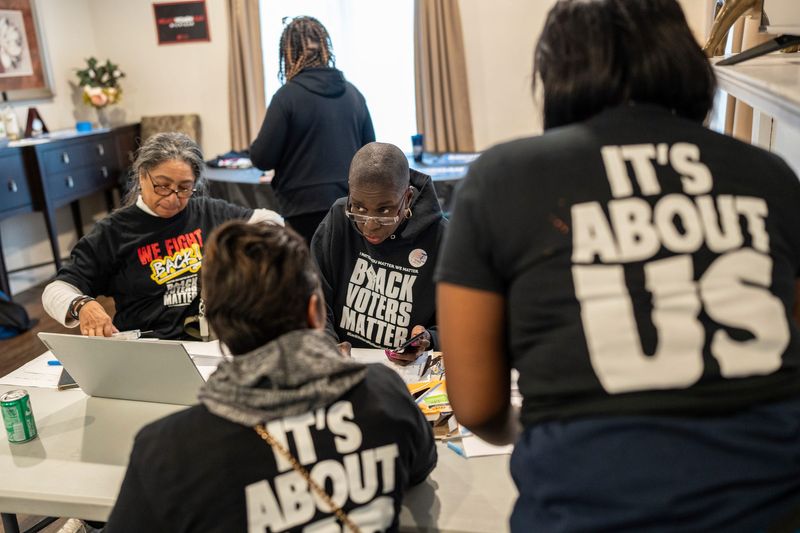
Before every election, an army of volunteers descends on Detroit, united by one goal: Get voters to the polls.

Al Williams is counting on the power of the pulpit, with an assist from modern technology. Kim Hunter believes in old-fashioned door-knocking. Wendell Anthony advises candidates to reach out to the Detroiters least likely to vote. Janice Winfrey is hopeful that free bus rides and activities at the polls will draw voter interest.
But not enough Detroiters vote ― and that’s unlikely to change in this election cycle.
Turnout here in presidential and gubernatorial elections lags the statewide rate, but over the last 20 years, Detroiters’ participation in those elections has been relatively consistent ― and during the same period, turnout for municipal elections has plummeted, from 41% of voting age Detroiters in 2005 to 20% in 2021.
Detroiters aren’t disengaging from elections ― they’re abandoning municipal elections.
The Free Press analyzed two decades of data to understand the trajectory of voter turnout in Detroit. We asked Detroiters why they’re not voting in municipal elections, and what it will take to change that. We’re asking elected officials to challenge the status quo ― and we’re talking to the Detroiters who do the painstaking work of getting out the vote.
‘Stay in the game’
Al Williams recalls knocking on doors with his dad when he was no more than 6, trying to encourage people to vote.
This year, Williams pitched Detroit pastors on an app that pairs congregation members’ information with data from the state’s Qualified Voter File, the massive document that records when or if a registered voter casts a ballot.
Detroit pastors have been shy about urging congregants to the polls. But Williams’ app merges an old school way of organizing through churches with new tech tools that can personalize pastoral voter outreach.
Williams, the director of the Lift Every Voice and Vote Detroit coalition, says using the app allows pastors and their teams to reach out to congregants who haven’t voted in mayoral elections.
And in the primary, he said, it worked ― among a dozen member churches, voter turnout ranged from 26% to 48% for the August primary, greater than the citywide rate of 17% of registered voters.
“If they (the Detroit Lions) didn’t stay in the game after losing, every single season, we wouldn’t have a championship team now,” he said. “And so, just like democracy … if we don’t stay in the game, it’s not going to get any better. It’s only going to get worse.”
The conversations are not easy, he said, but what has worked is “constant communication with young people about the importance of democracy, the constant communication with people on how politics and government is involved in your life, from the birth certificate to the death certificate.”
“If you don’t participate, you’re just giving in and giving up,” he said. “And that’s not what Detroit is about. And that’s not what our young people about are about,” he said.
For the general election, Williams has enrolled 24 churches. If this year’s work is successful, he hopes to launch it statewide next year.
‘You might strike gold’
Back in the day, says Rev. Wendell Anthony, president of the Detroit Branch NAACP, elections were presaged by droves of people knocking on doors, trucks and cars driving through the community blaring the news that an election was coming.
“I think we’ve lost some of that, and I think it has cost us,” says Anthony, with the shift to online, targeted advertisements and social media campaigning.
“You’ve got to touch people,” he said. “Then, we make the mistake of going to the same areas. We already know that in certain areas voting is going to be high. Those people got it, they understand the importance and critical nature of their votes. But we’ve got to touch people who aren’t touched, who don’t see candidates knocking on their front porch, dropping off literature saying, ‘Look, brother, I need you, this is about you and your family ― your vote is important.’ Everybody’s got to get on deck with this.”
This cycle, Anthony said, the NAACP did more door-knocking, and is encouraging candidates to look beyond the high-turnout parts of the city.
“Who knows?” he said. “You might strike gold there.”
But politicians have to make voting matter.
“I think the challenge we face today really is rooted in the fact that people don’t think in many cases that their vote counts, that it matters. They feel like people are not listening to them, people are not coming to where they are, and even when you see the impact of development throughout the city, some feel that ‘That’s not me.’ But that is you. The whole city is ours — downtown, the neighborhoods, the main thoroughfares, everything, from the riverfront to 8 Mile is our city.”
‘Anything and everything’
The city clerk is charged with running elections ― ensuring ballots are printed and distributed, polls and counting boards are staffed ― but Janice Winfrey, the Detroit City Clerk, does more: working to attract voter attention with billboards, mailers, DJs and other festivities at polling places, like backpack giveaways or face painting for kids, and ensuring voters can get to the polls, this year working with the Detroit Department of Transportation to offer free bus rides to poll-bound voters.
Winfrey says she is in the process of forming a community advisory committee to discuss ways to engage voters between the ages of 18 and 40, among the least likely to vote. The group will meet quarterly, she says.
“We do everything and anything that we think will get our voters out there to participate in the process,” she says.
Still, Winfrey says, the clerk and her staff can only do so much.
“The department of elections is like the referee,” says Daniel Baxter, Winfrey’s longtime director of operations. “The players are the ones who fill the stadiums. The same thing is true in terms of elections. It’s the candidates’ unmitigated responsibility to connect with funders of their campaigns to drive that message home.”
‘You’re not real unless you’re on the ground’
You’ve got to knock on voters’ doors, says Kim Hunter, social justice media coordinator for Engage Michigan, but it’s not enough to knock on a voter’s door when you want something.
“A lot of people want to do their work via media, long distance, disembodied, but it’s only successful if it sits on top of a ground game,” says Hunter, who started doorknocking for reproductive rights in the 90s. “You’re not real unless you’re on the ground.”
It’s inevitable, Hunter says, that candidates will, to some extent, focus on high turnout neighborhood. But even there, transactionality kills engagement.
Hunter recalls a pivotal moment on an organizing call with Stacey Abrams, who helped flip Georgia in the 2020 presidential election. Abrams described how her team started canvassing Georgia voters two or three years before the election, Hunter said: “They were on the ground asking people, ‘What are your issues? What are you concerned about? What can we work on for you?’ And so when the time came to vote … it was like, ‘Oh yeah, I’m doing it because y’all were here before the election.'”
Hunter says specificity, not abstraction, helps voters understand what’s at stake.
“I was raised in 48217, which is one of the most polluted places in the state. One of the things I tell my groups … if I’m going to talk with them about climate change, I’m going to talk about the Marathon Refinery,” he said. “I’m not going to talk about polar bears.”
Nancy Kaffer is the editorial page editor of the Detroit Free Press. Contact: nkaffer@freepress.com. Kristi Tanner is the Free Press data analyst: ktanner@freepress.com. Submit a letter to the editor at freep.com/letters, and we may publish it online and in print.
Want our sharpest, most relevant takes delivered straight to your inbox? Subscribe to Freep Opinion’s free, weekly newsletter.
This article originally appeared on Detroit Free Press: Detroit election turnout is dismal. They’re working to change that. | Opinion
Reporting by Nancy Kaffer and Kristi Tanner, Detroit Free Press / Detroit Free Press
USA TODAY Network via Reuters Connect