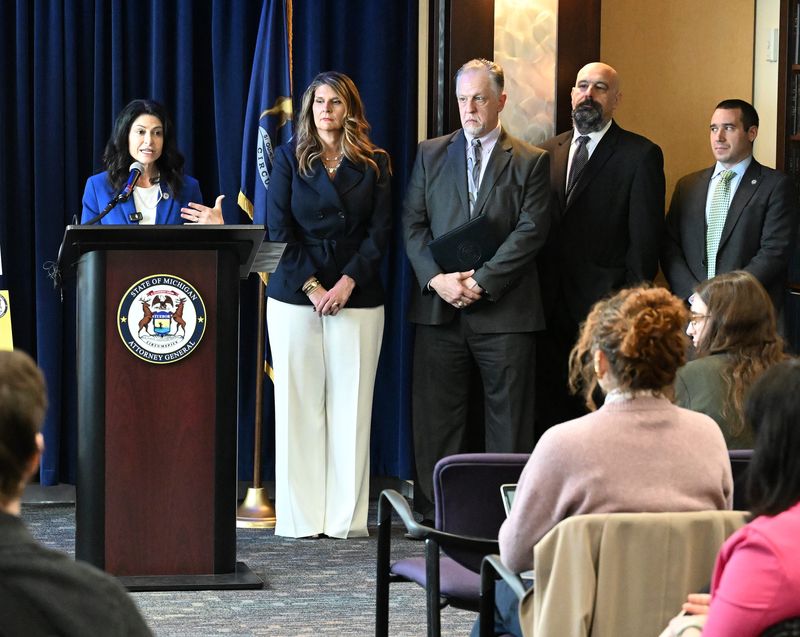
Lansing — A $20 million earmark designed to benefit a yet-to-be-created nonprofit for a politically connected businesswoman was designed as a “glass slipper grant” that allowed Fay Beydoun to receive the money without budget leaders identifying the political donor and appointee in the spending bill, Attorney General Dana Nessel said Wednesday.
That same “glass slipper” budgeting process was used frequently on about $1 billion worth of earmarks in the 2023 fiscal year budget — and in other past spending plans — to avoid naming the recipients of the public funds.

Nessel panned the Legislature’s longstanding practice of appropriating money in state law using language “in such granular detail as to whom may qualify to receive it that they could only possibly be rewarded to one intended recipient as predetermined by” lawmakers.
“They are, in that sense, glass slippers that can only fit one foot,” Nessel said. “The predetermined recipient of the funds walks into the administering agency with just the right foot and the foot for which the slipper was tailor made and then they walk out wearing the slipper,” she added. “And the slipper in this case was, of course, $20 million in taxpayer dollars.”
The process, which largely benefits politically-connected individuals, creates an unfair playing field for other unconnected groups seeking state funding through a competitive, transparent bidding system, Nessel said. And, combined with lax oversight during grant administration, it can end with the abuses like those alleged in the new criminal case against Beydoun, she said.
“It certainly adds to my frustration that this so-called grant was afforded a much more privileged status and pathway under insufficient, even careless, oversight and state administration solely because of the political connections of Fay Beydoun,” Nessel said.
The “glass slipper” grant process Nessel described long been the mode by which lawmakers insert funding for pet projects into state budgets.
For several years, while Michigan had a run of pre- and post-COVID tax revenue surpluses, lawmakers would insert dozens of items into the budget just before passage that contained a funding amount for a vaguely defined project for a geographic region described by population markers. The descriptions avoided a direct listing of the recipient, but left no room for doubt — among lawmakers, at least — about which organization it would benefit.
For example, Beydoun’s grant was described as going to “an international business accelerator located in a city with a population of between 83,500 and 84,000 and in a county with a population of between 1,250,000 and 1,300,000 according to the most recent federal decennial census.” Those population markers represent the city of Farmington Hills, where her business was later registered under her home address.
The same population-marker descriptions are used in current budgets as well. But lawmakers over the past two years have instituted a process — inspired by the uncovering of past suspect grants — that requires a nonprofit to have been in place for a certain time period and that requires details of the grant, its purpose, and its sponsor to be disclosed in advance of budget passage.
Nessel says state oversight is based on an ‘honor system’
But Nessel argued there is still more that must be done to ensure that the Michigan Economic Development Corporation, which administers most of those grants after lawmakers award them, has guardrails in place to provide proper oversight.
So far, the agency’s oversight has been “inadequate,” Nessel said. Specifically, in the case of Beydoun, the MEDC knew for months of suspect spending — as detailed in regular Detroit News reports on the grant — but did not cancel the funding until March 2025.
The MEDC has “terrible” oversight and needs better guardrails, Nessel said, but she also argued those failures are partly because the MEDC lacks the authority it needs to provide proper oversight.
If the MEDC had successfully administered funds, Nessel speculated, it was likely a “coincidence.”
“I think it’s irresponsible to continue to appropriate money through the MEDC until or unless you can be sure that those guardrails are in place,” Nessel said.. “… I’m sure there are many times when you can point to a project and say, ‘Yes that is serving the public and is a good use of tax dollars.’
“It’s just that, when that happens, it just happens to be a coincidence because there are no real policies that demand that that would happen or can ensure that would happen,” Nessel added. “You’re sort of on the honor system.”
The MEDC, throughout coverage of the Beydoun grant, has argued that it is inhibited in the enforcement actions it could take by the loose legal language used by lawmakers while awarding the grants.
For example, the budget language at that time required the MEDC to give half of the grant — $10 million in Beydoun’s case — upfront. The state agency has said its policy was to wait to conduct a thorough check of the quarterly spending reports Beydoun was submitting until she sought the second $10 million of the grant.
The MEDC said it would provide more thorough checks after The News reported Beydoun had used the grant money to buy a $4,500 coffeemaker and an $11,000 first class ticket to Budapest in April 2024.
A year after that report on the coffeemaker expenses, the MEDC finally canceled the grant.
In a statement Wednesday, the MEDC said it has made several changes in the way it handles earmark grants in the wake of the Beydoun scandal. All such grants now are reviewed by the agency’s in-house compliance team to ensure “we are closely monitoring how funds are being spent in accordance with their respective statutes,” said Danielle Emerson, a spokeswoman for the MEDC.
“The MEDC is committed to pursuing continuous improvement as a core value of our work, and we have already implemented many changes to address how legislatively directed spending items (LDSI) are managed,” Emerson said.
eleblanc@detroitnews.com
cmauger@detroitnews.com
This article originally appeared on The Detroit News: Dana Nessel rips ‘glass slipper grant’ process benefiting Fay Beydoun
Reporting by Beth LeBlanc and Craig Mauger, The Detroit News / The Detroit News
USA TODAY Network via Reuters Connect