Corewell Health announced that it has successfully performed the world’s first documented single-port robotic mitral valve repair, a groundbreaking procedure that helps patients have a faster recovery.
Dr. Rakesh M. Suri, regional director of Cardiac Surgery Robotics and Innovation at Corewell Health William Beaumont University Hospital, said it’s “the least invasive cure of the heart we’ve ever seen” in decades of heart surgery.

Some people have a leaky mitral valve, which is a valve in the heart that allows the heart to eject blood, Suri said. About 3-5% of people have a problem with their mitral valve.
Corewell doctors traditionally perform mitral valve repair surgery by using five ports. The Corewell team adapted this procedure, using a single-port approach with a second small access incision.
The health system said the technique is less invasive than the traditional method and could help patients recover faster, among other benefits.
Royal Oak resident Patrick O’Brien, 60, underwent the procedure on June 30 at Corewell Health William Beaumont University Hospital.
“I feel like I have a whole new chance at life now,” O’Brien said.
Corewell Health said O’Brien sought treatment after his long-standing heart murmur started causing heart palpitations, and he decided to have his leaking mitral valve repaired before the condition worsened.
O’Brien said if he hadn’t followed through on his heart murmur and seen doctors about it, it could have led to Atrial fibrillation, an irregular and often very fast heart rhythm, and congestive heart failure, which is when the heart muscle doesn’t pump blood as well as it should, according to the Mayo Clinic.
Benefits of the procedure
Corewell Health said a single-port approach with a second small access incision reduces “tissue disruption and surgical trauma.” Five cuts are more trauma than two cuts, Suri said.
Because the technique involves two incisions instead of five, the risk of bleeding is lower. Corewell also cited other benefits of the procedure, including fewer incisions, which can mean less scarring and “improved patient satisfaction.”
Suri and other doctors developed a robotic, five-port approach in the 2000’s. Suri said ports are small, finger-size incisions between the ribs.
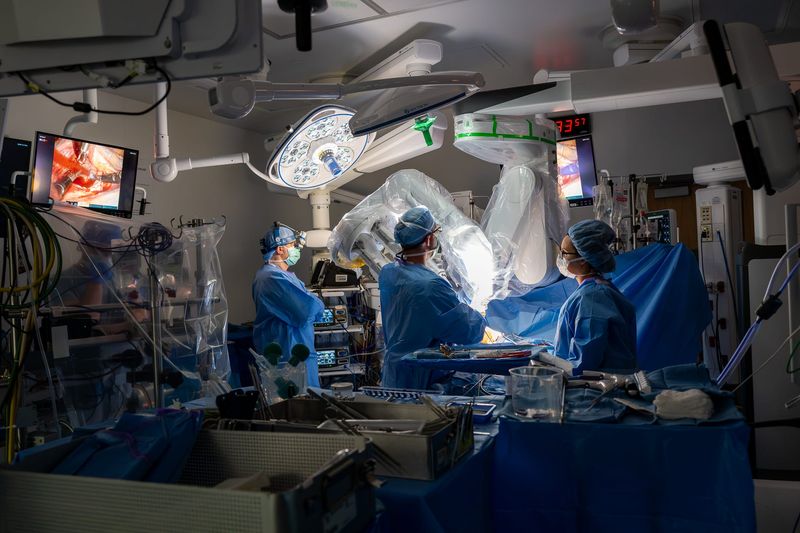
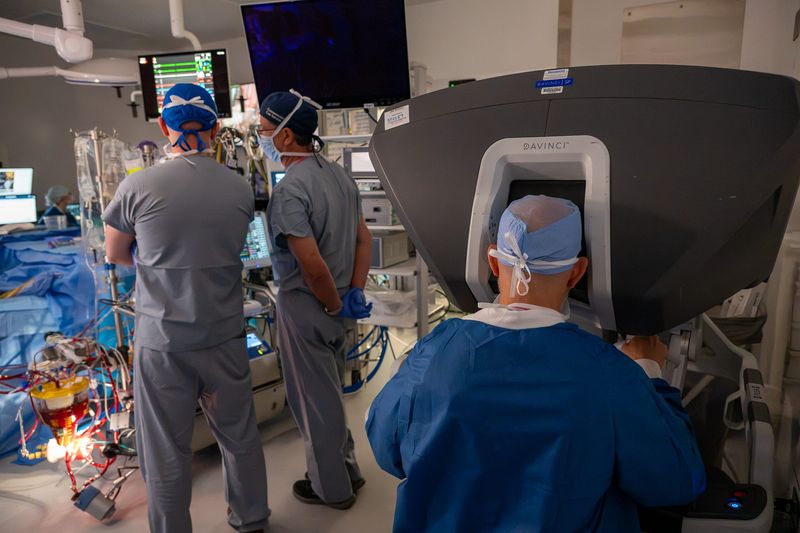
Suri and his team at Corewell recently came up with a new technique that only uses one port and one small access incision. The doctors fix the heart using a robot, which has three arms and a camera, all of which enter the body through the port. They practiced the technique on models.
Patient describes his experience
O’Brien, an independent contractor in the homebuilding business, said when he went to see a new primary care physician eight years ago, the doctor found that he had a heart murmur. He said he then underwent an echocardiogram, which showed that the leakage wasn’t “that bad,” so he didn’t need to address it then.
About two years ago, he started having symptoms such as his heart beating irregularly and light-headedness from strenuous activity. He said he didn’t feel he had to rush to get the symptoms checked out, though his wife often encouraged him to do so.
O’Brien said his wife passed away from cancer last fall.
“After that happened, it really made me think about her telling me to get checked out and just the fact that anything could happen at any time, so I did follow through at that point,” he said.
Ultimately, Suri told him in May that Corewell planned to try the single-port procedure in June and asked whether he’d be interested in taking part. O’Brien said “absolutely,” he recalled.
Now that he has had the surgery, O’Brien said he doesn’t feel his heart beat irregularly or feel lightheaded anymore. He will start cardiac rehab next week.
“Now, I’m in recovery,” he said, “and I’m feeling fantastic.”
“I want to at least say how appreciative I am of all the staff ― the nurses, the surgical team, Dr. Suri, especially, and my cardiologist, everybody involved ― for giving me this opportunity and getting me through it,” he said.
asnabes@detroitnews.com
This article originally appeared on The Detroit News: Corewell performs world’s first documented single-port robotic mitral valve repair
Reporting by Anne Snabes, The Detroit News / The Detroit News
USA TODAY Network via Reuters Connect
By Anne Snabes, The Detroit News | USA TODAY Network