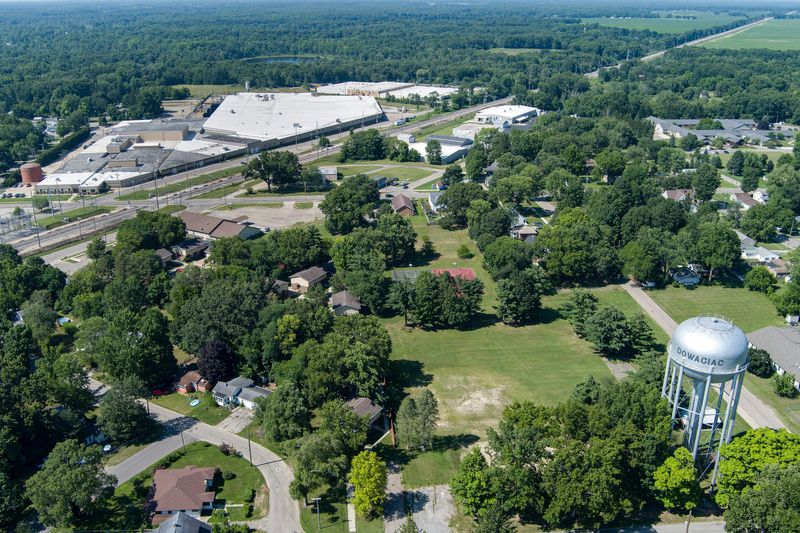
To look at the tree-lined residential neighborhood on Louise Avenue in Dowagiac, it appears like quiet, tranquil, small-town Michigan. But looks can be deceiving.
In recent years, those living along this otherwise unbusy street have an unwelcomed permanent companion: noise. It’s a droning, high-pitched, whining, almost constant noise, coming from a data center that opened in recent years at a nearby former factory site.

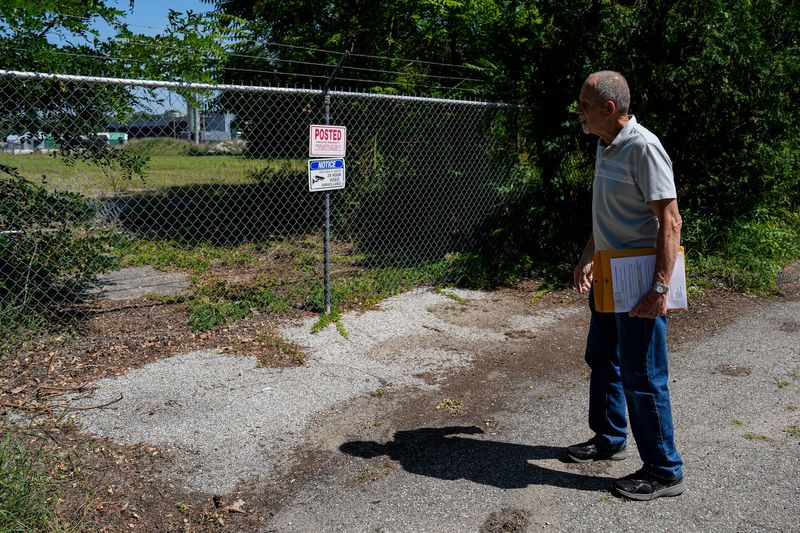
“They opened up that Bitcoin mining operation and that’s when the noise started like this,” said Louise Avenue resident Billy Finn.
“They” are Alliance Cloud Services and Hyperscale Data Inc.. The Las Vegas-based company in 2021 started Bitcoin mining at the site of the former National Copper factory at 415 E. Prairie Ronde St. in Dowagiac, a city of about 5,275 residents in southwest Michigan’s Cass County. Bitcoin, a digital cryptocurrency, gets created as Bitcoin miners verify cryptocurrency transactions on the blockchain and secure the network. Miners use powerful, specialized computers to solve complex mathematical puzzles. The first to solve the puzzle earns the right to add a new batch of transactions to the blockchain and receives newly minted Bitcoin plus transaction fees as a reward.
With Bitcoin worth more than $65,000 per coin, it’s a potentially lucrative activity, but it takes huge amounts of computational power. Those banks of computers create heat as they operate and must be cooled. And that makes noise.
Hyperscale Data more recently has begun transitioning away from Bitcoin mining into artificial intelligence and cloud computing. The noise has worsened in the nearby neighborhood, residents said.
Finn likened the nearly constant, high-pitched drone to a passenger jet engine’s winding on the tarmac before takeoff.
“We can’t come out and enjoy the porch in the evening,” he said. “The wife’s got Parkinson’s [disease] and we think all this noise has kind of made it worse. She’s developed tinnitus in her ears. When we go to her brother’s house, who lives out in the country, it goes away. But once we get home, after a half-hour or so, she starts getting the ringing in her ears again.”
Citizens and grassroots organizations nationwide are rising up against the rapid development of hyperscale data centers. Protesters argue that these massive tech operations are pushed through without sufficient community input. A nationwide day of protest against AI data centers is scheduled for Saturday, July 18, spearheaded by the nonprofit advocacy group Humans First. Demonstrations are planned in over 50 cities across 22 states to demand stricter regulations on the developments, including at the Livingston County Courthouse in Howell.
In many communities grappling with fast-developing, massive data facilities, concerns center around impacts to energy and water and loss of community character. Those concerns exist among Dowagiac residents as well. But it’s noise that’s front-and-center here.
Noise meets city’s ordinance — but not always
So-called A-weighted decibels, or dBA, measure sound levels adjusted to mimic human hearing. Because our ears are less sensitive to very high and very low frequencies, dBA filters these out. It is the standard unit for evaluating environmental noise and hearing damage risks. A small increase in decibels represents a large increase in sound energy — adding 10 decibels would sound as if the sound source had doubled in loudness. Noise at 70 dBA would sound twice as loud as a 60 dBA sound source.
The U.S. Environmental Protection Agency in 1974 issued guidance on noise levels affecting health and welfare that noted levels of 55 decibels outdoors and 45 decibels indoors were “preventing activity interference and annoyance,” allowing “spoken conversation and other activities such as sleeping, working and recreation.” The federal government’s involvement, however, quickly faded, with noise regulation left to state and local governments.
Finn held a decibel reader on his front porch and the noise coming from the data center across the street bounced between the high 50s and low 60s in decibels. This would meet the standard of the city’s revised ordinance, enacted earlier this year after angry residents complained about the data center’s noise. The ordinance allows noise up to 65 decibels during the day in residential areas, and 55 decibels at night. Enacted in late March, Hyperscale Data has already been issued notices of violation for exceeding the noise limits, City Manager Kevin Anderson said at a City Council meeting on Monday, July 13. The company is disputing the violations.
The city’s noise limits aren’t protecting residents’ quality of life near the data center, neighbors said.
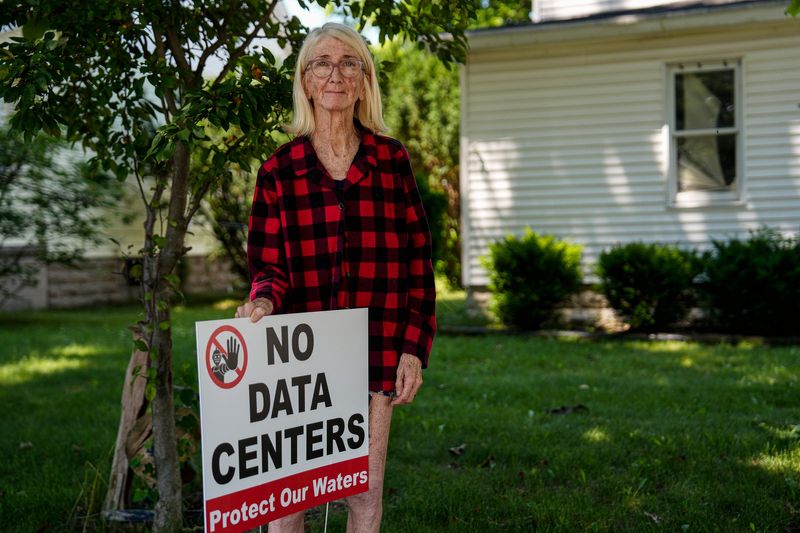
“The noise is every day, always, and then louder as the day goes on,” said Tammy Brooks, standing by a “NO DATA CENTERS” sign in her yard on East Prairie Ronde Street, only yards from the facility.
“My husband and I get dizzy, dizzy, dizzy.”
Added husband Toby Brooks, “At times, it’s like somebody just screaming at you. It’s a loud, whining, high pitch.”
The couple installed a small pond in their backyard surrounded by lawn chairs. It now goes unused, Toby Brooks said.
John Valdes, a few blocks away on Louise Avenue, said he also can enjoy the outside of his property only in small doses of a few minutes. “The noise is continuous, agitating and high-level, all the time. It started in 2022.”
Lindy Valenzuela, who lives a few houses down from Valdes on Louise Avenue, just gave birth to her and her husband’s second son on Saturday, July 11, joining his 1⅟₂-year-old brother.
“We hear it in the house, too, with all of the doors and windows closed,” she said. “I get headaches.”
The couple’s oldest son’s nursery is in a room facing the data center. The noise can be heard in his bedroom as he sleeps in his crib, Valenzuela said.
“We have no idea how it’s affecting them,” she said about her children. “He is not talking yet; if it is bothering him in some way, he can’t tell us. And that terrifies us.”
A possibly first-of-its-kind class action
Not receiving relief from the company or the city, local residents near the data center are now headed to court.
Valdes and Valenzuela in late May filed a class action in U.S. District Court’s Western District of Michigan. Detroit-based class-action attorney Laura Sheets, who is representing them, said it’s the first class-action lawsuit of its kind in the nation.
Sheets said her firm, Liddle Sheets P.C., has sued companies in residential areas for 25 years that “are polluting the neighborhood in some fashion or another” — odors, soot or ash, light pollution. The noise pollution from the Hyperscale data center is “a perfect case for a class action,” she said.
“It isn’t just John and Lindy, our two named plaintiffs,” Sheets said. “It’s not just impacting one or two people, or five or 10 people.”
The lawsuit seeks monetary damages for the loss of the use and enjoyment of class members’ property — nuisance — and the facility causing property values to depreciate.
“In addition to straight depreciation, even if a house is priced right, someone is still going to pull up and say, “No thank you,'” Sheets said. “It’s desirability.”
Hyperscale has asked for an extension in court for its response to the lawsuit until July 24.
Hyperscale CEO speaks to skeptical residents at council meeting
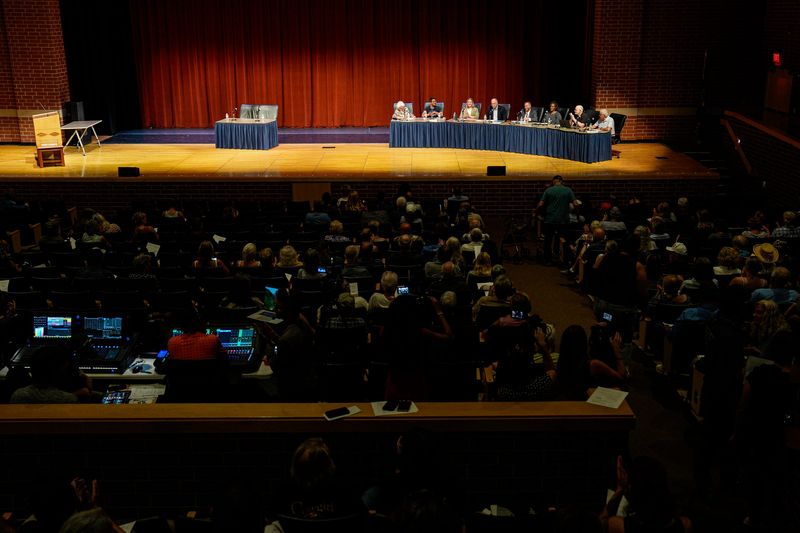
Hyperscale CEO and Vice Chairman William Horne gave a presentation on the company’s activities and responses to residents’ complaints at the July 13 Dowagiac City Council meeting. The meeting was moved to the city’s middle school auditorium to accommodate the large throng of residents.
Horne said the data center has grown from three employees to “about 25,” with plans to grow to as many as 500 employees in the future. Hyperscale is continuing its transition from Bitcoin mining to AI and cloud computing, and is adding robotics training to the 617,000-square-foot facility with a planned $100 million investment.
Horne noted that the data center has its own energy contract with Indiana Michigan Power Co. and does not affect the city’s electricity distribution. He added that the facility’s water use is “no more water than an ordinary office building would [use], and that’s not going to change.”
But then came the loud elephant in the room: noise.
“Anything that we can do to decrease the sound level, we are going to do,” Horne said. “We will work with the neighbors on Louise Avenue and we will try to make them happy.”
Horne said while Hyperscale Data’s facility was shut down earlier this month, the company did sound readings along the facility’s perimeter, with readings in the 50-range of decibels on the Louise Avenue side, and “closer to the mid-60s” in decibels on the other side.
“Although I recognize that there is sound for the people on Louise Avenue, and we will go through and help mitigate that sound and reduce it and address other grievances and concerns, there is only so much we can do because we are only generating a portion of the sound levels,” Horne said.
Horne discussed Hyperscale’s acquisition of a mostly vacant, 48-acre parcel to the north of its data center, to the shores of Pine Lake. Horne said the reason for the purchase was twofold: to assist the selling property owner who was dealing with legacy contamination from factories long before the data center arrived, and “to create a natural buffer (from data center operations) and make sure that buffer was maintained.”
Dowagiac residents, speaking during the public comment section of the council meeting, let Hyperscale officials know their frustration.
“Why should the community believe anything you say, any of the promises that you make?” resident Lisa Malloy said to rousing applause from the audience.
Added resident Kate Whitehall: “The bottom line is you are not a good neighbor. Your business has been sneaky, uncooperative with local ordinances and dismissive of Dowagiac’s concerns about the impact of the noise from your current Bitcoin mining operation.
“There is absolutely no reason for us to think that your expansion would be anything but more noise, more pollution and using more than your share of our power and water resources. We do not believe anything you say or promise. Prove to us that you really want to be a good neighbor and be quiet.”
Data center offers to buy out closest neighbors
Horne confirmed Hyperscale Data’s offer to buy the homes of Louise Avenue residents closest to the data center.
“I’m not trying to force anybody to sell,” he said. “But if somebody is living on Louise Avenue, and they feel even after we go through reconditioning the facility, putting in sound measures … if they still are not happy and feel their home is not enjoyable, then we will buy their property from them, and we will offer them fair value and we will help cover their moving costs.
“Again, I’m not trying to force anybody out; the homes don’t do me a lot of good. But I don’t want them to feel like they are trapped and we are the cause of it.”
Whitehall, who doesn’t live on Louise Avenue, called that no solution.
“You have created a massive noise and vibration nuisance — you know it; you are required to fix it,” she said. “Trying to buy out our neighbors isn’t a solution; it just pushes the problem into the next neighborhood.”
Toby Brooks said he and his wife haven’t yet received an offer from Hyperscale.
“There is nobody in this that’s complaining that wants money,” he said. “[But] they are going to take it, and I’ll take it if they offer me to move. I’ll never be able to sell my house for market value now because of the noise.
“But some of my neighbors, even those getting the absolute worst of it, they said they aren’t going to move. They have been in their houses 57, 58 years.”
Whether to take the money and run is “a really difficult question to answer,” Valenzuela said.
“You don’t want to give in to someone like that,” she said. “But you get to a point where you ae so desperate to get away from this thing that you really can’t fight against [it].”
Contact Keith Matheny: kmatheny@freepress.,com.
This article originally appeared on Detroit Free Press: Constant noise from Dowagiac data center prompts class-action lawsuit
Reporting by Keith Matheny, Detroit Free Press / Detroit Free Press
USA TODAY Network via Reuters Connect
By Keith Matheny, Detroit Free Press | USA TODAY Network