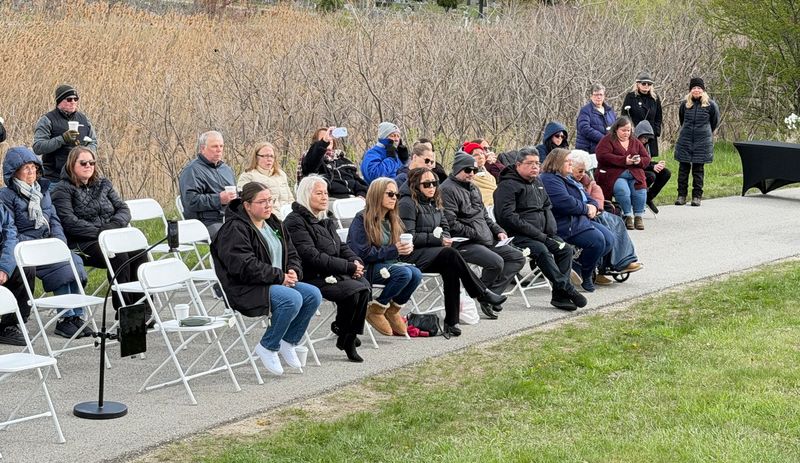
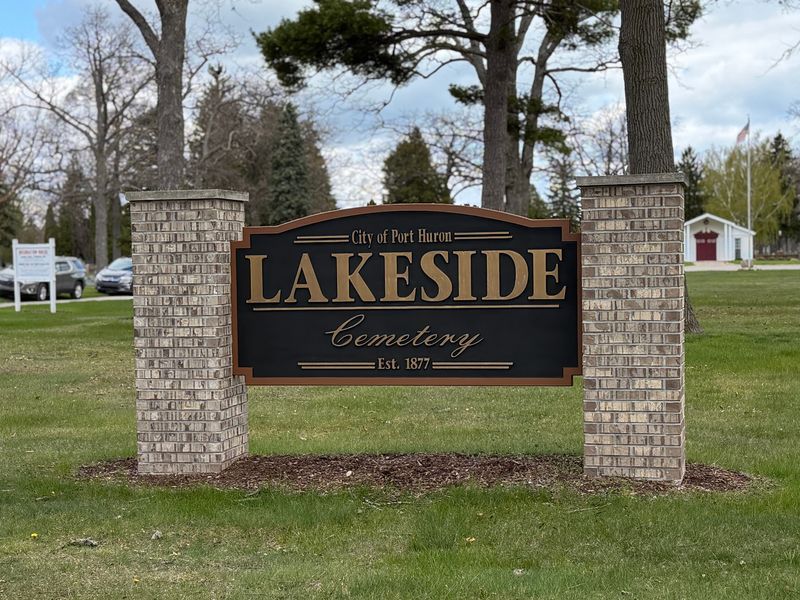
PORT HURON, MI — In temperatures more typical of late winter than early May, about 40 people gathered Saturday, May 2 at Lakeside Cemetery to formally recognize a place that, for generations, went largely unnoticed.
A light wind cut through the grounds, and by the end of the ceremony, snow flurries drifted down over Section AA — the cemetery’s paupers’ section — where hundreds are buried, many without names or markers.

Still, people came.
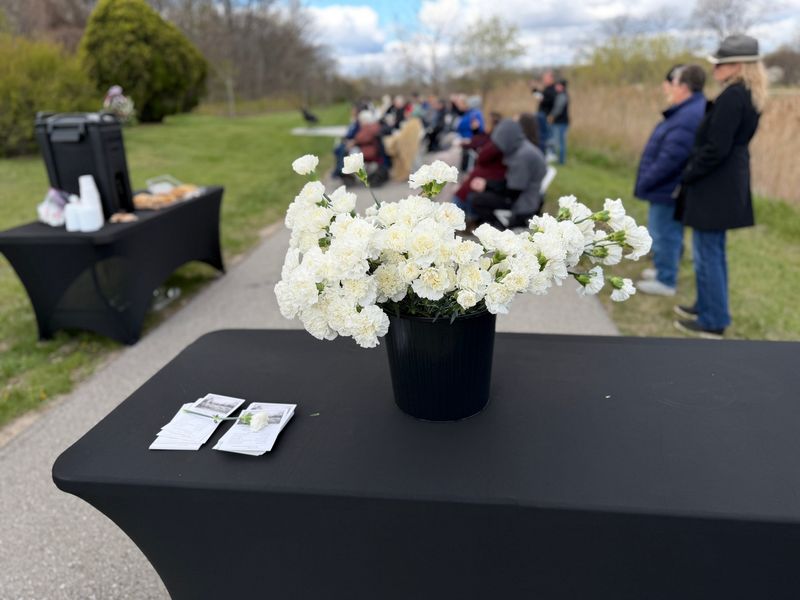
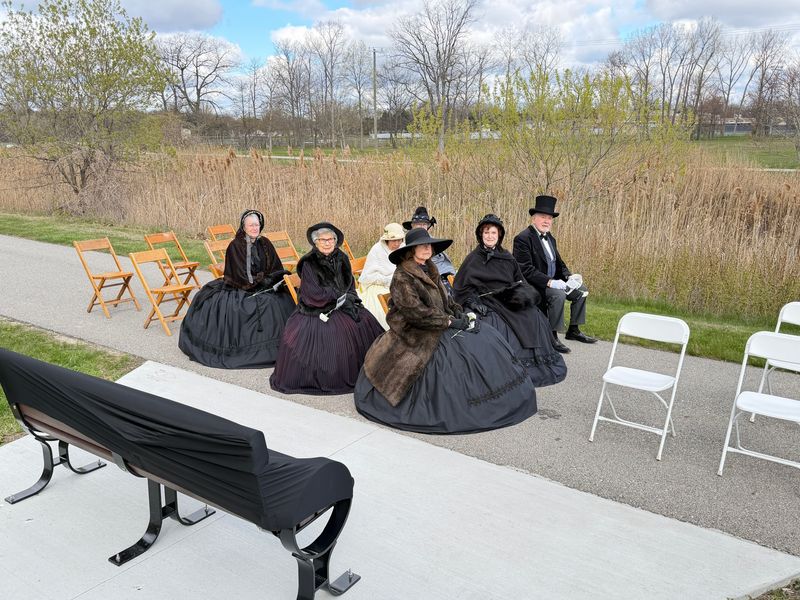
Most bundled in coats and gloves. Seven members of a local Civil War reenactment group stood in period clothing. Nearby, a large container of hot coffee and trays of cookies offered a small comfort against the cold.
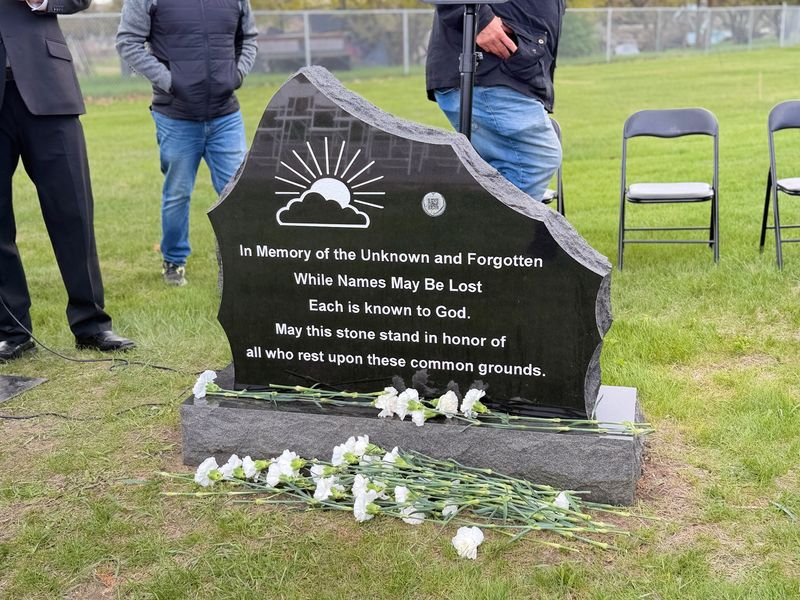
The one-hour dedication ceremony marked the official unveiling of a memorial stone and bench honoring those buried in the section, many of whom had long gone unrecognized.
A long-overlooked place
For years, Section AA at Lakeside Cemetery held little to indicate what lay beneath.
Only a handful of headstones are visible today — roughly six — despite estimates that more than 400 people are buried in the area, with some graves believed to contain multiple individuals.
The section, often referred to as a paupers’ cemetery or potter’s field, was historically used for individuals who died without family or financial means.
Saturday’s ceremony formally acknowledged those lives.
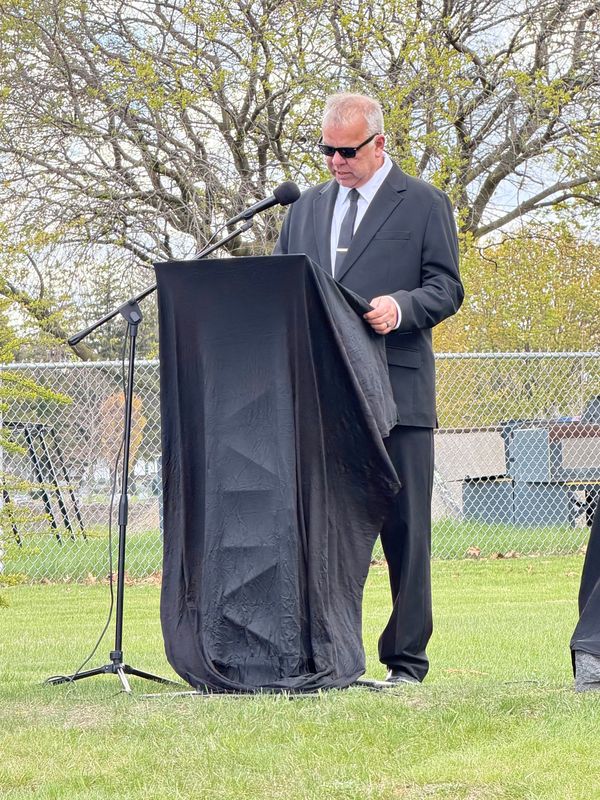
“We gather here today not only to stand in the silence of this resting place, but to raise our voices in honor of those whose names may be lost,” Erik Wurmlinger said during opening remarks.
A personal mission
For Wurmlinger, the project began with a family connection.
His grandfather, Cecil Gordon Martin, died at age 24 and was buried in the section in 1938. Decades ago, Wurmlinger’s father hand-carved a marker and placed it in the area.
When Wurmlinger returned in 2020, he could not find it.
After contacting cemetery officials, the marker was eventually rediscovered — a moment he said sparked a larger effort to document those buried there and bring recognition to the site.
Over time, that effort grew into a community-supported project, resulting in the installation of a memorial stone, bench and signage.
“Some were forgotten in life … but today, we remember them,” Wurmlinger said.
The ceremony followed the program order with remarks, prayer, historical reflection and music. Wurmlinger also sang “Amazing Grace (My Chains Are Gone)” before the dedication of the memorial.
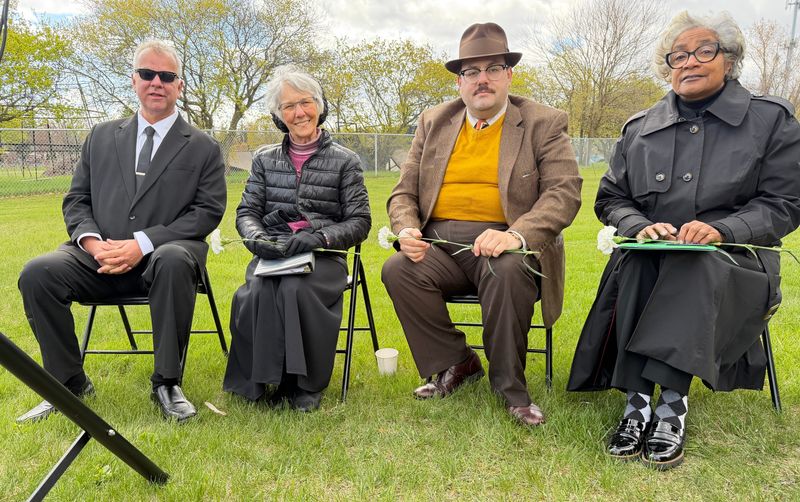
The event concluded with attendees invited to place white carnations at the monument.
“Today, we have remembered, we have honored and we have made a promise that those who rest here will not be forgotten,” Wurmlinger said.
History beneath the surface
Local historian Andrew Kercher said the site reflects a complex burial history tied to the city’s growth.
He explained that the term “potter’s field” has long been used for burial areas designated for the poor or those without family, a practice common in 19th-century cemeteries.
“You can learn a lot about a town from its cemetery,” Kercher said.
Burial practices in Port Huron changed over time as earlier cemeteries reached capacity. Remains were moved from initial burial grounds, including sites on Minnie Street and Pinewood Cemetery, before Lakeside Cemetery opened in 1877.
Kercher said what is now known as Section A originally served as the cemetery’s potter’s field. As the city expanded and cemetery layout changed, burials were relocated again in the 1930s to what is now Section AA near the Black River Canal.
Not all remains were moved, he added.
Kercher said records indicate the city gave families an opportunity to claim remains before the area was cleared, though many burials remained unmarked.
Community impact
Mayor Anita Ashford said the dedication reflects the city’s commitment to honoring those buried without recognition.
“Each life matters. Each life has a story,” Ashford said.
She shared that a woman recently contacted her after discovering a relative buried in the section, saying she was moved to tears seeing the community honor her family member.
Ashford said the moment highlights the broader impact of the project.
“Today we honor the history and legacy of those resting here,” she said. “While many may not have had wealth, recognition or family to mark their passing, they all were still … members of the city of Port Huron.”
A moment of reflection
The ceremony opened and closed with prayer led by Pastor Roxie Davis, who emphasized remembrance and dignity for those buried without markers.
Davis also noted the monument includes a lighthouse image on the back, symbolizing light and remembrance.
As the ceremony concluded, attendees stepped forward one by one, placing white carnations at the base of the stone.
Afterward, many walked through the section itself — a quiet stretch of grass where the physical markers remain few, but the meaning has changed.
Moving forward
Despite the cold, Wurmlinger said he was grateful for those who attended.
“I’m just happy that everybody came out,” he told the Times Herald. “If it wasn’t for the cold, there’d probably be a lot more.”
He said completing the project marks an important step, but not the end.
“I’m just so thankful … that we could get this accomplished and hopefully it’ll … move on from here,” he said.
Lakeside Cemetery is located at Lakeside Cemetery, 3663 10th Ave., Port Huron with the paupers’ section (AA) is located near the Black River Canal, toward the northwest corner of the grounds.
Contact reporter Andy Jeffrey at ajeffrey@usatodayco.com.
This article originally appeared on Port Huron Times Herald: Ceremony brings recognition to long-forgotten graves at Lakeside
Reporting by Andy Jeffrey, Port Huron Times Herald / Port Huron Times Herald
USA TODAY Network via Reuters Connect