The Democratic primary for Michigan’s open U.S. Senate seat is quickly becoming a preview of where governance could go if Democrats win in November.
Republicans would be wise to take it seriously.

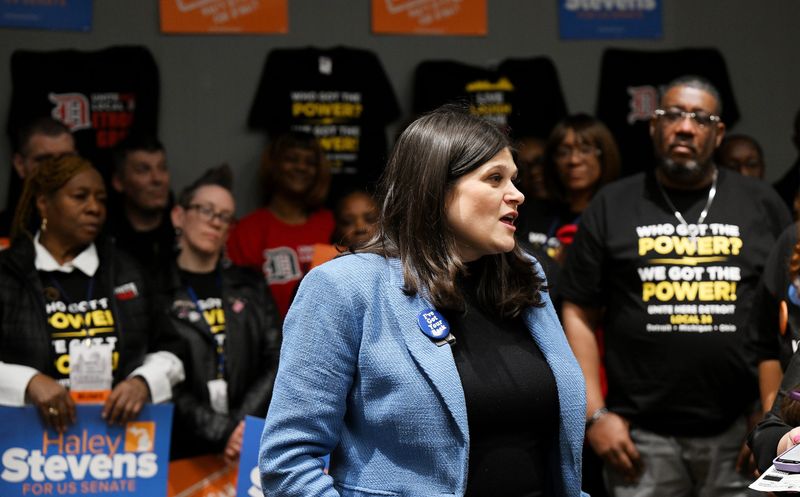
For proof, look no further than what happened at the Michigan Democratic Party’s nominating convention in Detroit, where Congresswoman Haley Stevens — once viewed as the safe, inevitable choice — was met with audible boos from her own party.
“Democrats, I love you, even when we disagree,” Stevens said.
It was a rather startling moment that shouldn’t be ignored.
In the old political order, Stevens would have been a shoo-in. She’s a three-term member of Congress, tied to the Obama administration and aligned with the kind of institutional Democratic politics that used to dominate primaries.
But that version of the party is losing ground.
Instead, the energy — and increasingly the polling — is behind state Sen. Mallory McMorrow and former Wayne County Health Director Abdul El-Sayed.
McMorrow has built a national profile, outraising Stevens after a highly publicized statewide tour and cultivating a following through cable appearances and viral moments. El-Sayed, meanwhile, is tapping into a deeper base that is far more ideological, far more online — and far less interested in moderation.
At the convention, it was El-Sayed who drew the most enthusiasm.
That shouldn’t be dismissed as a fluke.
El-Sayed has long advocated for sweeping expansions of government, including “Medicare for All,” laid out in his book. His politics are rooted firmly on the progressive left, and his rhetoric often aligns with the activist energy that has reshaped Democratic primaries nationwide.
He is also, importantly, charismatic, and increasingly competitive.
McMorrow, for all her visibility, has yet to demonstrate the kind of grounded, policy-driven campaign that typically sustains a frontrunner. Her campaign has leaned heavily on branding and exposure, which raises questions about whether it can hold up under the weight of a general election.
But that may not matter as much as it once did because the Democratic electorate is changing — and fast.
One of the most underappreciated dynamics heading into November is the expected surge in young voter turnout. In 2022, youth turnout, ages 18 to 29, jumped significantly compared to previous midterms, and early projections from groups like CIRCLE at Tufts University suggest 2026 could build on that trend, particularly in highly polarized environments.
Younger voters seem not just more engaged, but wildly more progressive.
They are the voters powering candidates like El-Sayed and McMorrow. They are fluent in the digital ecosystem that now shapes campaigns. And they are motivated less by party loyalty than by ideological clarity and confrontation — especially when it comes to opposing President Donald Trump.
Even with that kind of messy primary unfolding, Republicans shouldn’t fall into the trap of assuming these candidates are unelectable.
If anything, the dynamics that helped fuel Trump’s rise — outsider energy, populist messaging and dominance of digital platforms — are now being mirrored on the left.
If Democrats win in November with candidates forged in that environment, it will be a sharp turn in governance. The populism that reshaped the Republican Party under Trump won’t disappear.
It will flip.
Policies once considered socialist or fringe will move closer to the mainstream. The appetite for expansion of government in health care, education and the economy will grow. And the tone of governance will reflect the same ideological intensity driving today’s primaries.
The Democratic primary is showing what is at risk if Republicans get complacent.
kbuss@detroitnews.com
This article originally appeared on The Detroit News: Buss: Michigan Senate primary hints at a progressive future
Reporting by Kaitlyn Buss, The Detroit News / The Detroit News
USA TODAY Network via Reuters Connect